

In my inconsequential opinion, any serious young movie enthusiast is bound to be fascinated with the works of Jean-Luc Godard at first. After all, he is one of the greatest filmmakers in the cinema history besides being one of the most prominent members of the French New Wave during the 1950-60s, and some of his notable works including “Breathless” (1959) and “Vivre sa vie” (1962) have been quite influential for many years.
However, as getting older and more experienced besides having each own taste, some of those young movie enthusiasts may eventually feel more distant to many of Godard’s works just like I often did during last 20 years. Oh, yes, I once did enjoy some of his stylish experiments including “Contempt” (1963) and “Weekend” (1967), but then my reliable bullsh*t detector was turned on as I was subsequently quite baffled and frustrated with his several later works including “Goodbye to Language” (2014), and I came to observe many of his films with more skepticism and reservation while still admiring his undeniable contribution to the art of cinema.
In case of his 1965 film “Pierrot le Fou”, whose recently remastered edition happened to be released in South Korean theaters early in this month, it is an admirable exercise in style which unfortunately did not engage me as much as it did when I watched it for the first around 20 years ago. While it is certainly as distinctive as you can expect from your average Godard film, you can clearly sense that there is not enough substance to support its stylish genre game, and it also sadly reflects more of how Godard began to regard himself too seriously around that time in contrast to many of his fellow French New Wave filmmakers including François Truffaut (Full Disclosure: I like him much more than Godard).

The movie, which is based on Lionel White’s rather obscure novel “Obsession”, is about two contrasting figures who somehow get involved with each other despite having nothing common between them. At first, we are introduced to a middle-class writer named Ferdinand Griffon (Jean-Paul Belmondo, who feels less cocky compared to his breakout turn in “Breathless”), and the early part of the film quickly establishes how much he has been discontented and frustrated with his current status. While he has lived quite comfortably thanks to his rich wife, he was recently fired from his job at some broadcasting company without much prospect at present, and he has been wondering whether he should seriously try on a writing career someday.
Ferdinand’s hollow state of existence is mainly reflected by one evening party which he reluctantly attends along with his wife. A lot of talks and discussions are exchanged among him and many others at the party, but our eyes are drawn more to how Godard presents this sequence with a lot of visual touches, which, at least to me, do not seem to serve any particular purpose on the whole just like the rather gratuitous exposure of female breasts or the brief appearance of a certain legendary American filmmaker.
Anyway, Ferdinand eventually decides to commit a bit of transgression along with his ex-lover Marianne (Anna Karina), who happens to be associated with some unspecified criminal scheme when Ferdinand returns to her. When he enters her apartment, there is the body of a murdered man, but he does not seem that alarmed at all by that or several guns in her apartment, and he eventually runs away along with Marianne even though there is not much love or attraction between them from the start.
When they are not running away, he and Marianne often talk about whether they really love each other or not, but their rather disjointed conversations make them look more like puppets to be manipulated by Godard in one way or another. For instance, they frequently mention a lot of American culture stuffs ranging from Laurel and Hardy movies to William Faulkner and Raymond Chandler, and there are even several supposedly comic scenes where they attempt to embody some of these stuffs for no apparent reason.
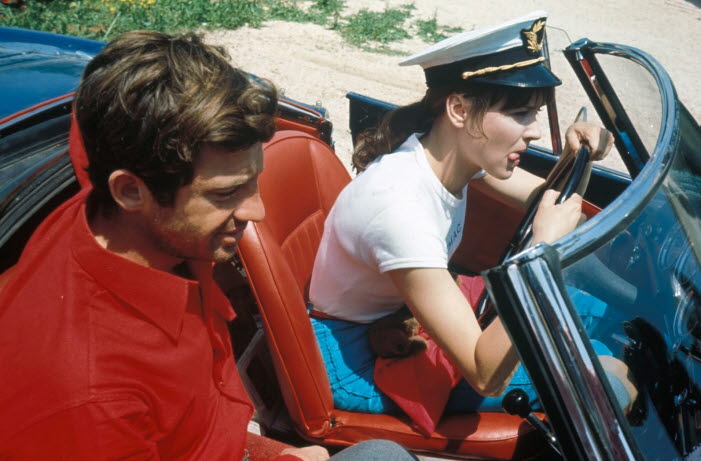
In addition, Marianne often calls Ferdinand “Pierrot” without explaining anything to him or us. As far as I can see, she simply enjoys his annoyance and bafflement from that, and Anna Karina, who incidentally divorced Godard around the time when the movie came out, did a good job of imbuing her character with some mischievous spirit.
As the movie aimlessly bounces from one point to another along with its two main characters without much narrative momentum to hold our attention, Godard peppers the story here and there with a series of superficial political statements which do not stick that much to us on the whole. At one point later in the story, he has his two lead performers do a silly comic sketch supposedly satirizing the geopolitical situation in Vietnam during the 1960s, but I think this can be a bit too crude and insensitive for Asian audiences now. In short, this is probably another example showing the increasingly glaring artistic limits of a European white male filmmaker during that period.
In conclusion, “Pierrot le Fou” is fascinating to some degree at times, but I do not think it is as great as “Breathless” or “Vivre sa vie”. Nevertheless, you need to check it out if you are a serious movie enthusiast willing to watch and learn more, and, regardless of whether you will like it or not, it will show you more of Godard’s filmmaking style in addition to helping you shape your own opinion on his works. Like there are dog persons and cat persons, there are also Godard persons and Truffaut persons, and please let me know which kind of person you are.


 Seongyong's Private Place