

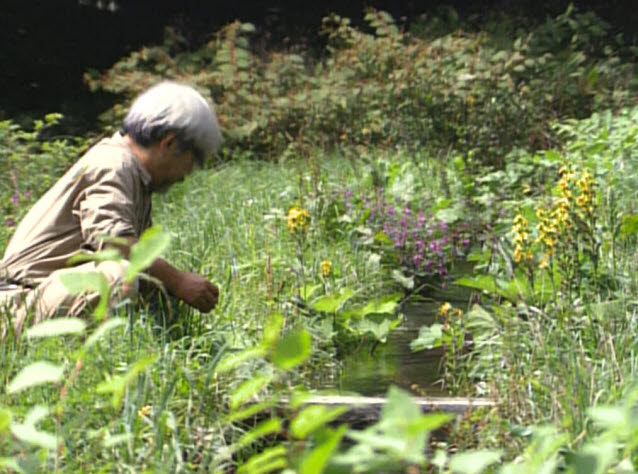
Documentary film “Miyazaki: Spirit of Nature”, which happens to be released in South Korea in last week, focuses on the art and philosophy behind the works of Hayao Miyazaki, who has been regarded as one of the greatest animation filmmakers of our time. Broadly looking over many of his notable works, the documentary presents to us his caring ecological view on nature and humanity inside these remarkable animation films, and we are reminded again of the deeply humanistic aspect of Miyazaki and his works.
At the beginning, the documentary opens with how things were pretty intense when Miyazaki and his Ghibli employees were working on “Princess Mononoke” (1997). Despite their full-throttle efforts, there were still lots of things to do for them, and, above all, Miyazaki struggled a lot on the finale. As many of you know, “Princess Mononoke” is the most ambitious work in his whole career, and he was not so sure about how to end his story even while the rest of the film was completed day by day.
The documentary subsequently moves back to Miyazaki’s early years, which were the main source of inspiration for his two last animations film “The Wind Rises” (2013) and “The Boy and the Heron” (2023). While the former reflects his longtime fascination with airplanes, the latter is partially inspired by his old childhood memories of World War II, and its autobiographic aspect is particularly reflected well by that strikingly horrific air raid scene early in the story. Even though he was only 4 years old at that time, he vividly remembered one air raid which happened around the end of the war, and that was certainly the origin of his lifelong pacifism.

Anyway, Miyazaki’s artistic talent and sensibility were suppressed during next several years as he was pushed into that demanding education process just like many other Japanese boys around his age, but there came a moment which changed his life forever. In 1958, he encountered a popular local animation feature film at a local movie theater, and, after being so impressed by this animation film, he eventually decided to make an animation film for himself someday.
Of course, the road to becoming an animation filmmaker was not so easy for Miyazaki, but then he gradually showed his potential as befriending the two people who became quite important for his career. One of them was none other than Isao Takahata, who would be regarded as another great Japanese animation filmmaker besides Miyazaki. He and Miyazaki instantly clicked well with each other as working together at Toei Animation, and they also shared a lot of progressive left-wing social/political beliefs between them via the labor union activities at their workplace.
The other one is Toshio Suzuki, a producer who was another crucial figure in the foundation of Studio Ghibli besides Miyazaki and Takahata. When his first animation feature film “Lupin III: The Castle of Cagliostro” (1979) miserably failed at the local box office, Miyazaki was quite disappointed to say the least, but then Suzuki suggested that he should try a bit on ‘manga’, a Japanese term for graphic novel. This led to Miyazaki creating what would be the basis for his next animation feature film “Nausicaä of the Valley of the Wind” (1984), whose considerable box office success brought Miyazaki back in business.
In not only “Nausicaä of the Valley of the Wind” (1984) but also his several subsequent films including “My Neighbor Totoro” (1988), Miyazaki steadily emphasizes that important relationship between humanity and nature, and this aspect became all the more prominent in “Princess Mononoke”, which is occasionally quite dark and horrifying as willingly exploring more into the conflicts between nature and humanity. Although more than 20 years have passed since I belatedly watched it on one summer day of 2003, I still remember many of its bold and striking visual style, and I am also quite touched by its surprisingly complex drama which is not afraid to recognize both the better and worse sides of its several conflicting main characters.

Because it seemed that he pushed himself and his employees to the limit during the production of “Princess Mononoke”, Miyazaki soon announced his retirement, but, what do you know, this just turned out to be the first of his several retirement announcements to be rebuked sooner or later. As peacefully working alone by himself as he always wanted, he soon got an idea for “Spirited Away” (2001), which incidentally brought him his first Oscar besides being another commercially successful work in his career.
Around the point when he gave us “Ponyo” (2008), Miyazaki became more concerned about how things have become more alarming for the next generations, and that was probably why he came out of his retirement again via “The Boy and the Heron”, which garnered him the second Oscar. I am still not so sure about whether this film is one of his best works, but its finale has haunted me more as his sincere statement to the next generations, and its original Japanese title certainly emphasizes that: “How Do You Live?”.
Overall, “Miyazaki: Spirit of Nature”, directed by Léo Favier, could show and tell more in my humble opinion, but it did a competent job of giving us the overview on Miyazaki’s artistic career and life philosophy within in its rather short running time (86 minutes). If you want to know more about Miyazaki and Studio Ghibli, I will recommend documentary film “The Kingdom of Dreams and Madness” (2013) instead, but this is also enjoyable enough on the whole, and you will certainly come to hope that Miyazaki still can amaze and surprise us again despite going through the final chapter of his life and career at present.


 Seongyong's Private Place