
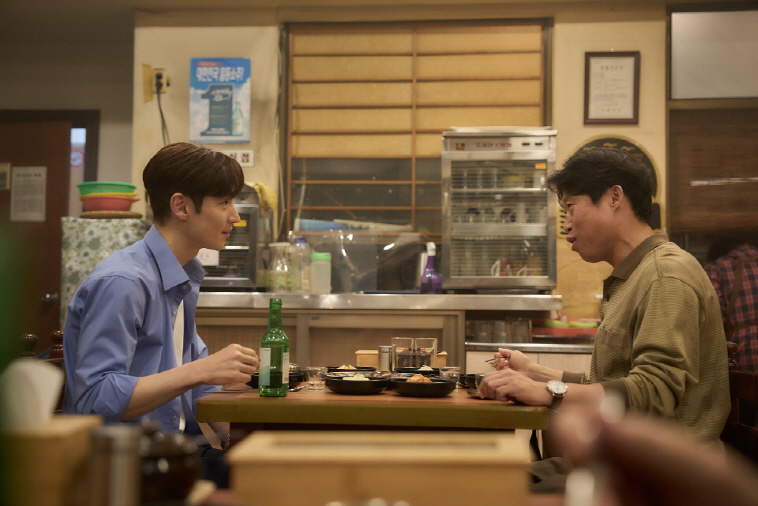
South Korean film “Big Deal” presents a fictional story loosely based on the real-life business deal involved with one of the biggest South Korean alcoholic beverage companies in the late 1990s. While the story itself is fairly interesting, the movie sometimes falters due to several weak aspects including superficial characterization and blatant plot contrivance, and the overall result is rather disappointing despite some good efforts inside it.
The early part of the story is set in early 1998, when the South Korean economy was turned upside down due to an immense financial crisis which swept up East and Southeast Asia in late 1997. Many of those big corporations in South Korea come to face bankruptcy, and Gukbo Group, which is clearly the fictional version of Jinro Group, is one of such desperate cases. While its CEO, who has simply occupied his position just because of his father who founded the company, is pretty useless to say the least, Pyo Jong-rok (Yoo Hae-jin), a diligent executive who has worked for the company for more than 20 years, has tried really hard for finding any possible way to save the company, and then there comes a chance via a prominent global investment firm named Solqueen. Mainly represented by an ambitious South Korean employee Choi In-beom (Lee Je-hoon), Solqueen has an offer which Jong-rok and his boss cannot possibly refuse, and it seems that the company will be safe at least for a while.
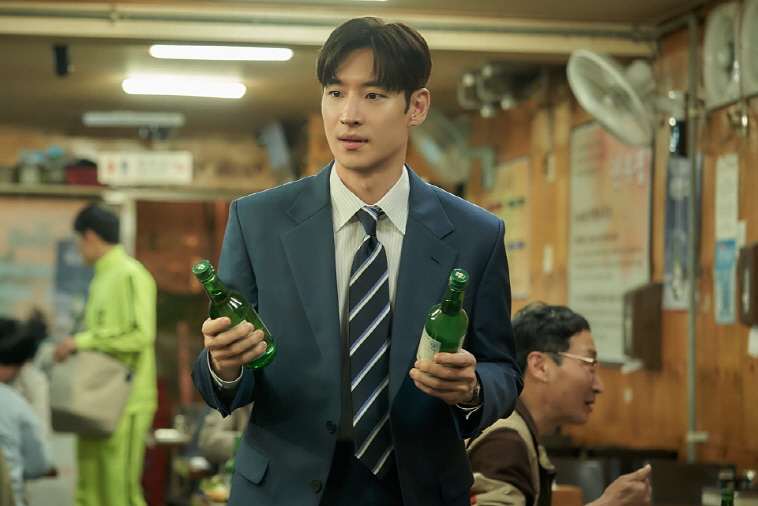
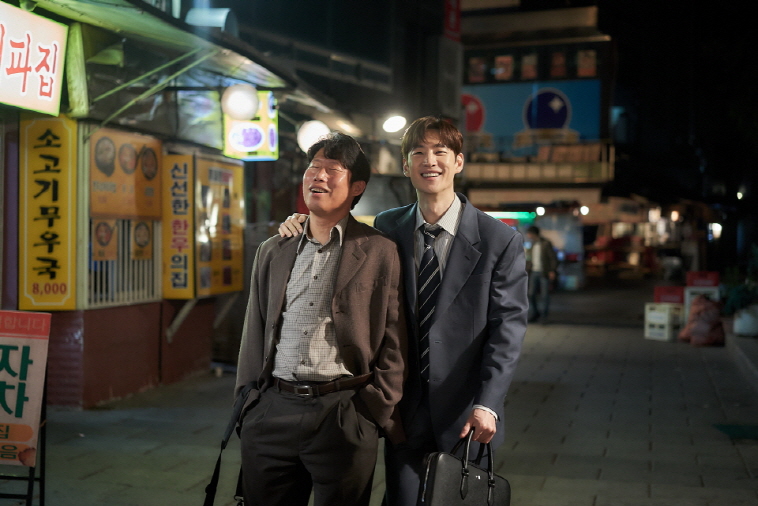
Under his boss’ order, Jong-rok is surely ready to be friendly and cooperative to In-beom as much as possible, and that leads to a series of lightweight moments involved with a lot of drinking between them. While they have one drinking night after another with many bottles of soju manufactured by Gukbo Group, Jong-rok willingly lets In-beom and Solqueen look more into the current financial status of Gukbo Group, and it looks like the promising beginning of the productive partnership between the company and Solqueen.

However, as already implied to us from the beginning of the story, Solqueen actually has a sneaky plan behind its back. Using all the inside information about Gukbo Group, In-beom and his colleagues in Solqueen embark on the hostile takeover of Gukbo Group in 2003, and they are certainly willing to attain their goal by any means necessary. For example, they persuade a powerful local law firm to work along with them even though this law firm also represents Gukbo Group, and the head of this law firm does not have any problem with this serious legal violation at all because, well, he knows how to pull some strings for getting away with it.
After belatedly coming to learn of what In-beom and Solqueen have been planning behind their back, Jong-rok certainly feels quite exasperated and disillusioned, and, to make matters worse, he is reminded again and again that there is no one to help or support him. His boss, who turns out to be more selfish and untrustworthy, cares more about his power and money than what may happen to Jong-rok or many other employees of his company in the end, and this certainly makes Jong-rok have more bitter doubt about his lifelong devotion to the company.
Meanwhile, In-beom comes to have a fair share of disillusionment and frustration as observing more of how mean and ruthless his investment company can be, but he also finds himself driven a lot by his growing hunger for more success and recognition. After all, he is the one who proposed the takeover of Gukbo Group from the very beginning, and his boss already starts to dangle a tempting big reward in front of him.
The second half of the film becomes tense as the business conflict between Gukbo Group and Solqueen eventually leads to the following court battle between them, but the movie does not take side with either of them. While flatly recognizing how greedy and opportunistic Solqueen is, it clearly points out how corrupt and problematic Gukbo Group has been due to its lousy CEO, and it does not overlook at all how the outcome of this conflict will affect those thousands of employees in Gukbo Group.
However, the movie also becomes more deficient around that narrative point. Considering its inevitable ending, several plot turns later in the story are rather unnecessary, and the finale is delivered a bit too abruptly in my inconsequential opinion. The movie soon tries to compensate for this flaw via the following epilogue scene, but this is not mixed that well with the rest of the film due to learning a little too much toward sentimentalism.
At least, the two lead actors of the movie did an admirable job of carrying the story together. Yoo Hae-jin, who has been one of the most dependable character actors in South Korean cinema during last two decades, is believable with the accumulating anger and frustration behind his character’s mild appearance, and his good performance eventually functions as the moral center of the story. On the opposite, Lee Je-hoon is less distinctive compared to his co-star due to his relatively blander character, but he manages to acquit himself well at least, and several other main cast members including Son Hyun-joo, Choi Young-joon, Byron Mann, and Kim Ki-hae are well-cast in their respective supporting parts.
In conclusion, “Big Deal” is enjoyable to some degree, but it could delve more into the story and characters more as giving us more insight on its main subject, and I become more aware of its several flaws including the glaring lack of substantial female character. Although I am not a big fan of soju, I got interested in what the movie is about, and I was ready to be entertained, but, folks, I ended up being rather dissatisfied with how it is about.


 Seongyong's Private Place