
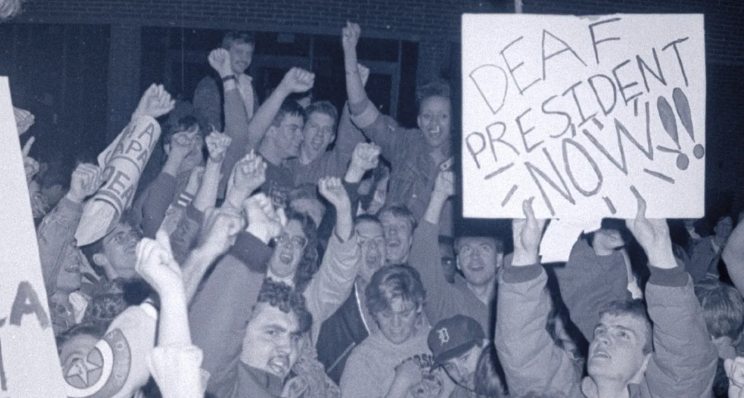
Documentary film “Deaf President Now!”, which was released on Apple TV+ a few weeks ago, presents a remarkable real-life story which will not only touch but also enlighten you a lot. During one week of March 1988, lots of students in Gallaudet University of Washington D.C. protested for more progress for themselves as well as their university, and their stubborn act of defiance actually led to a considerable social change for the people with disability in US.
Everything was started when the board of the Gallaudet University selected the new university president in March 1988. Although the university had been known as the only deaf university in US for more than 100 years, there had not been any deaf president yet, and the demand for a deaf president from the students became fiercer as two of the three final candidates happened to be deaf persons.
However, the board, which was led by Jane Bassett Spilman at that time and all of whose members were hearing persons, eventually decided to select Dr. Elizabeth Zinser instead, who was the only hearing candidate in the final list and, above all, did not have much knowledge or understanding on deaf people (She did not even know the sign language, for Christ’s sake). Understandably, hundreds of students in the university became quite furious, and they immediately went to a posh hotel in the city for confronting Spilman and several other board members. Once they saw that Spilman and the board would not step back at all, the students soon decided to become much more active, and that was the beginning of the Deaf President Now (DPN) protest.
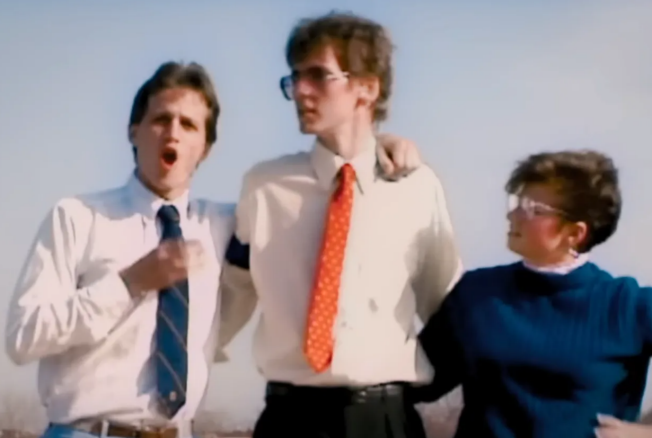
On the very next day, the students locked all the gates of the university for preventing Dr. Zinser from entering the university, and they demanded the immediate resignation of Dr. Zinser as well as Spilman. As Spilman and the board only became more adamant, the students saw that they really needed to be organized more under strong leadership, and that was how several students stepped forward as the key members of the ongoing protest.
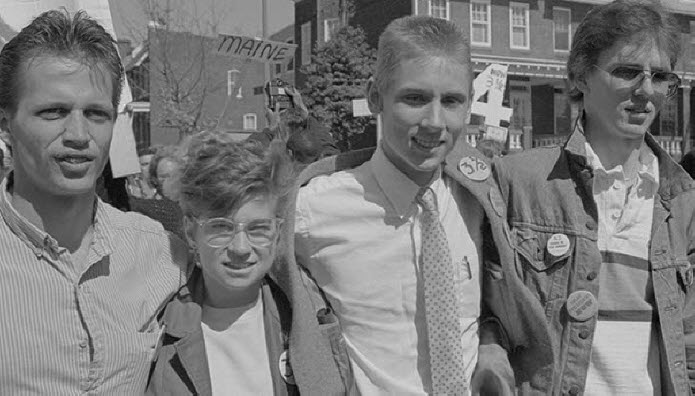
They are Bridgetta Bourne-Firl, Jerry Covell, Greg Hlibok, and Tim Rarus, who all incidentally participated in the production of the documentary besides being interviewed for the documentary. While Covell and Rarus were the ones who often galvanized the protest, Hlibok found himself becoming the unlikely representative of the protest because he just happened to be the president of the student body at that time, and Bourne-Firl also played a crucial part in the protest as a strong-willed liberal feminist who certainly made sure that the protest was inclusive for both female and male students.
As these four different figures talked about their story via sign language, the documentary let us have more understanding and empathy on their story. Thanks to its deft juxtaposition of archival footage clips and occasional reenactment shots, the documentary gradually immerses us more into what they and many other students went through during that time, and it also sometimes turns off or dials down the sound for conveying to us more of how they experienced the world surrounding them.
In addition, the documentary sharply points out that the discrimination against deaf people lies in how their disability has been regarded for many years as something to be fixed instead of being accepted. All of the deaf interviewees in the documentary had each own difficult and painful childhood struggle due to this misguided viewpoint, and that was still holding them back even in the middle of the protest.
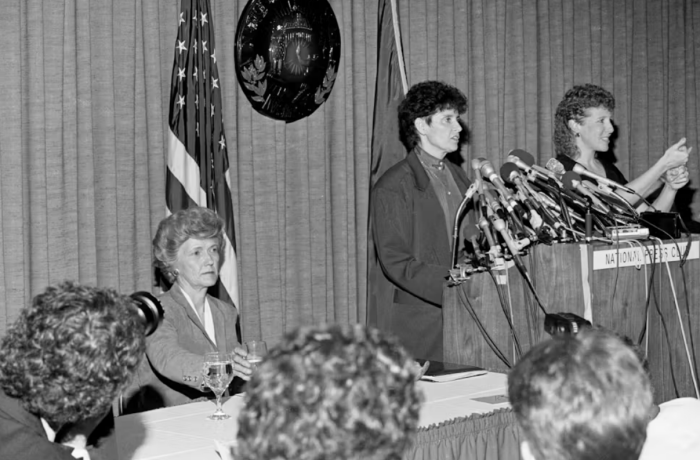
Nevertheless, they and many other students persisted against the board of their university and its chairwoman, who is inarguably the main villain of the story along with Dr. Zinser. While Dr. Zinser was an incorrigibly misguided professional who still had no idea on how much her insensitive words hurt the feelings of the students, Spilman, who was your average rich and haughty white old lady, simply cared about showing who the boss was to the students, and she flatly and aloofly refused to step back as only showing more of her deplorably condescending attitude to the students.
As days went by, the students became more unsure about the protest, especially after a deaf candidate fully supported by them came to side with Spilman and Dr. Zinser later. Nevertheless, they stuck together more than before, and then there came a big opportunity when Hlibok was going to have a live TV debate with Dr. Zinser. I will not go into detail about what eventually happened, but I can tell you instead that 1) it is really moving to see Hlibok finding some courage and determination via simply being himself around the end of this debate and 2) I was also quite touched as observing what happened next after what can be described as a breakthrough for Hlibok and his fellow deaf students.
In conclusion, “Deaf President Now!” vividly illuminates a rather obscure but undeniably important part in the American civil rights history, and co-directors/co-producers Nyle DiMarco, an actor who has also been known as a Deaf activist, and Davis Guggenheim, who is mainly known for his Oscar-winning documentary “An Inconvenient Truth” (2006), present this exceptional human story with considerable care and respect. Along with Oscar-nominated Netflix documentary film “Crip Camp: A Disability Revolution” (2020), this is one of the most powerful documentaries about disability during last several years, and I sincerely urge you to check it out as soon as possible.


 Seongyong's Private Place
Pingback: 10 movies of 2025 – and more: Part 2 | Seongyong's Private Place