
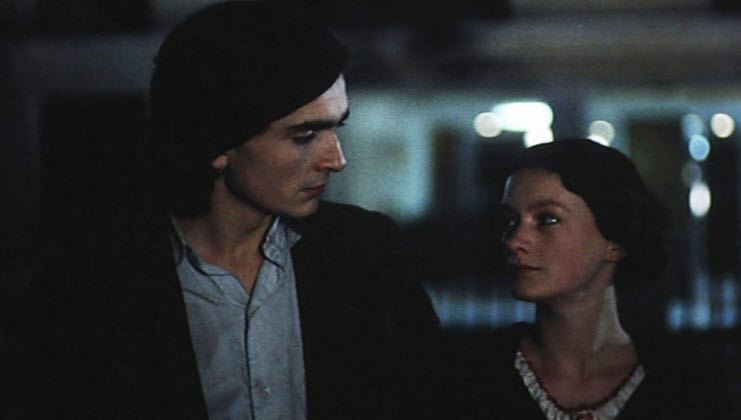
Robert Bresson’s 1971 film “Four Nights of a Dreamer”, which was released in South Korean a few days ago, is interesting for its unexpectedly lightweight mood and attitude. Compared to many of Bresson’s notable works such as “Pickpocket” (1959) or “Au hasard Balthazar” (1966), the movie is less dry and austere in its occasionally amusing romantic drama, and it actually feels more like the works of Éric Rohmer at times even though you can still clearly observe Bresson’s own distinctive touches.
Consisting of several individual chapters, the movie revolves around the accidental relationship between two total strangers. At first, we are introduced to a young Parisian artist named Jacques (Guillaume des Forêts), and the movie simply observes how he aimlessly wanders around here and there before ending up being around one of the bridges in Paris in the middle of one night. He happens to notice a young woman on the bridge, and, what do you know, he comes to rescue her when she is about to jump off from the bridge.
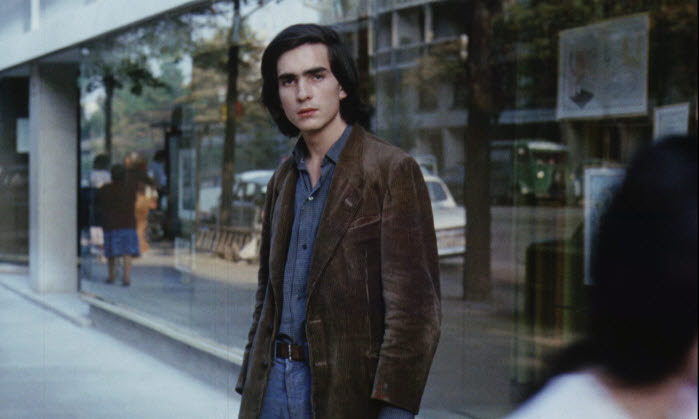
Her name is Marthe (Isabelle Weingarten), and she and Jacques come to confine to each other about their respective miserable lives. Jacques has struggled for more recognition via his artistic activities, but he often finds himself getting more frustrated and alienated without any bright prospect in front of him. Furthermore, he also cannot help but yearn for somebody to love, but, as shown from one flashback scene, he only makes himself look rather creepy and suspicious to several women he encounters during his aimless wanderings.
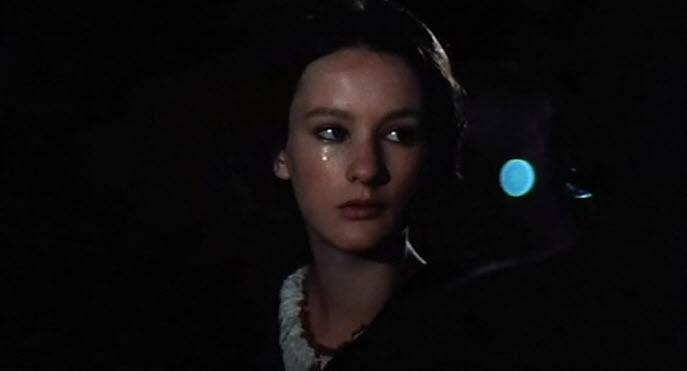
In case of Marthe, she has been desperately in love with some young man who was once a tenant in her and her mother’s residence. Although she was not so interested in that lad at first, she later found herself attracted to him more and more, and she eventually had a very intimate private moment with him. However, he was soon going to leave for US for his study, and she promised him that she will wait, but, alas, he does not seem that interested in reuniting with her even after his subsequent return.
As spending more nights with Marthe, Jacques gradually finds himself drawn to her, but she flatly admits that she is still hopelessly in love with that dude, even though she sincerely appreciates Jacques’ care and attention. This certainly makes Jacques quite frustrated, but he continues to stand by Marthe simply because he comes to love and care about her more. As a matter of fact, he even willingly helps her ongoing romantic pursuit a bit.
The complicated matter of heart between these two different characters is certainly reminiscent of what is so amusingly presented in Rohmer’s many comedy films, but its comic aspects are illustrated as dryly and flatly as you can expect from Bresson. The dialogues in the film are phlegmatically and monotonously delivered by the lead performers even when their characters become more emotional, and this further accentuates the absurd circumstance of their characters.
However, the movie sometimes throws several surprisingly tender moments to be admired and appreciated. Bresson and his cinematographer Pierre Lhomme vividly capture the nocturnal mood of the real locations in Paris, and there are also several lovely romantic moments accompanied with incidental music performance. During these wonderful scenes, everything seems fine and well for Jacques and Marthe at least for a while, and we come to sense more of the mutual attraction between them.

As they keep dancing around each other along the story, Bresson’s screenplay, which is loosely based on Fyodor Dostoyevsky’s 1848 short story “White Nights”, steadily maintains the gravitas beneath the romantic circumstance of its two main characters. I will not go into detail on what eventually occurs between them, but I can tell you instead that the movie remains true to what its two lead characters respectively want and desire, and its final scene will linger on your mind for a long time as you reflect more on how things can be tricky in case of the matter of heart.
The lead performers of the film, who incidentally had no previous experience of movie acting at that time, are well-cast in their respective parts. Isabelle Weingarten, who subsequently appeared in a number of notable films including Jean Eustache’s “The Mother and the Whore” (1973), effortlessly balances her character between humor and pathos with her deadpan performance, and she is ably complemented by Guillaume des Forêts, who brings some earnest quality to his youthful but disaffected character. Although they are understated as much as many other performers working under Bresson, their performances click well with each other on the screen, and we are alternatively amused and touched by how their characters pull or push each other throughout the story.
Overall, “Four Nights of a Dreamer” may not be one of the best works from Bresson, but it deserves more attention because of demonstrating the lighter side of Bresson’s talent. Although it was unfortunately not widely available during last several decades due to some complex issues associated with its distribution rights, it became more available after going through 4K restoration in last year, and that is how I and other South Korean audiences can get a chance to see this rather obscure work in Bresson’s career. I did not expect that much at first because I really did not know anything about it at all, but I was surprised and impressed much, and, folks, that is more than enough for recommendation.


 Seongyong's Private Place