
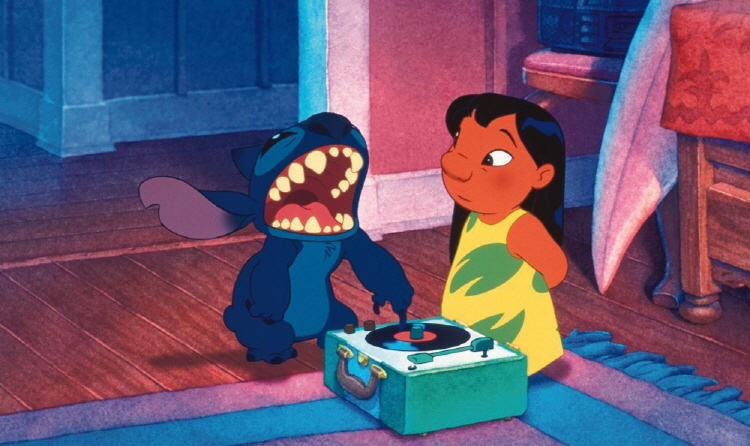
I somehow missed a chance to watch Disney animation feature film “Lilo & Stitch” when it came out in 2002, and now I deeply regret that after finally watching it at last night. While it looks rather modest in terms of story and character, it is undeniably inspired and charming in many aspects, and it also happens to be quite special as one of the last cell animation feature films from Disney during the 2000s.
The opening part quickly establishes one of its two lead characters, who is a creature created by a loony alien scientist who gets arrested and then incarcerated for his creation by the Galactic Federation. This creature looks small and rather cute, but it can be quite destructive and dangerous as genetically engineered by its creator, and the leader of the Galactic Federation eventually decides to incarcerate it just like its creator.
However, the creature manages to escape at the last minute, and then it flies away to the Earth after stealing a small spaceship. By coincidence, the spaceship falls onto one of the main islands of Hawaii, and that is how it later encounters Lilo Pelekai (voiced by Daveigh Chase), a little local girl who has lived with her older sister Nani (voiced by Tia Carrere) since their parents’ unfortunate death. Although it looks rather weird, Lilo instantly comes to like the creature when they come across each other at a local animal shelter, and he is soon called “Stitch” while continuing to hide his true nature and identity from Lilo and Nani.

As Stitch and Lilo begin to befriend each other more along the story, we get to know more about how things have been rather bad for Lilo and Nani. Nani is supposed to take care of Lilo as her only close family member at present, but she is not so good at balancing herself between her work and numerous domestic matters including the ones involved with her occasionally unruly younger sister. This certainly does not certainly look that good to their visiting social worker, who incidentally looks more like a character from “Men in Black” (1997).
While Stitch surely turns out to be quite problematic for both Lilo and Nani due to its edgy nature, it gradually gets accustomed to being a new family member of theirs. As often emphasized throughout the story, Nina and Lilo openly and flexibly accept Stitch as regarding it as another member of the “ohana” (It is a Hawaiian term meaning “family”, by the way), and Stitch finds itself slowly softened by their warm and gentle sincerity. As a matter of fact, it even gladly does the impersonation of a certain favorite pop singer of Lilo and Nani at one point, and that is certainly one of the funniest moments in the film (I also like when it gleefully imitates Godzilla, by the way).
Meanwhile, that alien scientist and a meek official of the Galactic Federation arrive in Hawaii for retrieving Stitch as soon as possible without being noticed by the Earthlings, and they surely come to function as a comic relief while clumsily disguising themselves as visiting tourists. One of the main jokes in the film is that the Earth has been protected as the preservation area of a certain pest species, and you will surely roll your eyes if you dislike that species as much as I do.
While things become more serious and frantic during its last act, the movie somehow strikes a right balance between its contrasting story materials, and it also distinguishes itself a lot as a well-made cell animation film. While its overall mood is as warm and colorful as you can expect from its main background, it also shines in small and big details thanks to its excellent application of watercolor style, and the overall result surely reminds us again of what we sadly lost since Disney Studios eventually abandoned cell animation after “The Princess and the Frog” (2009).

The film was also a breakthrough for the careers of directors/writers Chris Sanders and Dean DeBlois, who deservedly received an Oscar nomination for the film and then respectively went further with several good animation films during the next 22 years. After they subsequently made another Oscar-nominated animation film “How to Train Your Dragon” (2010) together, DeBlois made its two equally successful sequels, and Sanders, who incidentally provided the voice of Snitch, recently impressed us again with his Oscar-nominated animation film “The Wild Robot” (2024), which is one of the best films I saw during last year.
The voice cast members of the film are well-cast in their respective parts. Daveigh Chase imbues her occasionally wild but ultimately lovable character with a lot of pluck and spirit, and Tia Carrere complements Chase’s plucky voice acting well during their several key scenes in the film. In case of several notable supporting voice performers, David Ogden Stiers, who was previously the voice of one of the supporting characters in Disney animation film “Beauty and the Beast” (1991), and Kevin McDonald are constantly hilarious as a mismatched alien duo, and Ving Rhames also provides some deadpan humor as the aforementioned social worker.
On the whole, “Lilo & Stitch” is one of the best offerings from Disney Studios during the 2000s, and it makes me more wonder whether its upcoming live action film version is really necessary. As I said many times before, live action can rarely surpass animation for many reasons, but I sincerely hope that the people behind the live action film version kept in their mind what makes the animation version so special.


 Seongyong's Private Place