

Hong Sang-soo’s new film “What Does That Nature Say to You” has usual stuffs we can expect from him, but it somehow did not engage me much on the whole. While it gets some laugh from how petty its hero can be, the movie fails to generate enough comic momentum to hold my attention, and I also found myself often distracted by its unnecessary visual approach.
At first, we are introduced to Dong-hwa (Ha Seong-wuk) and his girlfriend Jun-hee (Kang So-yi). They have just arrived at the house belonging to Jun-hee’s parents by his car, and the movie lingers around them for a while before they eventually meet Jun-hee’s father. After wholeheartedly welcomed by his girlfriend’s father, Dong-hwa comes to spend some time with him, and they drink and smoke a bit together just like many other male characters in Hong’s movies.
Meanwhile, Jun-hee goes inside the house and then talks a bit with her sister, and we get some more information about Dong-hwa. While he is an aspiring young poet, he has earned his living via some menial job, and he does not particularly want to get any financial help from his father even though his father is quite a rich and influential figure.

While Jun-hee’s parents prepare the dinner for everyone during next several hours, Dong-hwa, Jun-hee, and her sister have a little lunch together outside and then go to a nearby temple just because, well, they have nothing else to do. As they simply look around here and there in the temple and its surrounding area, Jun-hee and her sister come to talk more about her boyfriend, and we also observe how petty Dong-hwa can be just because of his deep sense of inferiority.
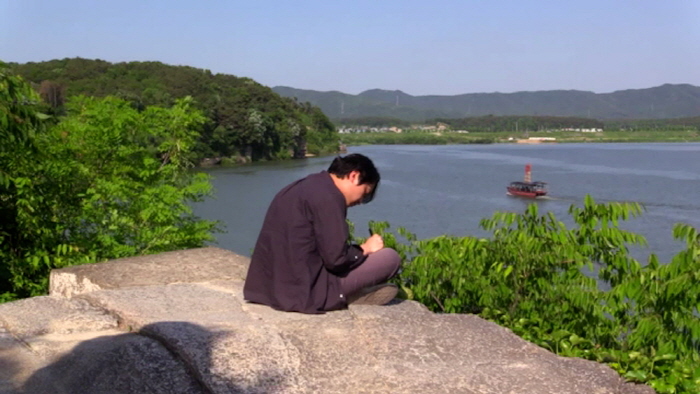
All these and other moments in the film could be more interesting to observe, but Hong deliberately shot his movie in low resolution, and this odd visual approach was quite distracting to me during my viewing. For example, the background often looks rather dim and blurry, and this frequently disrupts our attention when we are supposed to focus more on whatever is going on among the main characters in the story. In my humble opinion, it would be less problematic if Hong had shot the movie in black and white film just like he did in some of his recent films including “The Novelist’s Film” (2022) and “Walk Up” (2022), which are all rather crude in terms of visual quality but are covered to some degree by that distinctive quality of black and white film.
Around its second half, the movie becomes a little more interesting as Dong-hwa and his girlfriend have a big dinner in her parents’ house. As everyone at the table enjoys the chickens cooked by Jun-hee’s mother, more drinks are exchanged among everyone at the table, and the mood becomes livelier than before. I do not know whether the performers actually drank together in front of the camera just like many performers in Hong’s films allegedly did, but I can tell you that their interactions over the dinner table are spontaneously realistic. As they talk more and more, you will surely come to feel more like sitting along with them at the table.
Of course, just like those petty heroes of many of Hong’s previous films such as “Hahaha” (2010) and “The Day He Arrives” (2011), Dong-hwa cannot help but become petty as he drinks more and more. Just because his girlfriend’s sister previously talked a bit about his supposedly strained relationship with his affluent father, he becomes quite emotional, and this certainly embarrasses everyone else at the table. Fortunately for him, Jun-hee and her father handle him as tactfully as possible, and that certainly prevents more embarrassment for all of them.

What follows next is a couple of unexpected moments of reflection. As becoming less drunken several hours later, Dong-hwa is naturally quite ashamed of his pettiness, and that leads to a little solitary nocturnal walk outside the house. In case of Jun-hee’s father, he spends some time with his wife inside his little private spot outside the house, and the mood becomes tender and playful between them as they muse on a number of things including Dong-hwa’s embarrassing act of pettiness.
Although Hong’s screenplay does not give much detail and personality to its main characters, his main performers are good enough to bring some personality to their respective parts. While Ha Seong-guk is effective whenever he conveys to us a sense of inferiority behind his character’s seemingly passive attitude, Kang So-yi and Park Mi-so often brighten up the film with their youthful presence, and Kwon Hae-hyo and Cho Yun-hee are solid in their good supporting performance. As a matter of fact, Kwon, who has been one of Hong’s frequent performers during last several years, and Cho steal the show with the effortless chemistry between them, and their characters actually seem closer to Hong’s heart than the other main characters in the film.
In conclusion, “What Does That Nature Say to You” is interesting at times, but I still think it could work better if Hong stuck to his usually plain visual approach instead of making it look and feel a bit too crude on the screen. Now I am reminded of what late critic Gene Siskel often asked: “Is this movie more interesting than a documentary about the same actors having lunch?” I do not know whether the latter would be more interesting in case of “What Does That Nature Say to You”, but I am sure that it would look visually better at least.


 Seongyong's Private Place