
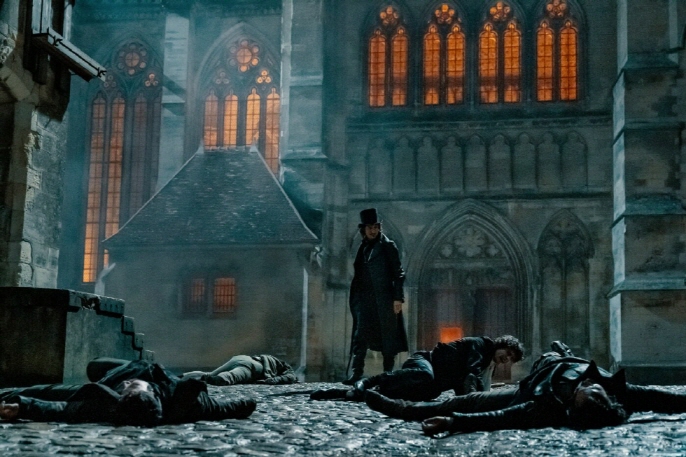
Alexandre Dumas’ classic novel “The Count of Monte Cristo” is actually a useful guidebook on how to execute a revenge on your mortal enemy as precisely and efficiently as possible. Besides patiently waiting for the right time and the right place for his cold-blooded vengeance upon his targets, its hero meticulously plans on how his targets can be truly punished and then destroyed to the end, and we get some nasty but cathartic fun from the effective execution of his devious revenge plan.
Its latest movie adaptation version of the same name, which came out in France in last year, knows and understands well what makes Dumas’ unabashedly pulpy novel so fun and thrilling, and its result is engaging enough to justify its almost 3-hour running time. While it is a bit strained at times as trying to press the epic melodrama of Dumas’ novel into the limited running time, the movie seldom bores us as busily juggling its plot and characters, and it surely serves its hero’s revenge pretty well on the whole.
The early part of the movie, which is mainly set in Marseille, France in 1815, establishes how its hero, Edmond Dantès (Pierry Niney), suddenly falls from one of the happiest days in his life to the bottom of hell. At the beginning of the story, he is a decent sailor lad who gets promoted to the position of captain because of one brave act of his in the middle of the latest voyage of his ship, and this unexpected change in fortune for him finally makes him propose to Mercédès Herrera (Anaïs Demoustier), a young beautiful women he has loved for years.

However, there are several people ready to destroy him for each own reason. His predecessor, Danglars (Patrick Mille), is not so pleased about getting fired, and he happens to have something quite useful for getting Dantès wrongfully accused of a serious act of treason associated with the exiled Napoleon. After Dantès is eventually arrested later, Fernand de Morcerf (Bastien Bouillon), who is Mercédès’ cousin and also Dantès’ best friend, tries to save his friend, but then he is subsequently persuaded to add more accusation on Dantès by the prosecutor assigned to Dantès’ case, who also wants to get rid of Dantès as much as Danglars and de Morcerf (Yes, he has also hoped to marry Mercédès).
Several years after he is sent to a remote island prison where he gets incarcerated in a solitary cell without any hope or consolation, Dantès happens to encounter someone who becomes his friend and mentor. That person is question is an old priest who turns out to be quite knowledgeable in many aspects, and Dantès and that old priest soon embark on their secret escape plan as Dantès becomes more determined about getting out of the prison someday.
The movie feels a bit clunky as hurriedly rolling the plot during its first hour, but it thankfully builds up more narrative momentum once its hero finally escapes from the prison shortly after his mentor’s death. After finding that everything in his life is gone, Dantès becomes more vengeful than before, and, fortunately, his mentor told him about the enormous amount of wealth hidden inside a little island located somewhere in the middle of the Mediterranean Sea (Do I have to tell you the name of the island, by the way?).
After getting to know more about how the targets of his revenge have been living pretty well since his arrest, Dantès carefully and patiently sets up the traps for each of them, and that is the main source of fun and entertainment in the film. He wisely waits until all of his targets feel like being at the top of the world thanks to more success and wealth for each of them, and then he slowly and insidiously shakes up their respective successful status in one way or another, while deftly insinuating himself into their world as a very wealthy aristocrat who may benefit them more.

As Dantès’ targets unwittingly get trapped more according to his plan, directors Matthieu Delaporte and Alexandre de La Patellière, who also adapted Dumas’ novel together, provides a series of effective moments to be appreciated. There is a darkly amusing scene where Dantès slyly toys with his targets as suggesting a certain terrible secret involved with one of this targets, and Pierre Niney, who previously appeared in Michel Gondry’s “The Book of Solutions” (2023), did a good job of balancing this scene between dramatic intensity and black humor.
Meanwhile, we also come to care more about a few other main characters besides Dantès. There are two certain figures willing to serve as the tools of his revenge, and there is some little poignancy in their respective subplots. In case of Mercédès, who is now married to de Morcerf, she instantly recognizes Dantès right from when they meet again, and we later get a bittersweet private scene where they are allowed to show a bit more of themselves while still not admitting anything to each other.
Because I have not seen every movie adaptation of Dumas’ novel (Full Disclosure: I have not even fully read Dumas’ novel yet), I cannot tell you whether “The Count of Monte Cristo” is the best one in the bunch, but the movie is entertaining enough for its skillful storytelling as well as its excellent production qualities. Sure, they say revenge is ultimately futile, but it is usually compelling to watch a revenge served quite well, and the movie presents well one of such fun cases in my trivial opinion.


 Seongyong's Private Place