
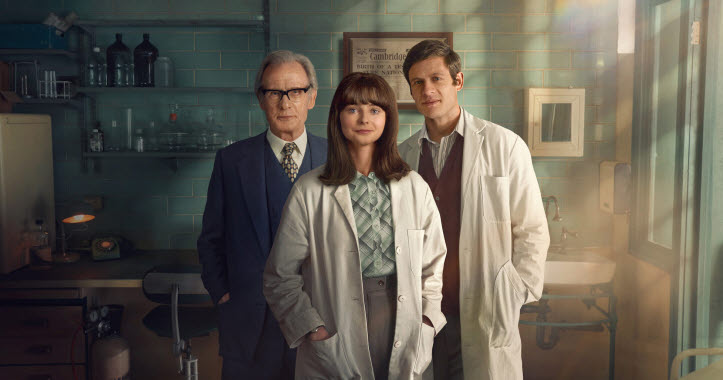
Netflix film “Joy”, which was released several months ago, is a mild but sincere drama about the development of in vitro fertilization. Mainly via the viewpoint of a certain real-life female figure who surely deserves more attention, the movie touchingly depicts how much she and her two male colleagues struggled for their groundbreaking medical achievement, and you may reflect more on what most of us have taken for granted for many years.
That real-life female figure in question is Nurse Jean Purdy, who could have received much more recognition if she had not died too early not long before the first successful case of in vitro fertilization in 1978. At the beginning of the story, she was just a young nurse applying for a position under Dr. Robert Edwards at the University of Cambridge, 1968. Nevertheless, she immediately impresses Edwards with her forthright attitude right from their first encounter, and she soon finds herself assisting him in his ongoing research on in vitro fertilization.
Because of the very sensitive aspects of his medical research, Edwards has struggled to get the funding for his medical research, but he finds someone who can give considerable technical help for attaining the ultimate goal of his research. After a lot of tests on animals, Edwards becomes more confident about how in vitro fertilization may help many unfortunate medical cases of infertility out there, and Dr. Partick Steptoe (Bill Nighy) is willing to provide his innovative medical techniques for the upcoming clinical test on a bunch of female candidates.

However, not so surprisingly, Edwards and his two colleagues soon find themselves facing a lot of objection and controversy for understandable reasons. They still struggle to get enough funding, so they have no choice but to do their research at a hospital where Steptoe has worked for years, even though that hospital is quite far from Cambridge and is also not exactly ideal to say the least. In addition, they soon draw a lot of attention once their medical research is known more to the media and the public, and they are openly criticized by many figures including a certain famous Nobel Prize winner.
And Purdy cannot help but feel conflicted about her job as a devout Christian woman. While still believing that she is really doing the right thing for many unfortunate women out there, she soon gets estranged from her conservative mother and church people, and then she becomes all the more conflicted when she comes to learn more about what Steptoe has often done at his hospital.
However, she and her two colleagues keep going as before, and we observe their strenuous efforts for reaching their goal. They thoroughly test a group of female candidates one by one, and it looks like they can actually succeed several years later, but then there comes an unexpected setback to frustrate and exhaust them all.
The screenplay by Jack Thorne, which is developed from the story by Rachel Mason, Emma Gordon, and Shaun Topp, stumbles more than once during its middle part, but it has its heart in the right place at least. As the plot is unfolded more, we get to know a bit more about not only Purdy but also some of those female candidates for in vitro fertilization, and there is a little poignant moment when Purdy reveals a little personal secret of hers to her ailing mother.

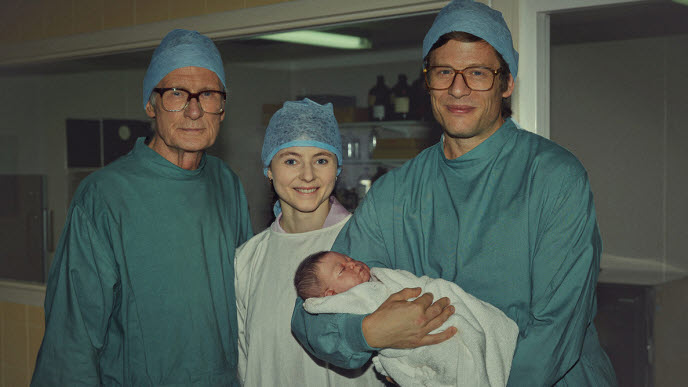
When Purdy and her two male colleagues eventually work together on their research again later in the story, the movie gradually regains its narrative momentum, but it stays calm and restrained even when they are about to accomplish their ultimate goal in the summer of 1978 (Is this a spoiler?). While things go pretty well up to that point, they are still careful and discreet as before, and they must be absolutely sure that everything is all right for their test subjects in the end.
Although the ending is rather anti-climactic, the movie still holds our attention with enough care and sincerity under the good direction of director Ben Taylor, and it is also supported well by its three main cast members. Thomasin McKenzie, a promising young actress who has steadily advanced since her breakthrough performance in Debra Granik’s “Leave No Trace” (2018), dutifully holds the center as required, and she is particularly good when her character comes to form more emotional connection with some of those female candidates along the story. James Norton is relatively bland compared to McKenzie’s engaging acting at first, but his performance gets better as his character shows more care and dedication on not only his research but also its numerous female candidates. In case of Bill Nighy, he is surely dependable as usual while occasionally providing some dry wit to the story as expected, and he and his two co-stars always click well with each other whenever they are on the screen together.
On the whole, “Joy”, which is incidentally derived from the middle name given to the first baby conceived via in vitro fertilization, sometimes feels rather bland and conventional compared to its extraordinary medical research story, but it is still worthwhile to watch for bringing more attention to its hidden female figure at the center of the story. Just like Dr. Rosalind Franklin, who was unfairly neglected for many years despite her undeniably crucial role in the understanding of the molecular structures of DNA, and many other exceptional but unrecognized women of science and technology, Purdy surely deserves to be known and recognized more in my humble opinion, and you will never forget her after watching this fairly entertaining movie.


 Seongyong's Private Place