
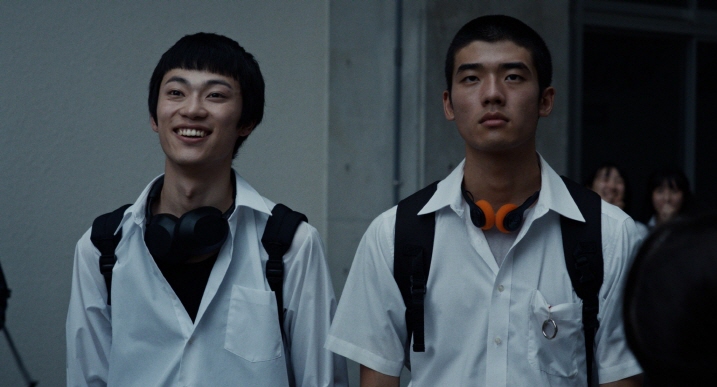
Japanese film “Happyend” observes a group of high school kids showing some spirit and defiance during the last year at their school. While they try to go further for more fun and freedom day by day, they are also often reminded more of the looming uncertainty in their future, but they come to grow up in one way or another in the end, and there is a bit of hope and optimism from the bittersweet ending of their coming-of-age tale.
The story, which is set in Tokyo in a near-future period, opens with its several main characters trying to have another fun evening. At first, they are not allowed to go inside a place where some famous DJ is throwing a music dance party, but Yuta (Hayato Kurihara) and Kou (Yukito Hidaka) eventually find a backdoor entry, and they and their three friends soon get inside that place, though their fun time does not last very long due to the subsequent arrival of policemen.
Anyway, we get to know a bit more about Yuta, Kou, and their friends; Ata (Yuta Hayashi), Ming (Shina Peng) and Tomu (Arazi). Each of them is an outsider in each own reason, and Kou is particularly discriminated a lot due to his Korean heritage, which has incidentally prevented him and his family from getting officially recognized as Japanese citizens. In case of Ming and Tomu, both of them also have each own racial background issue as you can easily guess from their respective appearances, and we are not so surprised to learn later that Tomu already decided to go to US shortly after his high school graduation.
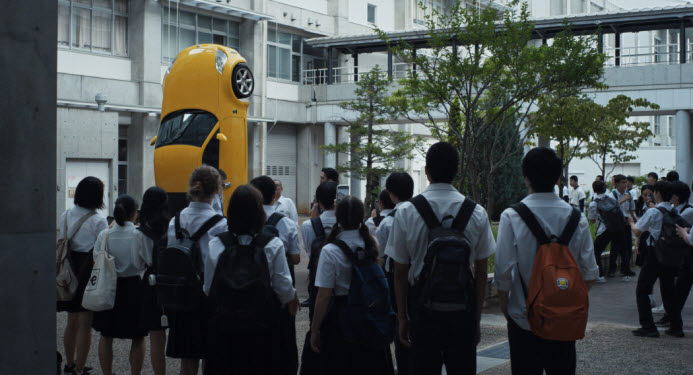
Nonetheless, these kids still stick together, and we see how they continue their rebellious night. After managing to get away from those policemen, they sneak into their club room in the school for simply enjoying themselves more, and then Yuta and Kou come to have a very naughty idea. They decide to commit a prank on a certain expansive property belonging to the principal of their school, and the consequence surely surprises everyone in the school on the very next morning.
Needless to say, the principal is not so amused, and he responds with a rather drastic measure in the name of safety and regulation. He has a high-tech surveillance system installed here and there in the school, and now every student in the school is constantly monitored mainly via facial recognition.
Naturally, Yuta and his close friends do not welcome this at all, and they soon come to show more defiance – especially when their club activity suddenly gets suppressed by the school after they are targeted as the prime suspects of the incident by the principal. There is an amusing scene where they fool the teachers for their little act of theft, and they certainly have some fun and excitement from that.
In the meantime, their graduation is approaching closer, and Kou becomes more serious about what to do for his future. As his mother has always hoped, he will go to a college someday, so he cannot help but become anxious and conflicted, but then he gets himself into another trouble via one of his female classmates, who has been incidentally more politically active than many other students. Along with her, he later joins a protest against the blatantly right-wing policy of the government, but then he hesitates as this can seriously jeopardize his ongoing application for college scholarship.
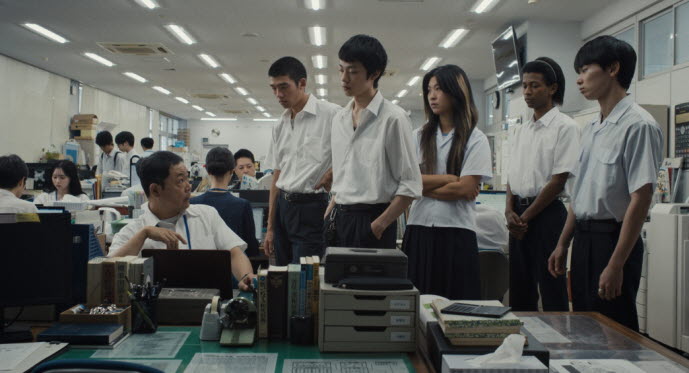
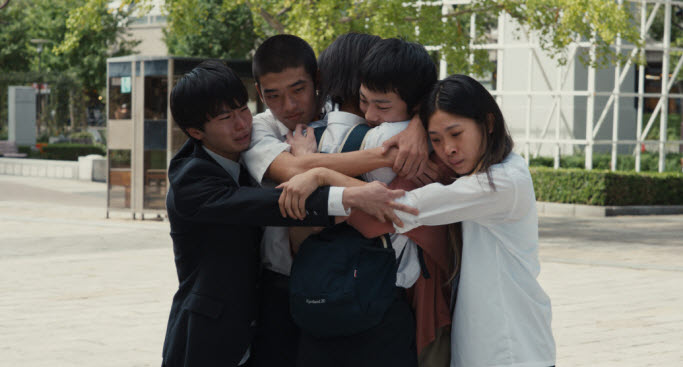
Compared to Kou, Yuta remains casual about his life and future, and that eventually leads to some estrangement between them, but the movie does not dramatize this too much. In the end, both of them come to get involved with a small protest against the principal, and there is some poignant irony when Yuta makes a big decision for both his friend and himself later in the story.
Except for a few futuristic elements shown in the background, the overall atmosphere of the film is quite plain and mundane, but director/writer Neo Sora, who is incidentally the son of Ryuichi Sakamoto, did a good job of engaging us more into the story and characters. As he and his crew members including cinematographer Bill Kirstein steadily maintain its phlegmatic overall tone, the movie effortlessly conveys to us a vivid and realistic sense of life felt from the daily life of its main characters, and we come to understand and care about them more even though the movie usually observes them from the distance.
The young main cast members of the film are all convincing in their solid natural performance. While Hayato Kurihara and Yukito Hidaka hold the center as required, Yuta Hayashi, Shina Pegn, and Arazi bring some colorful personality to their respective supporting role, and Shirō Sano is suitably obnoxious as demanded by his authoritative character.
In conclusion, “Happyend” is an engaging adolescent drama to be admired for its good mood, storytelling, and performance, and Sono, who previously impressed us a lot with his documentary film “Ryuichi Sakamoto: Opus” (2023), makes a solid feature film debut here. Although it surely requires some patience for its rather slow narrative pacing, you will appreciate how the movie subtly reveals its youthfully beating heart along the story, and it certainly deserves to be compared to its senior Japanese films including Shinji Sōmai’s “Typhoon Club” (1985). In my inconsequential opinion, Sono is indeed another promising new Japanese filmmaker to watch, and it will be interesting to watch what may come next from him during next several years.


 Seongyong's Private Place
Pingback: 10 movies of 2025 – and more: Part 2 | Seongyong's Private Place