
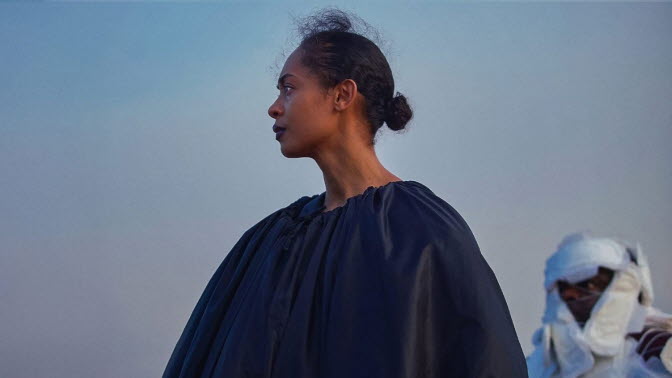
Runagno Nyoni’s second feature film “On Becoming a Guinea Fowl” is about a family funeral of one middle-class Zambian family. Mainly following one of the younger family members, the movie gradually reveals the secrets and traumas suppressed inside this family, and it is interesting to observe how it earns a glimmer of hope and determination as deftly balancing between drama and comedy.
The movie begins with the discovery of a body by its heroine. When she is returning to her home from some evening party by her car, Shula (Susan Chardy) spots that body on the road, and that turns out to be an uncle of hers. Naturally, she notifies this to her family and then the local police, but she only finds herself waiting there during next several hours along with one of her cousins, who also happens to pass by the spot.
Anyway, on the next morning, Shula returns to her home after seeing the police taking care of the body of the uncle. When the funeral is about to be begun, she instantly moves to a local hotel for taking care of some important work to handle, but then she is interrupted by several aunts of hers. It is apparent that she is not so willing to participate in the funeral, but the aunts firmly insist that she should help them handling the funeral, and she eventually follows their demand.

While Shula takes care of many things including picking up her mother at a local airport, the movie looks into how she and her many other family members go through the first several days of the funeral. Her aunts and many other older family members wail as much as possible for supposedly mourning for the death of the uncle, but it soon turns out that they are more occupied with how to handle the matters involved with his very young wife. They do not like her a lot to say the least, and they are already ready to blame her for her husband’s death just for taking away all the assets belonging to him later.
Meanwhile, Shula is frequently busy with whatever is demanded to do in the meantime. Along with several other family members, she has to prepare and then serve the meals to many different family members and visitors, but, not so surprisingly, her efforts are taken for granted without being appreciated much. At least, she gets some rest as occasionally spending time with several cousins of hers, but that does not last that long as there is always something to be handled by her.
We also get to know more about a certain deplorable family secret involved with her uncle. In fact, he sexually abused at least two cousins of hers, and one of them actually tries to kill herself not long after the beginning of the funeral. Needless to say, her mother and aunts have known everything for a long time, but they simply ignored that just for maintaining the patriarchy order of their family, and their hypocrisy becomes more evident when they actively repress Shula and one of her cousins in the name of family love.
As reflected by the occasional moments of hallucination, Shula turns out to have a fair share of secret and trauma behind her seemingly phlegmatic appearance. No matter how much she wants to look away from that, her mind cannot help but haunted by a few fragmented memories of her trauma, and her accumulating anger and frustration are often accentuated by the nervous score by Lucrecia Dalt.
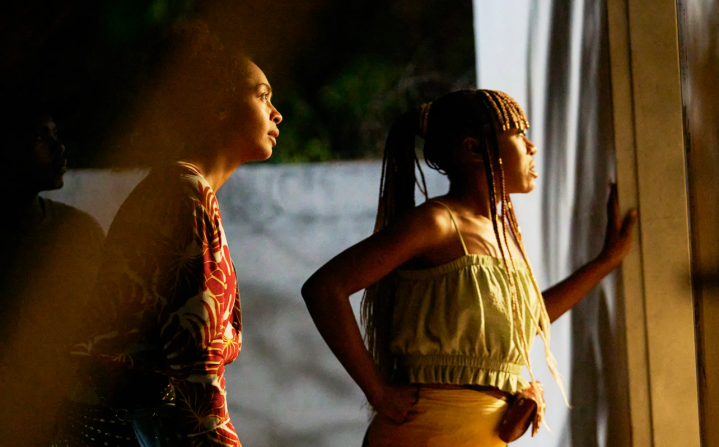
Continuing to alternate between dark absurdity and harrowing personal pain, the movie immerses us more into its heroine’s increasingly conflicted circumstance. Although we do not get to know a lot about many of her family members, they are depicted with enough personality and presence, and their interactions throughout the film feel vivid and naturalistic enough to engage us more. As a result, we come to sense more of how suffocating her family can be to Shula, and we also pay more attention to how things are despairing for her uncle’s young wife, who was virtually groomed by him when she was just a little underage girl and is now quite scared and helpless as frequently harassed by Shula’s aunts.
Everything dramatically culminates to the finale where a big meeting is held not long after the funeral, but the movie wisely avoids unnecessary melodrama under Nyoni’s skillful direction, and then it powerfully ends the story at an exactly right moment. While recognizing a lot of uncertainty in front of Shula, the movie subtly conveys to us that she will not be silent anymore, and that is further accentuated by a little symbolic act of hers, which is incidentally associated with the very title of the film. Gradually taking the center of the movie with her earnest natural performance, Susan Chardy functions as the beating heart of the film, and she is also supported well by a bunch of good supporting performers including Elizabeth Chisela, who is poignant when her character later comes to reveal more of the old personal pain behind her carefree attitude.
On the whole, “On Becoming a Guinea Fowl”, which received the Best Director award when it was shown at the Un Certain Regard section of the Cannes Film Festival early in last year, is another compelling work from Nyoni, who previously made a wonderful feature film debut with “I Am Not a Witch” (2017). With these two impressive works, she demonstrates that she is another talented filmmaker to watch, and it will be interesting to see what may come next from her in the future.


 Seongyong's Private Place
Pingback: 10 movies of 2025 – and more: Part 2 | Seongyong's Private Place