
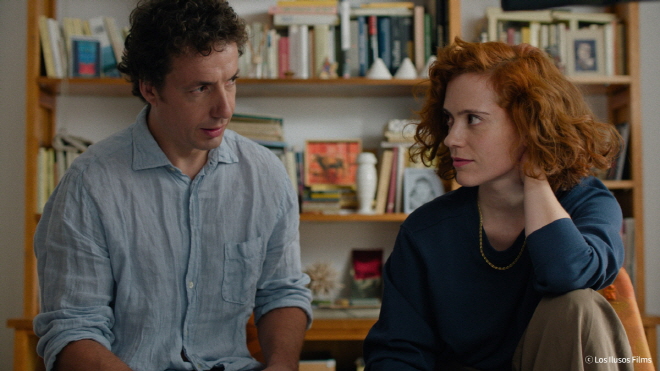
Spanish film “The Other Way Around” is a lightweight comedy about one young couple who suddenly decides to have a “happy” separation for no apparent reason. As they prepare for their separation step by step, the movie provides a series of humorous moments to enjoy, and it even becomes cheerfully self-conscious just like its two main characters.
They are Ale (Itsaso Arana) and Alex (Vito Sanz), who are a filmmaker and an actor, respectively. For more than 10 years, they have happily lived together as a couple, but then Ale suggests that they should break up with each other during one night, even though they do not have any particular problem between them at present. Alex is a bit surprised, but he and Ale eventually agree on separation, because, well, both of them have been rather bored about their fairly happy status.
And they decide to make their separation as joyous and painlessly as possible. They embark on planning the celebration party for their separation, and that leads to a number of absurd scenes where they freely talk about their separation plan to others around them. Needless to say, their friends and acquaintances are quite baffled by Ale and Alex’s sudden separation, and they are all the more confused as they are cordially invited to Ale and Alex’s celebration party.

Ale and Alex get the idea of their celebration party from Ale’s aging father, who once casually said about how separation should be as happy as, say, marriage. However, even Ale’s father is caught off guard by what his daughter and her boyfriend is planning, though he is willing to provide his residence for their upcoming celebration party.
Meanwhile, Alex and Ale keep working on their joint movie project, which turns out to be about their ongoing separation process. More than once, the movie blurs the line between reality and fiction along the story, and we naturally come to wonder more about the real thoughts and feelings of Ale and Alex. Are they really serious about their ongoing separation process? Or, are they actually enjoying this change suddenly coming into their rather plainly stable private life?
Regardless of whatever Ale and Alex respectively feel and think about their upcoming separation, the movie keeps dancing as becoming more self-conscious about their circumstance along with them. With its considerable intimacy shown from their domestic life, the movie often evokes Ingmar Bergman’s great film “Scenes from a Marriage” (1973), and we are not so surprised when a friend of Ale shows a deck of tarot cards inspired by Bergman’s works. At one point later in the film, more than one famous classic Hollywood comedy film about divorce is mentioned, and that certainly brings some extra amusement to the story.
Needless to say, around the time their movie project is nearly completed, Alex and Ale become less certain about whether they can actually celebrate their separation as planned. As the time for their celebration party gets closer and closer, we sense the growing strain between them, and there is a brief private moment giving us a little glimpse into how Ale feels about the approaching official end of her relationship with Alex.

Nevertheless, the movie does not lose any of its bouncy comic momentum and lightweight sense of humor even at that narrative point. There is a funny scene where Ale and Alex’s friends and colleagues give some comments on the rough cut of Ales and Alex’s movie, and this works as a sly self-conscious wink from director Jonás Trueba, who incidentally developed the screenplay with his two lead performers. Around the point where Alex and Ale’s celebration party is finally started, we get more laughs as the movie goes back and forth between fiction and reality more than before, and you will gladly follow its free-flowing narrative line without much complaint.
It helps that the movie is constantly supported well by the good chemistry between its two lead performers. Although we do not know that much about the long past shared between their respective characters, Itsaso Arana and Vito Sanz click well with each other from the beginning to the end, and they did a good job of conveying to us the comfortable sense of intimacy between their characters while subtly shaping up their characters more along the narrative. While Arana imbues her role with a lot of charm and spirit, Sanz complements his co-star with his laid-back acting, and they are also surrounded by a number of good supporting performers including Fernando Trueba, who is Trueba’s father and is also known well as for directing several notable films including “Belle Epoque” (1992) and “They Shot the Piano Player” (2023).
In conclusion, “The Other Way Around”, whose Spanish title is “Volveréis” (It means “You Will Return” in English, by the way), is an enjoyable romantic comedy thanks to its witty storytelling and engaging performance to be savored. Although my condition was not exactly good when I watched the film yesterday, I soon found myself quite amused and entertained to the end, and its ending took me back to the last scene of “Scenes from a Marriage”. No matter what will happen to them next, Ale and Alex come to have a better understanding of themselves and their relationship in the end just like the couple in “Scenes from a Marriage”, and they will certainly appreciate that more in the future.


 Seongyong's Private Place