

“Gondola” is a simple but charming romantic comedy film to be cherished. While it often feels more like an extended short film especially during its second half, the movie thankfully has enough wit, style, and personality to fill its 82-minute running time at least, and you will be frequently tickled by its many humorous moments.
The movie is set in some rural mountain village in the Georgian mountains, and it begins with the return of a young woman named Iva (Mathilde Irrmann). Her father recently died, and there is no one to welcome her in the village, but she decides to settle in the house belonging to her father, and she eventually begins to work as a conductor of the cable car line in the village just like her father did for many years.
Set between the two mountain peaks, the cable car line is operated by a rather mean dude who does not pay that much to Iva and Nino (Nino Soselia), who is another female cable car conductor. Day by day, Iva and Nino handle their respective cable cars on the line, and we frequently see how their respective cable cars go back and forth in the opposite direction throughout the story.
As time goes by, it becomes apparent to us that Nino and Iva are quite attracted to each other, and the movie has some fun with the wordless depiction of the developing mutual attraction between them. As a matter of fact, the movie does not have any dialogue from the beginning to the end, and it almost feels like a silent film even though it frequently uses sound for dramatic or comic effects.

Once they come to sense more of the romantic feeling between them, Nino and Iva become more expressive about that. At first, they interact with each other via a chess game, but then they entertain each other more and more whenever their cable cars pass by each other. At one point, they do a little costume play just for showing more of their mutual affection to each other, and then they subsequently go further as they playfully decorate their cable cars (Don’t ask me how they can possibly do that for themselves within such a short time).
It goes without saying that these two ladies eventually arrive at the expected moment when they open themselves a lot more to each other than before, but, of course, there comes a couple of obstacles. As already shown to us during the early part of the film, Nino has aspired to get out of the village and then become a flight attendant someday, and she is certainly delighted when an opportunity finally comes to her on one day, but this inevitably causes a conflict between her and Iva later in the story.
And there is also that unpleasant boss of theirs. When his lecherous approach to Nino is failed, this despicable dude subsequently tries to get closer to Iva, and that is certainly the last thing Nino and Iva want. When he later discovers how playfully Iva and Nino have worked together, he is not so amused to say the least, and Nino and Iva come to dislike him more than before.
Nonetheless, the movie continues to maintain its cheerfully pleasant mood as before. Considering how conservative its main background looks, it is unlikely that two young women can enjoy their openly homosexual romance, but the movie mostly sidesteps this issue as never stopping amusing us more and more along the narrative. Besides Iva and Nino, we get to know a bit about several other town folks, and we get an extra chuckle from a little subplot involved with two young kids in the village.
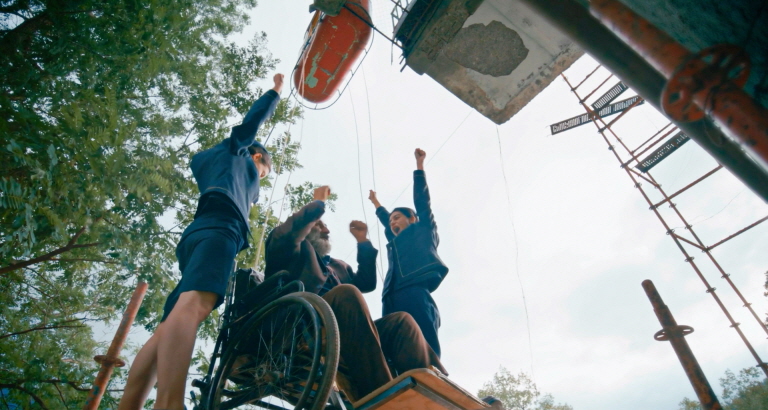
The most entertaining moment in the film comes from when Nino and Iva show a little generosity to one disabled dude. Just because he is bound in his wheelchair, he is cruelly rejected by Iva and Nino’s boss, but Nino and Iva later find a clever way for having him enjoy a cable car ride, though I must say that this is not so recommendable for anyone despite some safety measures.
And there is also a lovely sequence where Iva and Nino come to have a little romantic evening together on one of their cable cars. Watching them having a good time up in the air, you may wince a bit if you have acrophobia like me, but you will also be tickled a lot for good reasons. For the music to accompany this romantic moment, several town folks gladly help bit by bit, and that is another fun moment in the film.
Above all, the movie is carried well by the solid chemistry between its two lead actresses. Although they do not say at all throughout the film, Mathilde Irrmann and Nino Soselia interact well with each other during their several key scenes, and it is engaging to observe how their acting flawlessly swings between comedy and drama along the story. As the villain of the story, Zuka Papuashvili is suitably obnoxious, and you will certainly cheer for how his character gets a deserving comeuppance in the end.
While it is occasionally a bit too thin as a feature film, “Gondola” always bounces up with more fun and amusement for us thanks to the competent direction of director/writer Veit Helmer, a German filmmaker who made several films since his feature debut film “Tuvalu” (1999). It is still pretty simple and modest on the whole, but I enjoyed it more than expected, and that is surely enough for recommendation.


 Seongyong's Private Place