
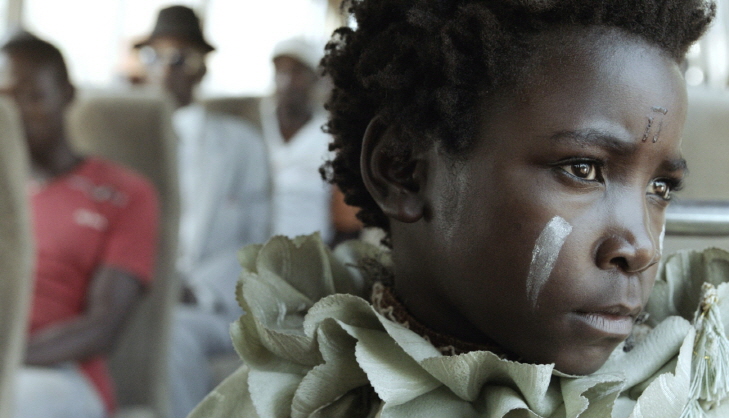
You will not easily forget Rungano Nyoni’s 2017 feature debut film “I Am Not a Witch”. Following the plight of one little girl accused of witchcraft, the movie presents a somber but powerful contemporary story about an outrageous social injustice inflicted upon many unfortunate women out there in Africa, and the result is alternatively absurd and harrowing with a little but precious touch of magic realism.
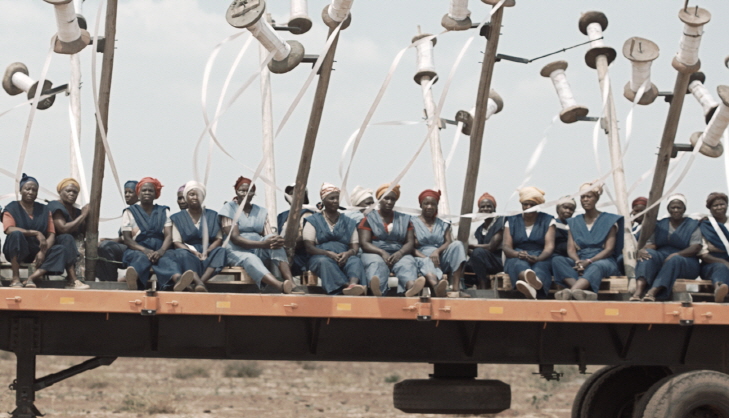
The movie, which is mainly set in a rural area located somewhere in Zambia, opens with several tourists stopping by a spot where “witches” are presented in front of them. All of the witches, who are mostly elderly women, are tied to each own large spool of white ribbon, and you may roll your eyes when the guide explains the reason to those tourists.
We are subsequently introduced to a little quiet anonymous girl who is later named Shula (Maggie Mulubwa). Just because they are disturbed by her mere presence, many people in the area come to believe that she is a witch, and she is eventually taken to a local police station. While many of them willingly accuse Shula of witchcraft, a female police officer tries to handle this situation as sensibly as possible, but a government official named Mr. Banda (Henry B.J. Phiri) soon comes, and that is followed by another absurd moment in the film.

In the end, Shula is “officially” confirmed as a witch, and then she is promptly sent to a camp belonging to the witches. She certainly does not want this at all, but she is already tied to her own spool of white ribbon, and she gradually gets accustomed to her changed circumstance. Just like the other witches, she is often forced to work on fields, and there is a darkly amusing moment when Mr. Banda eagerly announces that he gets a new big truck to carry them to the fields.
The situation becomes more absurd for Shula when Mr. Banda decides to use her more as a “government property”. At one point, she must help him on a little case of theft, and she will have to pick out the culprit from a bunch of suspects. Thanks to some advice from her fellow witches, she manages to accomplish her tricky task, and Mr. Banda is willing to use her more for his own benefit. At one point, he presents her in front of many audiences at a local TV show, and we are more saddened as observing how her thoughts and feelings are casually ignored by him and everyone else around her.
Meanwhile, we get to know a bit more about the witches as they and Shula go through their hard reality day by day. When the daughter of one of the witches drops by their camp, she is not welcomed much by her mother for a good reason, but the other witches are willing to buy what she offers to them nonetheless. In case of the wife of Mr. Banda, she turns out to be a former witch, but, not so surprisingly, she still cannot hide her social stigma as shown from one brief scene later in the story.
The story becomes a bit tense when the area and its people come to suffer a rather long dry season, but the movie takes its time as before, while looking closer into its young heroine’s inner conflict. As exploited by Mr. Banda in one way or another, Shula feels more miserable and discontented, and she naturally begins to show some defiance, but her spool of ribbon constantly reminds her of her limited status. She may cut it if she wants, but she is told that she will be turned into a goat if she ever does that, and it seems she really believes that just like the witches.

That is certainly a silly superstition for many of us, but the superstitious belief of the characters in the film feels strong to us nonetheless, and this often makes a contrast to how much the area looks modernized. Despite considerable modernization, many people in the area still stick to their longtime tradition and superstition, and so are the witches, who had no choice but to stick together as social pariahs from the beginning.
I must confess that I have no idea on how much the story actually reflects the reality in Africa, but I can tell you instead that Nyoni did a commendable job of filling the screen with vivid mood and details to be appreciated. After being inspired by several actual stories of witchcraft accusations in Zambia, she did some research as visiting a real witch camp in Ghana, and her efforts are clearly showed from the considerable realism of the film. In case of the main cast members, most of them are non-professional performers with no movie acting experience, but they give unadorned natural performance under Nyoni’s skillful direction, and Maggie Mulubwa’s earnest lead performance is supported well by several substantial supporting performers including Becky Ngoma and Becky Ngoma.
In conclusion, “I Am Not a Witch” is a modest but undeniably impressive debut work by Nyoni, who recently made her second feature film “On Becoming a Guinea Fowl” (2024). While it requires some patience due to its slow narrative pacing at first, the movie is a very rewarding experience on the whole thanks to Nyoni’s confident handling of mood and details, and I was particularly touched by how it shows some little hope coupled with an unexpected moment of magic realism during its rather ambiguous finale. In my humble opinion, this is small film is too good to be overlooked, and I assure you that it will linger on your mind for a while after it is over.


 Seongyong's Private Place