
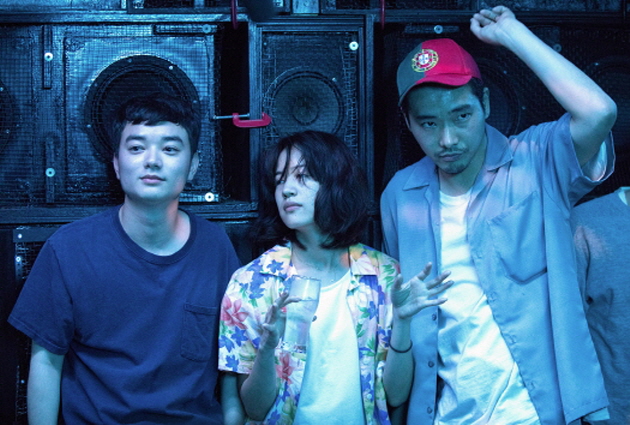
Shô Miyake’s 2018 film “And Your Bird Can Sing”, which happened to be released in South Korean theaters several days ago, seems to be merely following the aimless daily life of its three young protagonists, but it turns out to be more than that. As these three main characters interact more with each other along the story, we come to sense more of the genuine melancholy behind all those youthful moments among them, and this compensates for the rather superficial plot and characters of the film to some degree.
At first, we are introduced to a nameless young man, who is simply named “Me” (Tasuku Emoto) in the end credits. “Me” works as a part-time employee at a local bookstore in his neighborhood, but he is not exactly someone to be chosen as the employee of the month, and we see him going through another drinking night along with his friend/roommate Shizuo (Shôta Sometani) instead of doing some work at that local bookstore.
In case of Shizuo, he is no better than his roommate. He has depended on unemployment benefits for some time, but he is not particularly interested in getting employed, and the only trouble in his daily life is his problematic mother, who usually comes to spend some time with him whenever she is not with his older brother. As he simply listens to whatever she babbles about, it is quite apparent to us that there is some distance between Shizuo and his mother, though both of them are not so willing to recognize that.
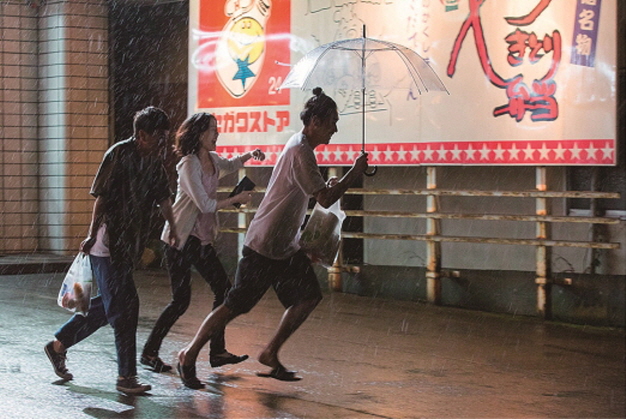
Meanwhile, there is some little change in the daily life of “Me”. After letting down a young woman also working in his workplace, he subsequently gets himself involved with Sachiko (Shizuka Ishibashi), another young woman in his workplace. Although it later turns out that Sachiko has been actually in a relationship with their boss, “Me” does not mind that a lot, and Sachiko is willing to get more involved with him just because, well, she can always have some fun time with him besides sex.
Needless to say, it does not take much time for Shizuo to discover what is going on between his roommate and Sachiko, but he lets her spend more time at his and his roommate’s apartment, and we accordingly get something not so far from François Truffaut’s “Jules and Jim” (1962). Just like the three young main characters of “Jules and Jim”, Sachiko, Shizuo, and his roommate come to enjoy each other’s company as spending more time together, and the movie gives us a series of spirited moments as these three main characters casually throw themselves into more fun and excitement.
Needless to say, all of them want their fun time to last as long as long possible, but there always comes another day – along with the reality they have to face in one way or another. While Sachiko must decide where her heart really lies, “Me” comes to realize that he does care much more than his constant laid-back attitude suggests, and Shizuo also becomes a bit more serious about his life after one unexpected incident involved with his mother.
However, Miyake’s screenplay, which is based on the novel of the same name by Yasushi Satô, often spins its wheel in case of plot and character development. As the movie sticks to its calm and distant storytelling approach, we never get to know enough about its main characters even in the end, and that is the main reason why a few dramatic turns later in the film are not as impactful as intended. For instance, the last shot of the film could be more effective if the movie delved more into its main characters’ feelings and thoughts before that narrative point.
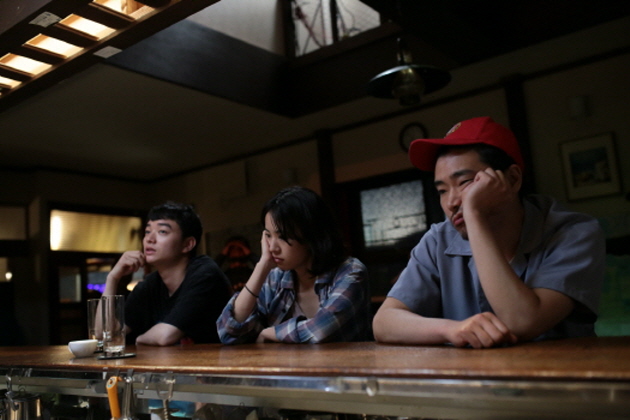
At least, there are some strong points to be admired and appreciated. Miyake, who also did the editing of the film, and his cinematographer Hidetoshi Shinomiya did a competent job of capturing the daily atmosphere surrounding the main characters of the film, and you will observe Miyake’s considerable potential as a burgeoning filmmaker. After this film and “Wild Tour” (2019), he advanced further as making “Small, Slow But Steady” (2022) and “All the Long Nights” (2024), and he is now regarded as another new exciting Japanese filmmaker to watch.
Miyake also draws the good natural performances from his three principal performers. While Tasuku Emoto brings some likable human qualities to his rather elusive character, Shizuka Ishibashi imbues her character with enough warmth and spirit, and Shôta Sometani holds his own place well between his two co-stars despite his relatively under-developed character.
In conclusion, “And Your Bird Can Sing” is one of the minor works in Miyake’s filmmaking career, but it is not wholly without interesting stuffs to observe at least. To be frank with you, many of Miyake’s works are an acquired taste for me, but I still admire how effortlessly they bring a considerable amount of realism onto the screen, and “And Your Bird Can Sing” is no exception. Yes, I often felt impatient and distant to its story and characters, but I also got the glimpses of Miyake’s undeniable filmmaking talent, and now I see more of how much he has steadily advanced since he made his feature film debut with “Playback” (2012). Is he really going to be as widely known as, say, Hirokazu Kore-eda or Ryusuke Hamaguchi? We will see, folks.


 Seongyong's Private Place