
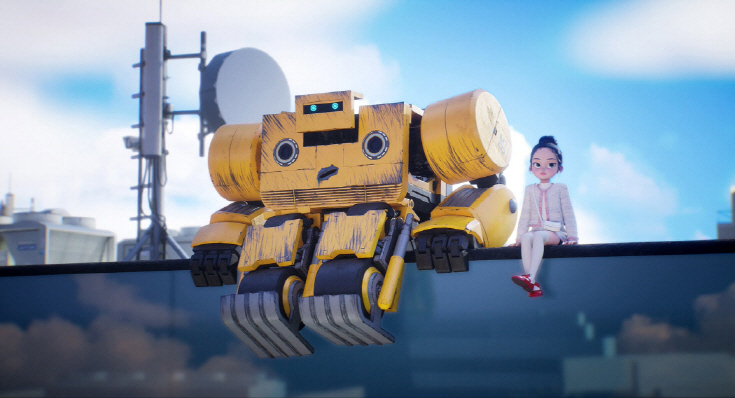
If it had come out around, say, 20 years ago, I might have been more generous to South Korean animation feature film “Mr. Robot”, which should not be confused with that popular American TV drama series of the same name. As watching it early in the morning at a local theater, my mind instantly compared the film to a bunch of similar works ranging from “Real Steel” (2011) to “The Wild Robot” (2024), and I was a bit dissatisfied mainly because the film is no more than an assembly of numerous familiar genre stuffs.
Set in a futuristic version of Seoul, the story quickly establishes its background via its opening action scene. When a robot suddenly becomes quite dangerous due to some malfunction problem, a special police squad is quickly dispatched to take care of this serious situation, and we soon meet its leader Tae-pyeong (voiced by Park Sung-young), who deftly and swiftly gets things under control once he and his squad members spot and then corner that malfunctioned robot.
Meanwhile, we are also introduced to Nana (voiced by Kim Yeon-woo), a young girl who has felt quite lonely and discontented mainly due to the constant absence of her parents. While her scientist father is usually busy with the ongoing research at his big robot company, her mother is mostly occupied with handling her own big business day by day, and Nana is quite disappointed for having to spend her birthday alone by herself again as only surrounded by her servant robots.

On that day, Nana’s father is going to present the prototype of the latest robot model from his company, but something quite unexpected occurs not long after that prototype robot is presented in front of him and others. The robot suddenly begins to target him for no apparent reason, and Tae-pyeong, who happens to be there with his several squad members just in case, instantly tries to stop it, but he only gets himself seriously injured before it was finally stopped.
Tae-pyeong’s unconscious body is taken to a hospital, but another unexpected thing happens. When he wakes up some time later, he is surprised to discover that his consciousness was somehow transferred to that prototype robot during that incident, and then he gets himself involved with Nana, whom he happens to save when she is in a serious danger due to a villainous figure responsible for her father’s death at that time. While still confused about his current status, Tae-pyeong instantly decides to run away along with Nana, and they are immediately pursued by not only that villain but also Tae-pyeong’s colleagues.
While staying at Tae-pyeong’s little apartment for a while, Tae-yeong and Nana get to know each other bit by bit. While treating Tae-yeong like any other robot in her possession, Nana comes to sense something special about him, and Tae-yeong becomes more protective of her because, well, she reminds him of his lost daughter as reflected by the occasional flashback scenes. As continuing to run away together, they depend and care about each other more than before, and there is a sweet little scene when they come to have a sort of father and daughter moment.
Of course, things eventually become more serious and melodramatic later in the story, and the film naturally pours plenty of action upon the screen. Although our robot hero looks rather simple and blunt on the surface, he is equipped with numerous different tools and gadgets inside his metallic appearance, and these tools and gadgets surely come handy during a number of action scenes in the film. In case of that villain, this nefarious figure has a big factory where hundreds of robots can be easily produced within a short time, and his robots, including a lethal female robot clearly borrowed from “Blade Runner 2049” (2017), are certainly ready to strike upon our robot hero at any time.

The overall result in the film is fairly competent on the whole, but I could not help but notice some deficiency in its technical aspects. For instance, the digital animation of the film sometimes feels too flat and bland, and the human figures in the film actually look more robotic than various robot figures in the film. As a matter of fact, this further emphasizes the superficial characterization of many of the human figures in the story, and I must point out that Tae-pyeong is relatively more expressive as a robot compared to when he was just a stiff human character early in the story.
At least, I cared about the unlikely relationship between Tae-pyeong and Nana along the story. As your average plucky little girl, Nana surely brings some spirit and charm to the film besides being more than a mere damsel in distress, and her bouncy personality is complemented well by the unflappable attitude of our robot hero, which looks gradually softened somehow as he shows her more of his human side.
In conclusion, “Mr. Robot”, directed by Lee Dae-hee (He previously made “Swimming to Sea” (2012), by the way), does not surpass its source of inspiration that much, and it feels instead like a modest test run for whatever may be achieved by the people behind it. Considering not only its relatively small production budget but also how rare it has been for me and many other South Korean audiences to watch a local animation film at theater for many years, the film does deserve some attention, but I still think it could be more creative and imaginative, and I sincerely hope that Lee will entertain me more in the next time.


 Seongyong's Private Place