
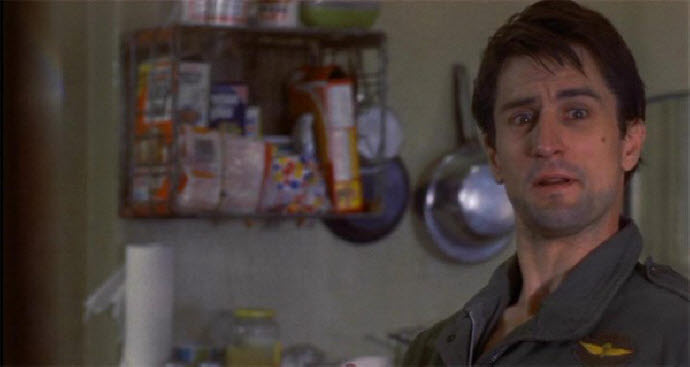
Even after almost 50 years since it came out, Martin Scorsese’s 1976 film “Taxi Driver” still has the power to disturb and fascinate us. Here is a dark but undeniably compelling character study focusing on one very disturbed man and his festering evil, and you will be alternatively interested and alarmed as observing his descent into madness and violence along the story.
Needless to say, Travis Bickle (Robert De Niro) has been one of the most famous anti-hero figures in the movie history, but I noticed again how little the movie shows or tells about his past. At the beginning, we are told that he is an ex-marine who once served in the Vietnam War, but that is all we can know about his past. In fact, he does not seem to have anyone beyond his solitary life in the middle of New York City, though he writes a letter to his parents at one point later in the story.
Nonetheless, Travis comes to us as a vivid human figure to observe as Scorsese and his screenplay writer Paul Schrader skillfully and meticulously illustrate Travis’ aching loneliness and growing anger toward the society. As Schrader’s screenplay adds more detail to its hero’s life and personality, Scorsese and his crew members including cinematographer Michael Chapman palpably capture the urban atmosphere of New York City on the screen, and the frequent nightmarish qualities of the nocturnal scenes in the film give us more understanding on Travis’ increasingly unhinged state of mind, which is full of anxiety and anger fueled by all those seedy sights and figures on the streets and alleys of the city.
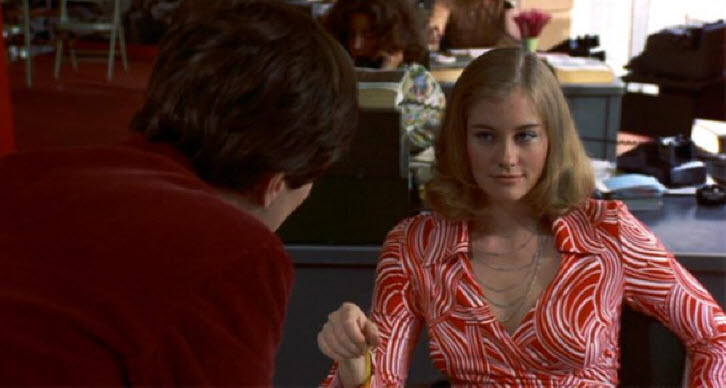
As he drives here and there around the city, Travis feels more isolated and lonelier than before, and he surely feels the need of any kind of human connection, but we observe again and again how clumsy and awkward he is in interacting with others around him – especially women. During one early scene, he tries to approach closer to a clerk working in a local pornography theater, but he only ends up alarming her. In case of Betsy (Cybill Shepherd, who is as alluring as she was in Peter Bogdanovich’s “The Last Picture Show” (1971)), a young beautiful woman working in the ongoing political campaign of a well-known senator, she seems interested when he finally approaches to her after watching her from the distance for a while, but she promptly rejects him without any hesitation when he unwisely takes her to one of his frequent pornography theaters. When he tries to approach to her again on the phone, a sense of rejection is so painful that even the camera soon moves away from him instead of watching him to the end.
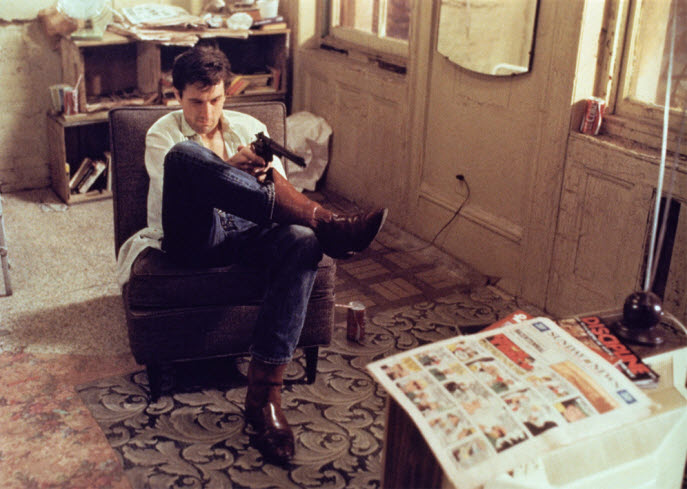
What follows next is a textbook case of incel male violence. Getting angrier and moodier due to being rejected by Betsy, Travis becomes gradually obsessed with that senator she works for, and we soon see him buying several guns and then preparing for his spiteful assassination attempt step by step. However, he is still lonely and miserable as before, and that is quite evident from that iconic moment which has been imitated by many people including Robert De Niro himself (Remember “The Adventures of Rocky and Bullwinkle” (2000), folks?). “You talking to me?”, he keeps saying to himself in the mirror, and then that is followed by the one of the most revealing lines in the film: “I’m the only one here.”.
Meanwhile, Travis gets involved with another female figure who happens to be on his way. She is an underage prostitute named Iris (Jodie Foster in one of her first major roles), and Travis immediately feels the need to save her from those horrible people exploiting her, but, just like Betsy, Iris does not feel any particular need to be saved by him. This ironic situation between them is certainly reminiscent of John Ford’s classic film “The Searcher” (1956), where John Wayne’s hero character struggles to extract his kidnapped niece from a Native American tribe but she does not want that at all.
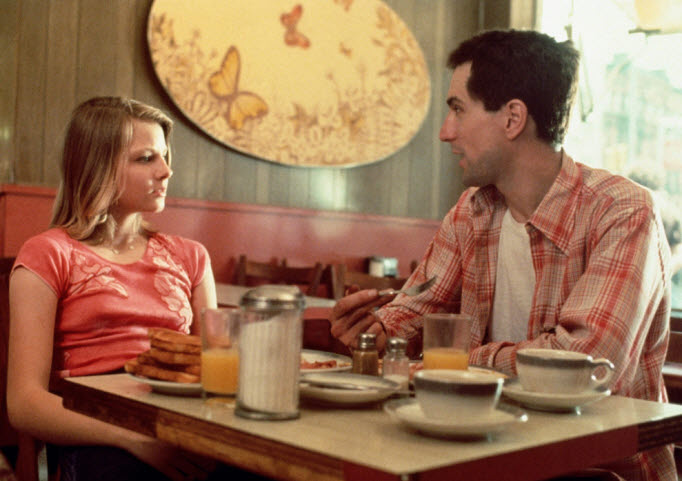
The movie becomes all the more disturbing for us as Travis is about to go beyond the point of no return, but Scorsese’s confident direction holds our attention to the end while never losing the control over the story and characters. After what inevitably happens due to Travis’ exploding madness, the camera phlegmatically and chillingly looks over the aftermath, and that is further accentuated by the broodingly dramatic score by Bernard Herrmann, a legendary film music composer who incidentally died shortly after finishing the recording of his score.
In the end, the movie arrives at the ambiguous ending which may actually be no more than the delusion of Travis’ disturbed mind, and De Niro’s unforgettable performance, which deservedly received an Oscar nomination, adds a small but significant touch to that. Yes, Travis seems to find some inner peace at last, but you may also wonder how long it will last, and De Niro subtly conveys to us another possibility of madness via a brief but disconcerting facial expression. (While watching the rough cut of the film, Herrmann correctly observed this: “You know, he’ll do it again.”).
On the whole, “Taxi Driver”, which happens to be re-released in South Korea yesterday, is one of the best works in Scorsese’s long and illustrious career, but we all also know that it is also something to handle with considerable caution. As shown from the assassination attempt on President Ronald Reagan in 1981, it has inadvertently influenced too many incel dudes like Travis out there, and even Scorsese’s subsequent work “The King of Comedy” (1983), which is sort of the comically straight-jacketed version of “Taxi Driver”, could not stop this at all (Just look at the disagreeable commercial success of Todd Philips’ “Joker” (2019), a hollow and toxic piece of work which shamelessly copies both films in many aspects). Despite all these troubles, “Taxi Driver” survives nonetheless, and I am sure it will certainly continue to intrigue and unnerve us as before.


 Seongyong's Private Place