

I must confess that I scratched my head more than once when I watched Katsuhiro Otomo’s 1988 animation feature film “Akira” for the first time in 2010, which happens to be released in South Korean theaters yesterday. Yes, this is one of the most visually striking animation films I have ever seen, and my eyes were thoroughly dazzled to say the least, but my mind kept wondering what is exactly happening in the story.
Maybe that is because the film attempts a bit too much as trying to do a lot of things from Otomo’s classic manga series of the same name. Or, as my critic friend Michael Mirasol told me a few days ago, chaos and confusion are the whole point of the story, where its two lead characters keep struggling to understand what the hell is going on around them along the plot. Regardless of which explanation is correct, I chose to embrace its overwhelming visual qualities as watching it at a Dolby screening room this time, and I am glad that I watched it in this way.
The story is set in New Tokyo, 2019, a futuristic city which was built after the former one was destroyed by one sudden massive disaster which started World War III in 1988. As watching all those towering skyscrapers in this dystopian background, you will be definitely reminded of not only Fritz Lang’s “Metropolis” (1927) but also Ridley Scott’s “Blade Runner” (1982), which incidentally came out in the same year when Otomo’s manga series did.
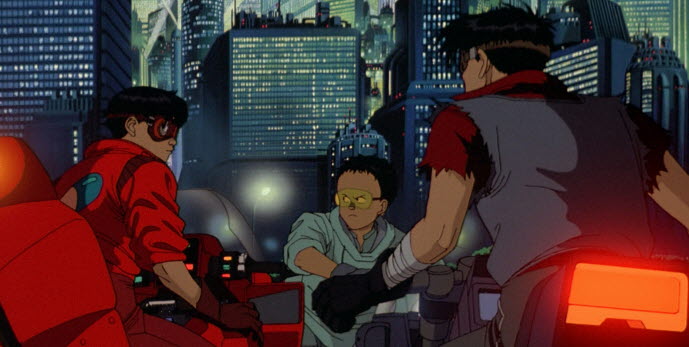
At the beginning of the film, we are quickly introduced to the two lead characters of the story: Shōtarō Kaneda (voiced by Mitsuo Iwata) and his best friend Tetsuo Shima (voiced by Nozomu Sasaki). They are the members of one of the local biker gangs in the city, and we soon get the intensely exhilarating action sequence where they and their fellow gang members clash with their main rival group.
Mainly because he wants to show that he does not need Kaneda’s protection at all, Tetsuo is quite determined to show more of his skill and guts, but then something unexpected happens. He has an accident when suddenly coming across an odd little figure who looks like an extremely aged boy, and, what do you know, he is soon taken along with that odd figure to somewhere by a bunch of soldiers under the command of Colonel Shikishima (voiced by Tarō Ishida).
While Kaneda is subsequently trying to find where his friend is, the plot thickens with more figures entering the picture. We meet two other strange figures who also look as aged as that odd figure. We get to know more about what Colonel Shikishima and other bureaucrats have been trying to hide behind their back. We see what he and his men do to Tetsuo, who becomes a new subject for their top-secret scientific experiment involved with the titular figure in the story. And we also watch the city being thrown into more chaos and violence as its citizens are more frustrated and furious about the incompetence of their city government.
In the midst of this chaotic circumstance, Kaneda encounters a young woman named Kei (voiced by Mami Koyama), who turns out to be involved with a sort of resistance group in the city. It seems that she and her colleagues try to stop what Colonel Shikishima and his men are attempting to do, and Kaneda eventually gets himself more into their situation because 1) he needs some help from them for finding Tetsuo and 2) he somehow got smitten with Kei right from their first encounter.
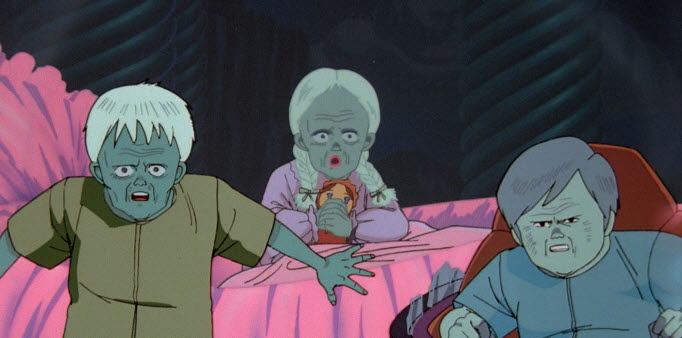
Around that narrative point, your mind may feel like being a bit overtaxed by all these and many other things in the story, but the film keeps things rolling via a number of unforgettable images to overwhelm and then haunt you for a long time. As he somehow gains a superpower way beyond his knowledge and control due to that scientific experiment, Tetsuo’s mind becomes more volatile and reckless step by step, and there is a nightmarish moment when his mind gets quite disturbed by the equally considerable psychic power of those three little odd figures, who turn out to have a poignant personal story later in the film.
In the end, everything expectedly culminates to the epic showdown between Tetsuo and Kaneda, who becomes quite determined to stop Tetsuo by any means necessary as his immense but uncontrollable power causes a lot of destruction in the city (I have to warn you that the depiction of violence in the film is quite brutal, bloody, and gruesome, by the way). Although things get quite frantic with a lot of bangs and crashes across the screen, Otomo and his crew never lose their focus on style and detail as well as story and character, and you may not mind at all even when their efforts go way over the top without any restraint.
On the whole, “Akira” will sometimes baffle you due to its rather murky and complicated plot which leaves a lot of things left unresolved and unexplained, but you will be impressed by its undeniable visual power, which has steadily influenced a lot of subsequent works such as Alex Proyas’ underrated SF masterwork “Dark City” (1998). Despite some glaring dated aspects (Its two substantial female characters feel flat and perfunctory, for example), the film is still capable of intriguing and then thrilling us even at this point, and I certainly admire it more than before.


 Seongyong's Private Place