
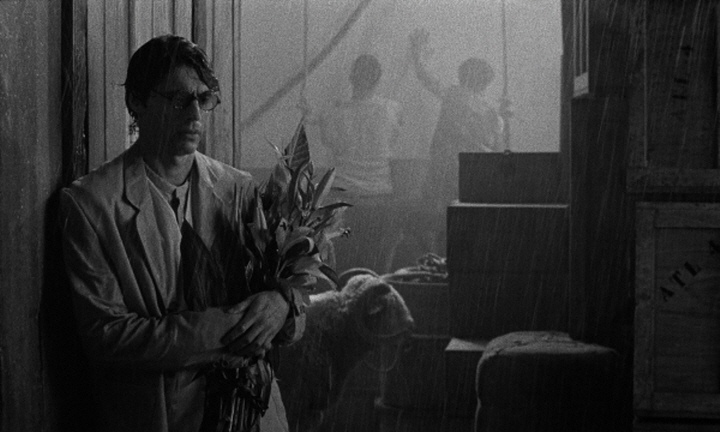
Portuguese filmmaker Miguel Gomes’ latest film “Grand Tour”, which was selected as Portugal’s submission to Best International Film Oscar in last year, a baffling but interesting work with some artistic touches to admire and appreciate. While you may occasionally scratch your head as wondering what it is actually about, it is often intriguing to observe its unconventional mix of past and present along with a number of various languages, and I observed this odd concoction with enough interest despite getting impatient from time to time.
At first, the movie, which is loosely based on the W. Somerset Maugham’s “The Gentleman in the Parlour: A Record of a Journey from Rangoon to Haiphong”, seems to be about Edward (Gonçalo Waddington), a young British lad working as a civil servant in Myanmar under British colonial rule, 1918. In the beginning, he is waiting for the arrival of his fiancée Molly (Crista Alfaiate) at the port in Rangoon, but then he becomes afraid of marrying her, so he impulsively decides to leave for Singapore right before her arrival.
Edward simply expects Molly to go back to London, but, alas, his trouble does not get solved that easily. Once he arrives in Singapore, he comes across a cousin of hers, and then he is notified that she will also come to Singapore soon. Becoming more desperate than ever, he quickly gets on a train going to Bangkok, Thailand, but then the train gets unexpectedly derailed in the middle of its route to Bangkok, and he soon finds himself depending on a local guide accompanied with his three wives.
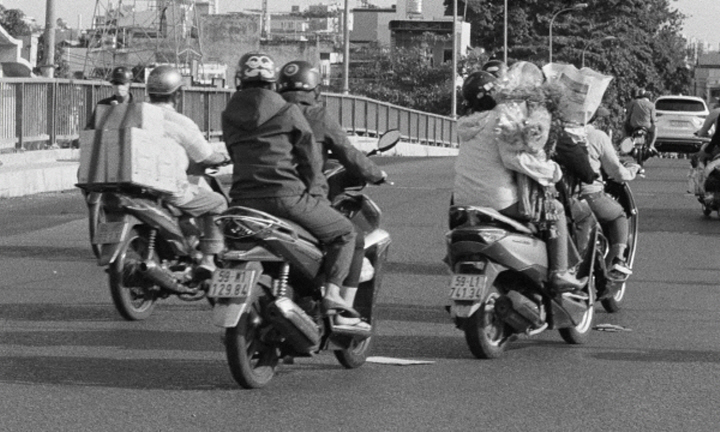
Around that point, we begin to sense that the movie is more about mood and details than story and characters. At one point in the middle of the story, we see a smartphone, and that is just another example showing how the movie freely and fluidly moves from back and forth between past and present. As Edward moves from one Eastern Asian city to another, the movie usually shows the montage of many different sights observed from these cities in our time, and the narration, which is delivered in several different languages according to the locations, phlegmatically describes whatever Edward does and experiences during his increasingly complicated tour across Eastern Asia.
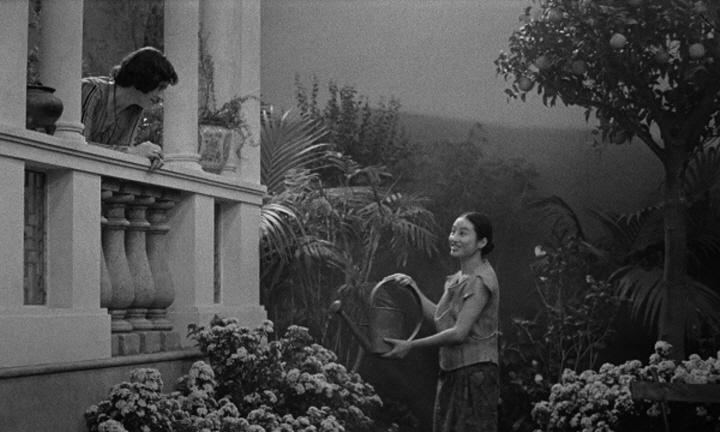
This strange juxtaposition between past and present in the film surely baffles us from the very beginning, but it is also somehow amusing for the surreal qualities generated from this offbeat narrative approach. As the past and the present continue to swirl around each other, the movie becomes more reflective on the gap and connection between its two different parts, and it also provides a number of gorgeous visual moments provided by cinematographers Gui Liang, Sayombhu Mukdeeprom, and Rui Poças. Curiously, many scenes in the movie are shot in black and white film, but its “dream” parts are shot in color film in contrast, and this certainly contributes extra surrealism to the overall result.
Around the narrative point where our hero eventually ends up being somewhere in China, the movie shifts its focus to his fiancée, who is not daunted at all even after she arrives in Singapore and then finds that Edward already left for Bangkok. Molly continues to follow his trail, but then she discovers that she is much more physically fragile than she thought, when she comes to receive a bit of hospitality from some rich dude smitten with her.
Without hurrying itself at all, the movie steadily rolls toward its eventual destination, and we keep getting more of what has been gorgeously presented across the screen, though it continues to disorient us as before. During one particular scene around the end of the film, the movie deliberately shows the artificial aspect of this scene, and this will make you muse more on how the movie is about instead of what it is about.
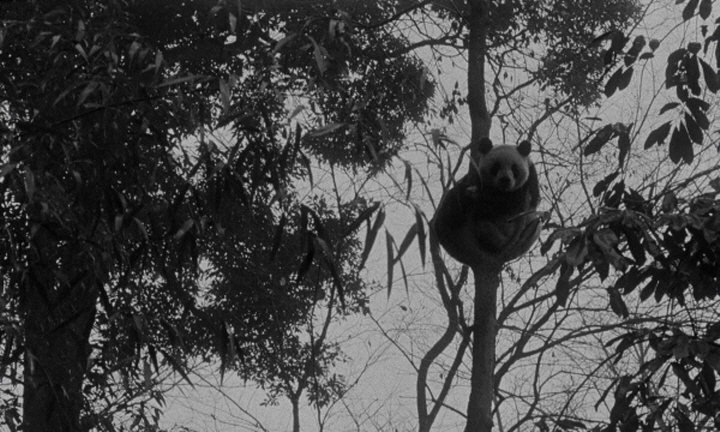
I must confess that I am still trying to process and understand the film, but I also find it fascinating for its indelible atmosphere and detail, and I can only enumerate what lingered on my mind for a long time after the movie was over. I remember a striking scene where two very different moments overlap with each other for no apparent reason but generate an interesting dramatic effect on us. I remember a sublime moment where the relentless flow of urban traffic is accompanied with that famous classic waltz piece by Johann Strauss II. And I also remember an uncannily ethereal shot which simply looks at a foggy mountain forest for a while.
Because I have not watched many of his works including “Tabu” (2012) and “Arabian Nights” (2015) yet, I cannot say whether the movie is one of the better works in Gomes’ career, but I admire his confident handling of mood and details on the whole. Yes, I did feel frustrated or impatient at times during my viewing, but I also sensed the clear artistic vision inside the film, which continued to hold my attention to the end.
In conclusion, “Grand Tour”, which received the Best Director award when it was premiered at the Cannes Film Festival early in last year, is not definitely something you can casually watch for fun and entertainment, but I recommend it especially if you are really looking for something different and challenging. Although I still have some reservation, it is an interesting experience nonetheless, and I think you should try it someday.


 Seongyong's Private Place
Pingback: 10 movies of 2025 – and more: Part 2 | Seongyong's Private Place