

There are several factors preventing me from being really entertained by South Korean film “The Match”. While it did a fairly good job of presenting a series of intense Go matches on the screen, the movie feels rather unbalanced as often focusing more on one of the two Go players at the center of the story, and this glaring imbalance is further accentuated by how its trailer and promotion have put much emphasis only on one of its two lead performers for a big reason to be discussed later.
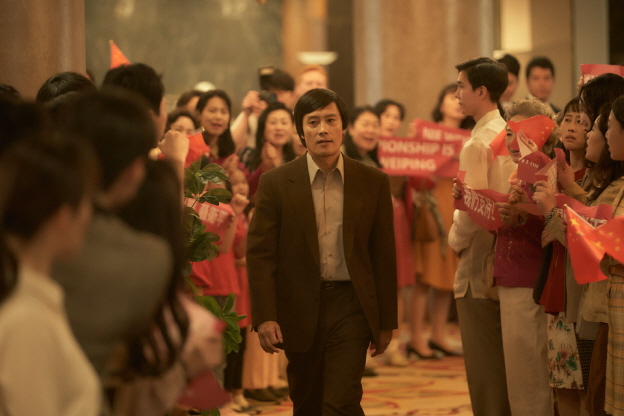
The two real-life figures at the center of the story are Cho Hun-hyun (Lee Byung-hun) and his pupil Lee Chang-ho (Yoo Ah-in), both of whom have been known well for many years as two of the best Go players in not only South Korean but also the international field. The early part of the movie, which is set in the 1980s, begins with how Cho became the world champion after a big match in Singapore, and then we see him being celebrated by many of his countrymen as a national hero while also being regarded as an ultimate opponent to be defeated someday.
On one day, Cho comes across Lee, who is played by young performer Kim Kang-hoon at this point. Although he is quite young to say the least, Lee already shows considerable potential as a future Go player, and Cho becomes more interested when Lee later solves a little but challenging Go problem from him. Nurturing Lee’s talent looks like another exciting challenge given to him, so Cho eventually takes Lee under his wing, and we soon see Lee becoming a member of Cho and his wife’s little domestic life.
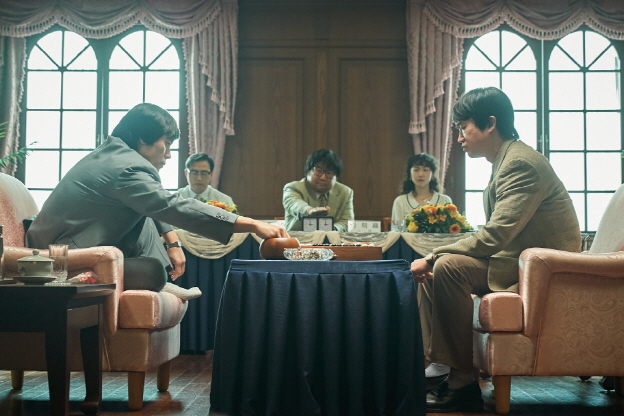
After next several years of study and training, Lee, who is now played by Yoo Ah-in, impresses his mentor more and more, and his mentor decides that it is really the time for Lee to go out for himself for the first time. At first, Lee seems quite underachieving, but he gradually establishes his own methods and strategies for playing Go, and Cho naturally becomes prouder of his pupil as Lee rises further in his own way.
It is not much of a spoiler to tell you that Cho subsequently finds himself in a rather tricky situation as his pupil advances much faster than expected. During one national tournament, Lee swiftly defeats one opponent after another, and, what do you know, he inevitably confronts his mentor in the final match. While firmly encouraging his pupil that he should always do his best regardless of whoever will be his opponent, Cho cannot help but become more aware of the growing possibility of losing his No.1 position, and so are many others around them.
The second half of the movie are driven mainly by a series of big matches between Cho and Lee, and the screenplay by director Kim Hyung-ho and his co-writer Yoon Jong-bin deftly handles many details observed from these matches. To be frank with you, I do not know that much about how to play Go, but the movie kept me engaged nonetheless as diligently doling out enough amount of necessary information and detail for understanding whatever is being exchanged between Lee and Cho on the screen, and that is a commendable thing in my inconsequential opinion.
However, the movie is also hampered by the narrative imbalance between its two main characters. As focusing more on Cho’s inner conflict caused by his matches with Lee, the movie fails to delve more into Lee instead, and Lee consequently becomes too bland and colorless to hold our attention. Sure, he is supposed to feel conflicted a lot between his own ambition and his deep admiration toward his mentor, but he only ends up remaining a merely blank counterpart to Cho, and that is the main reason why the movie loses some of its narrative momentum during its last 30 minutes.

Is this the fault of Yoo, who has incidentally been one of the most overrated South Korean actors to me and many others? As far as I can see, his earnest efforts here in this film do not sink the whole movie, but I must point out that Yoo’s blandly low-key acting is overshadowed by the more spirited performance from Kim, who looks promising considering that he does more than holding his own small place well in front of Lee Byung-hun during the early part of the film.
In addition, there has been a big promotion problem which has riddled the movie during last several years. The movie was supposed to be released by Netflix two years ago, but it was quickly shelved after Yoo’s big public scandal involved with not only drug abuse but also some allegation on same-sex sexual assault. The movie was finally released in South Korean theaters a few days ago, but I and many other South Korean audiences could not help but notice the unmistakable absence of Yoo in its trailer and promotional posters, all of which only emphasize his co-star again and again throughout last several weeks.
Lee, who also had a fair share of public scandal around 10 years ago, handles his part fairly well, and so are several other cast members including Ko Chang-seok, Hyun Bong-sik, Jo Woo-in, Jeon Moo-song, and Jeong Suk-yong. As the sole substantial female character in the film, Moon Jeong-hee manages to overcome her rather thankless role, and she is particularly good when her character sharply reminds Cho of what is more important for him later in the story.
In conclusion, “The Match” is often problematic for a number of reasons inside and outside it despite some entertaining elements. Mainly because my mind was frequently distracted because of what I pointed out in this review, I give it 2.5 stars, but I will not stop you at all if you just simply want to enjoy the movie itself as an audience, and let’s discuss later more about that lasting question on whether we can really separate art from artist.


 Seongyong's Private Place
The first critic is such a judgemental prick. It’s so obvious you have a problem with Yoo Ah In. This is why nobody takes movie critics seriously anymore. Go watch the movie guys, you will love it. Period
SC: I do have a problem, and I frankly admit that here, sir.
ALL I CAN SAY IS IT WAS WORTH IT. I didnt feel the two hours. Whatever controversies surrounding their personal life has nothing to do with the movie. you might find it slow-paced but for me every second was necessary to build the depth of every scene. When the student won against his mentor but couldn’t celebrate his victory. I don’t want to spoil it. Again, it was a movie I’d sit and watch again.
SC: I am glad you enjoyed it more than me.
I have no idea how to play baduk, but this film kept me locked to the screen. The acting is fantastic – showing emotions without grand gestures. The cinematography and directing is fascinating; it captured the feel of the eighties and early nineties, the smoky atmosphere and subdued colours of the era. The only disturbing thing was LBH’s eighties’ hairstyle in the beginning of the movie 🤣, but that was the fashion of that era. Going to watch it again tonight.
SC: It is a well-made film which could do better in my trivial opinion.
Assistimos a um duas brilhantes interpretações. Caracterizadas a ponto de serem confundidos com os personagens reais.
No primeiro momento o professor ensinando humildade e respeito ao oponente. Qualquer um que jogou algum tipo de esporte sabe como a soberba do vencedor é humilhante.
Em um segundo momento vemos um professor profundamente desestruturado por não estar preparado para ser superado pelo aluno.
Mesmo sem entender do jogo, nos foi explicado que ele criou uma forma diferente de enxergar um jogo milenar. Ou seja mudou o que parecia imutável.
SC: Thanks for leaving a comment.