

Movies about writers and ideas are not usually something really engaging or compelling to watch, but Ava DuVernay’s latest film “Origin” is one of those rare exceptions. In addition to being a touching human drama to observe, the movie also works as the fascinating sociological presentation on caste and its toxic effect on the humanity, and its humanist ideas are certainly all the more relevant considering how our global world has been thrown into the dark bottom of apathy and cruelty these days.
The movie, which is based on Isabel Wilkerson’s acclaimed book “Caste: The Origins of Our Discontent”, follows how Wilkerson (Aunjanue Ellis-Taylor) came to write the book around the late 2010s. When the killing of Trayvon Martin happens in 2012, Wilkerson is approached by an old colleague of hers, who suggests that, as a prominent African American writer, she should write about the complex racial issues surrounding that tragic incident. Although she is not so willing to do that mainly because she wants to have some rest after writing her first book which incidentally won a Pulitzer Prize, Wilkerson cannot help but become quite disturbed when she later listens to a piece of recording associated with the incident.
Meanwhile, Wilkerson tries her best in taking care of her aging mother along with her white husband, but then there come a couple of devastating personal incidents which turn her life upside down. Despite still struggling with her immense loss and grief, Wilkerson embarks on her next book project, which is going to find and explore a common theme among Nazi Germany, the American Slavery, and the Indian caste system.
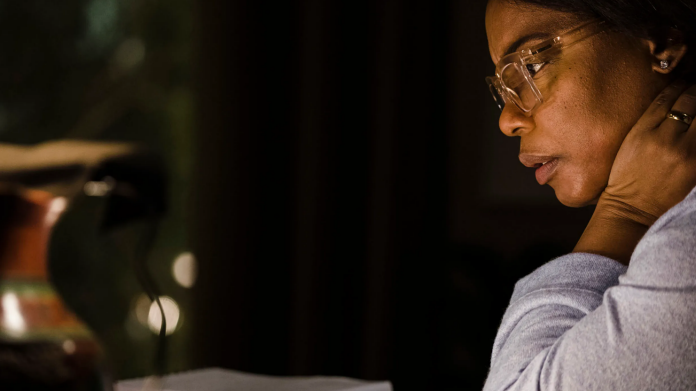
Now it will probably sound rather boring to some of you, but the movie gives us a series of interesting human moments as Wilkerson delves more into the main subjects of her book project. In Germany, she does some extensive research on how Nazi Germany systemically oppressed many Jewish people in the country during the 1930s, and there is a rather amusing moment when a German friend of hers insists that the Holocaust is quite different from the American Slavery even though both of them are basically driven by racism.
Meanwhile, Wilkerson comes upon a revealing moment when she reads a piece of record which inarguably proves a surprising connection between Nazi Germany and the American Slavery. According to that record, those racist policies of the Nazi Germany were actually inspired a lot by how the American society discriminated and oppressed its African American citizens in one way or another, and that makes Wilkerson more convinced that her research process is going on the right way.
For making Wilkerson’s intellectual journey of discovery more palpable to us, the movie sometimes directly shows us several real-life stories she encounters during her research. In case of a real-life African American couple, they came to Nazi Germany around the early 1930s simply for doing some academic research, but they came to witness more of the racism and fascism growing inside the country day by day. When they subsequently returned to America and then did a rather risky academic research on the Southern American society along with a white Academic couple, they faced a racial caste system not so far from what they saw from Nazi Germany, and they and their white partners eventually wrote an influential book based on their joint research.
While the American slavery still exerts its virulent influence over the American society via its lasting caste system, the movie observes along with Wilkerson that caste system and its resulting discrimination and oppression have actually been pretty common around the world. When Wilkerson later visits India for meeting a prominent Indian intellectual, she get to know more about how those people at the bottom of the last caste system in the country have frequently been discriminated and disregarded throughout their whole life, and there is some bitter irony in how one of the founding fathers of India was actually a member of the lowest group in the Indian caste system.

Steadily making a number of strong points on racism and caste, the movie also focuses on a number of intimate human moments observed between Wilkerson and several others around her. We get to know a bit more about the strong marital bond between Wilkerson and her husband, and we are touched as observing how Wilkerson gets some emotional support from a close cousin of hers who has been like a sister to her. When some other cousin of hers reminisces about her first experience of racism later in the story, Wilkerson listens to her cousin’s painful story with empathy and compassion, and that is one of the most poignant moments in the story.
As the human center of the story, Aunjanue Ellis-Taylor, who has been more prominent thanks to her recent Oscar-nominated supporting turn in “King Richard” (2021), gives another stellar performance to remember, and she is constantly engaging as her character becomes more passionate about her book project along the story. She is also surrounded by a bunch of good performers including Jon Bernthal, Niecy Nash, Emily Yancy, Finn Wittrock, Vera Farmiga, Audra McDonald, Connie Nielsen, Blair Underwood, and Nick Offerman, and each of them have each own moment to shine around her.
Overall, “Origin” is another excellent work from DuVernay, who steadily advanced since her first feature film “I Will Follow” (2010). Besides being quite enlightening in many aspects, the movie also comes to us as a powerful drama just like DuVernay’s previous film “Selma” (2014), and it will certainly leave you something to muse on after it is over. In short, this is one of the most thoughtful and intelligent films I have ever watched during last several years, and I think you should check it out as soon as possible.



 Seongyong's Private Place