
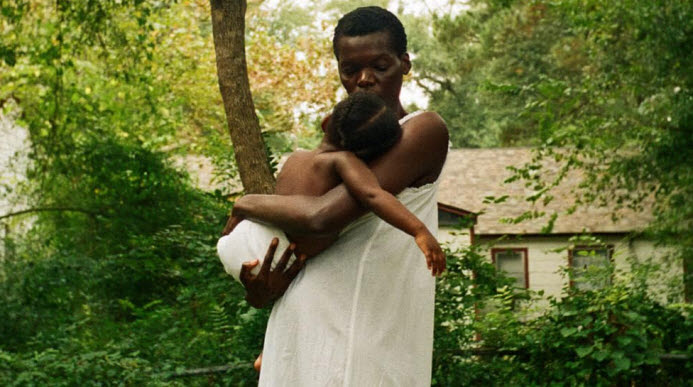
“All Dirt Roads Taste of Salt” requires you to take your time for reflecting more on its many individual moments to be savored and cherished. Yes, this is surely one of those “slow movies” demanding some patience from you, and you may struggle a bit at first as trying to understand what and how it is about. Nonetheless, you may eventually find yourself immersed in a seemingly random but ultimately absorbing stream of personal memories, and you will probably admire its little artistic achievement.
The backbone of the non-linear narrative flow in the film is the life of one plain African American woman living somewhere in a rural region of Mississippi. Her name is Mack (Charleen McClure), and the movie begins with a piece of her childhood memory associated with her parents. As her parents teach her a bit on how to catch and handle fish in the river of their neighborhood, the camera lingers on small details here and there on the screen, and we become more attuned to whatever is being observed and remembered by young Mack (Kaylee Nicole Johnson).
As the movie freely moves from one personal memory to another in a non-chronological way, we gradually gather the outline of Mack’s life story bit by bit. We see young Mack hanging around with one of those neighborhood boys, and then we later observe how they became more than friends when they were about to enter adulthood – and how what happened next between them led to a heartbreaking moment between them for a rather unspecified reason. We also see how close young Mack and her younger sister Josie (Jayah Henry) were to their mother, and we come to learn more of how much both of these young girls were devastated by their mother’s death.

Curiously, the movie does not give a lot of specific details on how these and many other things happened in Mack’s life. While the cause of her mother’s death remains quite elusive, we never get to know that much about why Mack eventually decided to break up with her boyfriend instead of marrying him, and we also do not get much information on how she came to get another chance for love later in her life.
I must confess that this was initially quite confusing for me during the first 30 minutes of the film, but I also came to admire the considerable confidence of director/writer Raven Jackson, who incidentally made a feature film debut here after making several short films. She simply lets us fill some gaps in the story for ourselves and then follow the free-flowing emotional narrative behind it, and she did a commendable job on that. Each individual moment is organically connected with each other via mood and details, and we are more engaged as sensing more of personal feelings beneath the screen.
According to the IMDB trivia, many of the key scenes in the film were inspired by not only the photograph albums of Jackson’s maternal grandmother but also a number of photography books including “The South in Color” by William Ferris, and what Jackson and her cinematographer Jomo Fray present on the screen is quite impressive to say the least. Shot on 35mm Kodak film, the movie is often imbued with the sense of old times being remembered, and Fray’s handheld camera brings a considerable amount of realism and verisimilitude as deftly capturing a series of small but undeniably poetic moments to remember.

What I particularly remember from the film is how it often captures the hands of the main characters throughout the narrative. I remember young Mack’s hand immersed in the muddy water of river. I remember young Mack and her sister’s hands being together with their paternal grandmother’s. And I also remember the hands of Mack and her boyfriend well in the middle of their bittersweet reunion, which tell a lot about their wistful feelings toward something which will never return to them. Later in the film, we see Older Mack (Zainab Jah) putting her hand in the river, and this act of hers speaks volumes even though the movie does not specify her quiet but palpable sense of loss at all.
Even at the end of the film, we do not get to know that much about Mac and several characters around them, but they look and feel vividly real as we go down further along the rather twisty memory lane of hers, and the main cast members of the movie ably embody their respective roles as required. While Charleen McClure, Kaylee Nicole Johnson, and Zainab Jah are flawlessly connected together in their performance, Jayah Henry and Moses Ingram are also effective as Mack’s sister, and several other cast members of the film including Reginald Helms Jr., Preston McDowell, Sheila Atim, and Chris Chalk are well-cast in their small but crucial supporting parts.
In conclusion, “All Dirt Roads Taste of Salt”, which incidentally refers to the common practice of eating clay dirt among poor African American people in the Southern US, is another interesting addition to African American cinema, and its unique poetic qualities will linger on your mind for a long time after it is over. As a foreign audience, I still do not think I totally process and understand what and how it is about, but I was intrigued and impressed enough during my viewing at least, and Jackson is certainly a new talented filmmaker to watch in my inconsequential opinion. I will have some expectation on whatever she will make next, and I am certain that she will go further than this modest but admirable debut.


 Seongyong's Private Place