
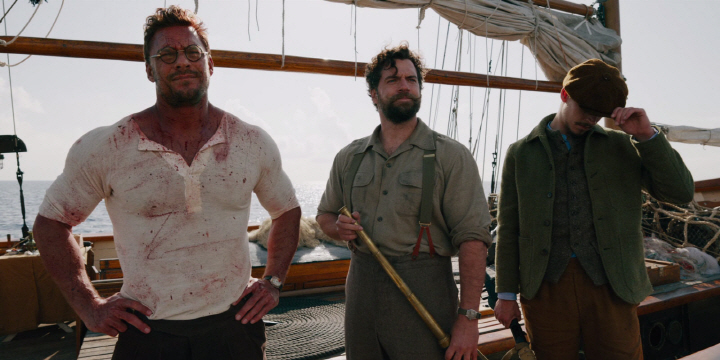
Guy Ritchie’s latest film “The Ministry of Ungentlemanly Warfare” is a middling copy of many similar World War II actions flicks ranging from “The Dirty Dozen” (1967) to “Inglourious Basterds” (2009). While it surely attempts to have some fun as borrowing a lot from its numerous seniors, the movie is often too flat and bland in terms of story and characters, and we can merely enjoy a few good moments not caring that much about the story and characters.
As emphasized at the beginning and end of the film, the movie is based on one of those interesting real-life stories during World War II. Yes, there were the members of the British Special Forces who accomplished a number of very dangerous missions, and their activities were certainly crucial in fighting against Nazi Germany.
However, it is apparent from the beginning that the story, which is set in 1942, is not interested at all in giving us the realistic presentation of what those brave soldiers went through during that big war. During the opening scene, we are introduced to a British military officer named Gus March-Phillipps (Henry Cavill) and his several comrades, but they are more like archetypes instead of real human figures to observe, and this aspect becomes more evident as they swiftly eliminate a bunch of Nazi German soldiers and their ship within a few minutes.

After that, we get to know more about where they are heading at present. When US eventually joins the war after the Pearl Habor attack in late 1941, Winston Churchill (Rory Kinnear, who vaguely resembles his real-life counterpart) and his British government are certainly relieved a bit, but there is one big problem. US certainly is ready to send soldiers and many other things necessary for the war via ships to sail across the Atlantic, but the Nazi Germany Navy armed with many U-boats and ships is blocking their way at present, and Churchill really needs to find any possible way to deliver a damaging blow to the Nazi Germany Navy.
And then there soon comes a good chance for that. Most of those U-boats usually get their necessary supplies from a certain big cargo ship at a little island near Nigeria, which has incidentally been a neutral zone. All the British intelligence agency, headed by Brigadier Gubbins (Cary Elwes), needs to do is finding when that cargo ship will come while full of those necessary supplies for the U-boats and then handing that information to March-Phillipps and his colleagues, who are sailing to that island while avoiding both the Nazi Germany Navy and the British Navy as much as possible.
While March-Phillipps and his colleagues go through another violent adventure on their way, the movie also focuses on the two British secret agents operating in that island. Disguising himself as a fairly trustworthy broker/businessman, Richard Heron (Babs Olusanmokun, who looks a lot more dapper compared to his brief appearance around the end of Denis Villeneuve’s “Dune” (2021)) assists a female agent named Marjorie Stewart (Eiza González), and he arranges a meeting between her and Heinrich Luhr (Til Schweiger, whom you may remember for playing a crucial supporting role in “Ingourious Basterds”), a sadistic Nazi Germany officer supervising the safety of that cargo ship.
Thanks to their skillful handling of their risky operation, Heron and Stewart not only get the information about that cargo ship but also set the stage for March-Phillipps and his colleagues. Heron is deliberately going to distract those German soldiers and officers in the island via holding a couple of big parties, and March-Phillipps and his colleagues will blow up the cargo ship and then leave as soon as possible.

Of course, they face several setbacks when they are about to begin their perilous operation, but the movie does not generate much suspense as they casually and brutally eliminate any Nazi solider on their way to accomplishing their mission. Sure, Nazi soldiers are run-of-the-mill villains whose death we can usually cheer for without much guilt, but those numerous Nazi soldiers in the movie feel more and more like video game figures to be killed, and the rather laid-back attitude of March-Phillipps and his colleagues on their brutal and ruthless killings further emphasizes that.
Moreover, the screenplay by Ritchie and his co-writers Paul Tamasy, Eric Johnson, and Arash Amel, which is based on Damien Lewis’ nonfiction book “Churchill’s Secret Warriors: The Explosive True Story of the Special Forces Desperadoes of WWII”, fails to develop many of its main characters into interesting figures to amuse or engage us. March-Phillipps and his colleagues just remain as stock war movie characters from the beginning to end, and you may want to check out Lewis’ book for really getting to know who March-Phillipps and his colleagues were in real life (He was actually one of the main inspirations for the character of James Bond in the novels by Ian Fleming, who is incidentally played by Freddie Fox in the film)
Henry Cavill and several notable performers including Alan Ritchson, Alex Pettyfer, Henry Golding, and Cary Elwes try as much as they can do with their caricature roles, but they are often limited by superficial characterization. In case of Eiza González, she brings some genuine spirit to the movie during several key scenes of hers, and the movie could be more interesting if it just focused on her character’s espionage adventure.
Overall, “The Ministry of Ungentlemanly Warfare” does not distinguish itself much compared to its many seniors out there, and it is also underachieving even compared to Ritchie’s recent solid works such as “The Gentleman” (2019) or “Wrath of Man” (2021). To be frank with you, I am considering revisiting “Ingourious Basterds” right now, and I think you should watch it instead of this pale imitator.


 Seongyong's Private Place