
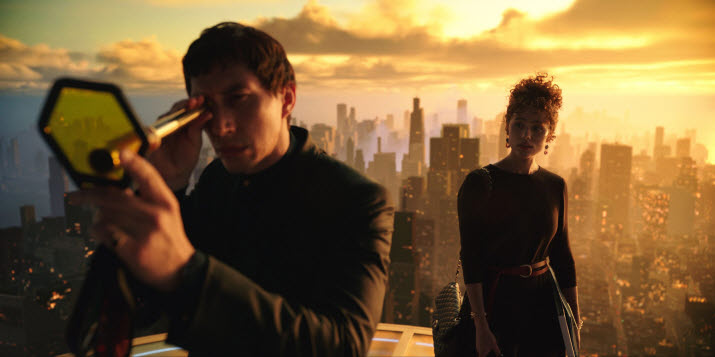
Francis Ford Coppola’s comeback work “Megalopolis” frustrated and baffled me a lot more than once. Here is a legendary filmmaker reaching for another chance for greatness, but the result only shows that he merely wasted a lot of the talents assembled by him as well as the production budget mostly provided by himself (It was more than 100 million dollars, as many of you already know). To be frank with you, this is not even an enjoyable or interesting folly at all compared to Tarsem’s “The Fall” (2006) or the Wachowskis and Tom Tykwer’s “Cloud Atlas” (2012).
The main problem of the movie is that Coppola does not seem to have any clear idea on whatever he wants to achieve here. Sure, lots of literature/philosophical stuffs pop here and there throughout its 138-minute running time, and he looks like trying to present a modern fantasy fable reflecting not only the despairing chaos of our time but also the defiant artistic individual spirit standing against that. However, the movie ends up being a total mess in terms of both idea and narrative, and I must confess that this is one of those very rare cases where I was really at a loss about how to follow and process whatever was going on.
The story, which is set in the post-modern version of New York City which is called “New Rome”, is supposed to be about Cesar Catilina (Adam Driver), a very talented architect who is also an ambitious individualistic visionary a la Ayn Rand. Besides recently receiving the Nobel Prize for inventing some revolutionary metallic material (No, it is not called Unobtainium or Vibranium), he also has a certain special power, and we see him testing his power at the top of the Crysler building during the opening scene.

All Catilina wants to do seems to be unfolding his exceptional futuristic vision upon the city, but he has been involved in a rather complicated political turmoil along with some of the most powerful figures in the city. One of them is the arch-conservative mayor of the city, and Mayor Cicero (Giancarlo Esposito) was incidentally once the district attorney who brought Catilina to the court after Catilina’s wife died under a rather mysterious circumstance. Because he does not approve of Catilina disrupting the status quo of the city, Mayor Cicero is determined to stop Catilina as much as possible, but that is not so easy because Catilina has a wealthy and powerful uncle who is incidentally the head of a very important bank in the city.
Meanwhile, Mayor Cicero’s rebellious daughter Julia (Nathalie Emmanuel) becomes curious about Catilina, and, what do you know, she soon finds herself quite attracted to him even though he has been very promiscuous since his supposedly beloved wife’s death. Naturally, her father is not so amused by this, but she only gets more involved with Catilina while things seem crumbling around them and many others in the city.
Indeed, as Catilina’s driver and assistant Fundi Romaine (Laurence Fishburne) phlegmatically observes via his narration, things do fall apart in the city no matter how much Mayor Cicero tries to get the city and its citizens under control, and we are accordingly served with a lot of wild and chaotic moments including a big public event held for celebrating the recent marriage of Catilina’s rich uncle. During this sequence, the movie randomly mixes lots of Roman stuffs into the 21st century background as expected, and that looks a bit entertaining at first, but then it sadly loses its way in its unruly excessiveness along with its hero having a lot of hallucination in his drugged state.
The movie subsequently attempts to sort out its resulting mess after something eventually occurs as expected from the beginning, but it only comes to ramble and trudge a lot without really intriguing or engaging us at all. We never get to know that much about whatever Catilina is trying to do for the city – or how he is going to pull that off in the end. We never get the full picture of all those political intrigues swirling around Catilina, Mayor Cicero, and many others including Catilina’s opportunistic cousin. And we never get any clear understanding about who they are or what motivates them.
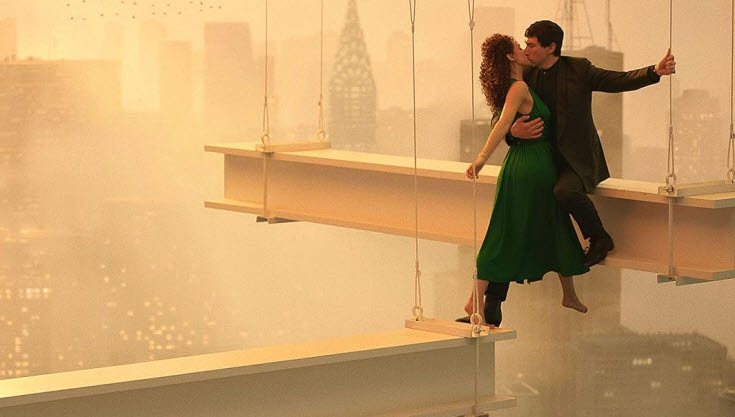
Adam Driver somehow does not embarrass himself throughout this daunting mess, and that is sort of an achievement in my humble opinion. There are several vapid moments of big speech he must deliver with uttermost seriousness, but he manages to survive them all thanks to his own distinctive presence, and I am sure that he will move on as usual after this colossal cinematic catastrophe.
In case of many other cast members, only a few of them are as lucky as Driver. While Giancarlo Esposito and Laurence Fishburne maintain some dignity, Nathalie Emmanuel, Aubrey Plaza, Talia Shire, and Kathryn Hunter are stuck in their respective thankless female roles, which show a lot about how Coppola is hopelessly out of touch in case of female characters. In case of Jon Voight, Shia LaBeouf, and Dustin Hoffman, they simply come and go without much purpose, and I wonder whether Coppola hired them just because they became quite cheaper to get due to their respective controversies during last several years.
Overall, “Megalopolis” is an almost total disaster, and, to make matters worse, Coppola and his distributor Lionsgate Films damaged its public image in one way or another even before it came out in US 6 months ago (You probably heard about the allegation about his serious misconduct on the set, by the way). The movie is an epic mistake, but, folks, Coppola gave us no less than four great films when he was at the height of his filmmaking career during the 1970s, and I think he can afford to make such a humongously self-indulgent mistake like this at least once.


 Seongyong's Private Place