
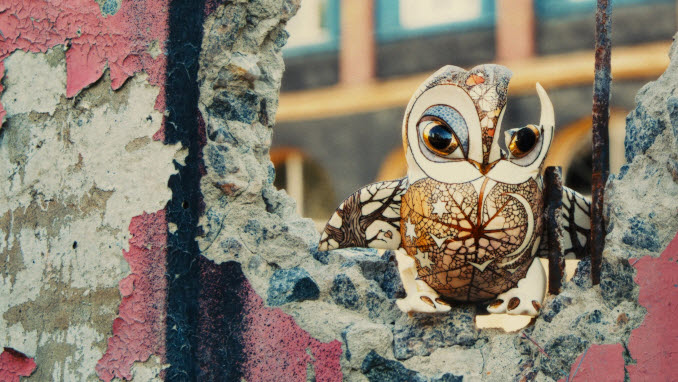
Documentary film “Porcelain War”, which won the U.S. Documentary Competition Grand Jury Prize at the Sundance Film Festival early in last year and then was recently nominated for Best Documentary Oscar, looks at the activities of several Ukrainian artists in the middle of the ongoing war in their country. While their country is constantly being disrupted and devastated by the war every day, they all try to maintain their art and culture as much as possible whenever they are not fighting against their enemy, and their artistic defiance is sometimes touching to watch.
At first, we are introduced to three different local artists: Slava Leontyev, Anya Stasenko, and Andrey Stefanov. They all once resided in the Crimea region of Ukraine before they had to leave due to the Russian occupation in 2014, and then all of them joined the Ukrainian defense when Russia invaded their country further in 2022. In case of Leontyev, who incidentally co-directed the documentary with Brendan Bellomo, he became a machine gun trainer, and we later observe his considerable dedication as he trains other volunteers.
When he is not working for his country, Leontyev usually spends time with his longtime partner Anya Stasenko, who has known him for many years since their childhood years. Whenever Leontyev makes a number of porcelain figurines, Stansenko paints these figurines bit by bit, and their lovely results certainly make a big contrast with what is happening in the city where they currently reside. As one of several cities quite close to the frontline, the city is frequently attacked by the Russian military, and we are not so surprised when there eventually comes a point where the horror of the war gets a lot closer to Leontyev and Stansenko’s cozy home than before.

Nonetheless, both of these two talented artists do not give up hope and resistance as continuing their artistic activities as usual, and the documentary sometimes provides lovely animation scenes based on their little precious figurines. Their porcelain works certainly look fragile, but these works also show resilience as well as artistic spirit inside them, while expressing each own stories via their individual shapes and paintings.
Meanwhile, the documentary also shows how things are getting worse for Ukraine and its people via what Leontyev and many other soldiers have to endure and then survive. We see them operating a number of drones which will drop some bombs on their enemy, and we also get a closer look into how they manage to stop their enemy’s advance at least for a while.
Many of the footage clips in the documentary were shot by Stefanov, and he tells his harrowing personal experience at one point later in the documentary. As the city became more dangerous due to the war, he reluctantly accepted the offer from a friend living in Lithuania, who was ready to take care of Stefanov’s two children for protecting them from more trauma to come. While his two daughters safely arrived in Lithuania in the end, he and his family had to go through a lot of risk before that, and he also feels guilty about his present absence even though recognizing that his daughters are now safe at least.
As showing more of the horror and sadness from the war, the documentary seems to lose its focus in my humble opinion. Sure, what Leontyev and Stansenko are trying to do during their private time is nobly defiant, but these intimate artistic moments of theirs are inevitably overshadowed by those more intense moments in the documentary from time to time. For example, there is a gritty and striking sequence which closely follows several soldiers trying to handle their emergency situation, and that is certainly one of the most memorable moments in the documentary. However, I must point out that such a tensely urgent moment like this does not get mixed that well with the relatively milder scenes observed from Leontyev and Stansenko’s personal life.
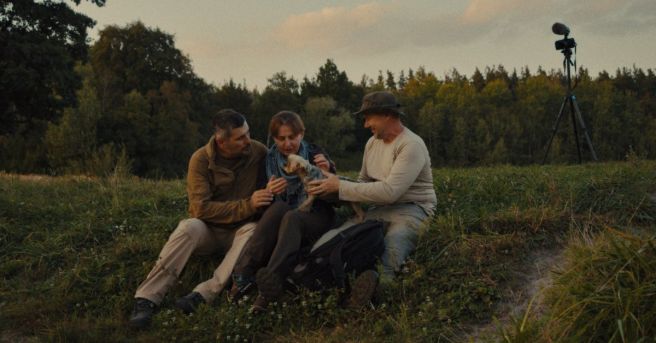
Perhaps, this jarring impression I got from the documentary is actually its whole point. Even though the circumstance around them and many others in the city becomes all the more despairing later, Leontyev and Stanskenko are not deterred at all as trying to keep going as usual in one way or another, and we are often moved as observing more of their defiant spirit and determination. There is a brief but precious warm moment when they take a walk along with their plucky pet dog in a nearby forest for getting some mushrooms, and the mood remains peaceful and pleasant even while they occasionally locate and then mark a hidden land mine here and there in the forest.
On the whole, “Porcelain War” does not surpass the harrowing urgency shown from recent Oscar-winning documentary “20 Days in Mariupol” (2023), but it will surely be remembered as one of the notable documentaries about the ongoing war in Ukraine. Considering the current status of the war at this point, I seriously wonder whether all those artistic efforts of Leontyev and Stasenko during the wartime may actually mean anything at all in the end, but the documentary reminds me that art itself has always been an act of defiance against all the senselessness and meaningless throughout our frequently chaotic human history. Therefore, I can only sincerely hope that they and their art will prevail – no matter what will happen to them during next several years.


 Seongyong's Private Place