
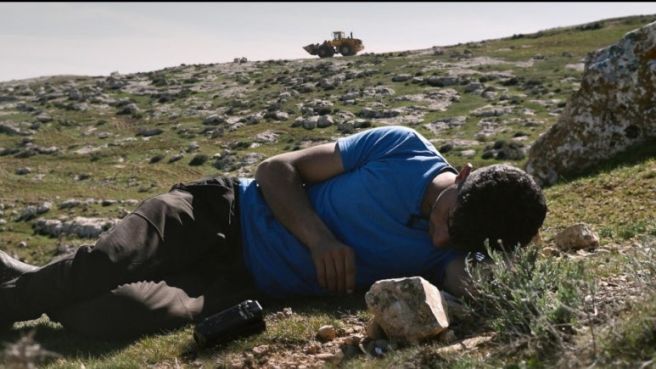
Documentary film “No Other Land”, which won the two awards including the one for Best Documentary at the Berlin International Film Festival early in last year and then won a Best Documentary Oscar in last week, calmly and thoughtfully follows a personal perspective on what has been unjustly happening in Palestine for many years. It may not shock or surprise you much if you have ever paid any attention to that gross injustice being committed by the Israeli government even at this point, but the documentary is still alternatively heartbreaking and infuriating while never losing its human dimensions, and the result is one of the most powerful documentaries of last year.
The central figure of the narrative of the documentary is a young Palestinian man named Basel Adra, who incidentally directed, wrote, and edited the documentary along with Hamdan Balla, Rahel Szor, and Yuval Abraham. During the early part of the documentary, a series of archival footage clips shot by Adra’s father show us how things have become worse and worse for him and many others in their little village in the West Bank region during last two decades thanks to the oppressive tactics of the Israeli army and government, and the documentary observes how Adra and many villagers including his father have struggled to record their longtime suffering via video cameras and smartphones.
What they recorded is sadly not so far from what I watched from Oscar-nominated documentary “5 Broken Cameras” (2011) more than 10 years ago, which is the personal chronicle of a plain Palestinian man and his neighbors struggling with the same issues day by day just like Adra and his fellow villagers. Despite frequently harassed by the Israeli army and government, Adra and his fellow villagers defiantly try to stick and stand together because, as one of the villagers flatly says at one point, they have no other land of theirs to live, but their stubborn defiance only leads to more oppression, and Adra and others sometimes cannot help but have more doubt on their ongoing resistance.
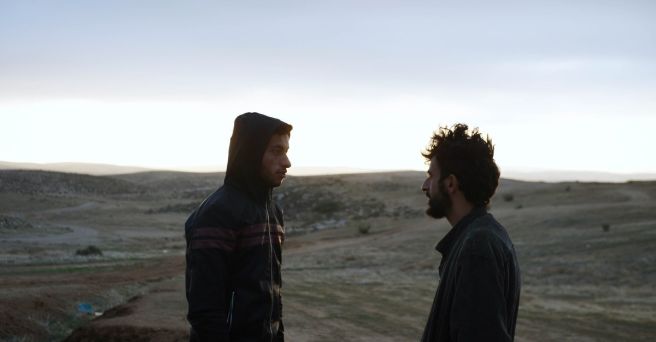
At least, Adra and others get some consolation as reminded at times that there are still many people who do care a lot about their increasingly despairing status. One of such people is Abraham, and he and Adra have been close colleagues even though Abraham is a Jewish Israeli. While sometimes reminded that there is always a gap between his position and what Adra and many others have to endure everyday, Abraham is always ready to do more for them, and we observe the genuine mutual trust and admiration between him and Adra during their several casual conversations in the documentary.
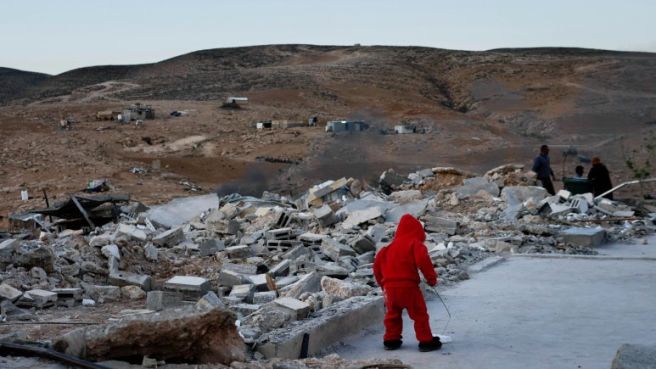
As the documentary phlegmatically doles out what they recorded from 2019 to 2023 via their video cameras and smartphones, we see more of the atrocities committed by the Israeli army and government. Once the Israeli Supreme Court rules in the favor of the Israeli army, the Israeli army push into the region containing Adra’s village and several other villages just for making a “military training zone”, and they begin to demolish the villages bit by bit while totally disregarding the angry protests from hundreds of villagers – even after one of those villagers is shot and then seriously injured.
Not so surprisingly, the Israeli army also put more oppression on Adra and Abraham’s defiant journalistic activities. While their activities are blocked more frequently than before, Adra’s village is disturbed more and more by Israeli soldiers suddenly coming for arrest or search, and there is a tense moment showing how Adra manages to evade the Israeli soldiers coming for him on one day. In case of Abraham, his sincere efforts on the Israel media are often undermined by those deplorable right-wing folks, and he even finds himself openly ridiculed by one of those extreme settlers later in the documentary.
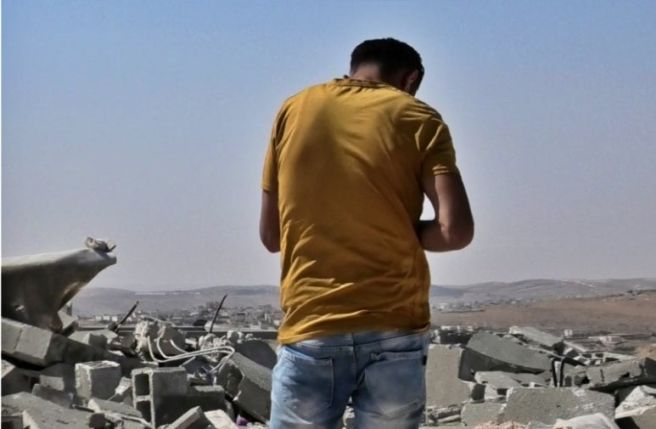
However, the documentary does not resort to easy anger at all as quietly and intimately focusing on the human moments observed from Adra and many others in the village. As observing more of the aching humanity of these people, we come to empathize more with their simple human wish to remain in the land which has always been theirs for many years, and there is a poignant moment when Adra bitterly muses a bit on his future during his conversation with Abraham. Sure, he wants to have his own good life just like many other ordinary people out there, but who can possibly try that under such an unstable circumstance like his?
As many of us know too well, the situation became all the worse for Adra and many other Palestinian people out there during last several months, and now I reflect more on a number of good films and documentaries about the conflict between Israel and Palestine during last two decades besides “5 Broken Cameras” and “The Gatekeepers” (2012), another Oscar-nominated documentary which will make a striking double feature show with “5 Broken Cameras” for good reasons. In one way or another, all of these movies and documentaries emphasize that the conflict must be resolved as peacefully as possible before things will get much worse, but their sincere messages and warnings were mostly ignored by those figures in power, who could begin some change and then peace but choose more violence and oppression instead just for their petty political reasons.
Seriously, I have a reasonably pessimistic doubt on whether it can actually do anything about what is going on between Palestine and Israel, but that does not diminish the emotional power of “No Other Land” at all in my inconsequential opinion, and I can only hope that it will bring a bit more awareness on its urgent social/political issue at least. After all, hope is definitely not something we can afford to give up that easily during this increasingly grim period of ours at present, isn’t it?


 Seongyong's Private Place
Pingback: 10 movies of 2025 – and more: Part 2 | Seongyong's Private Place