
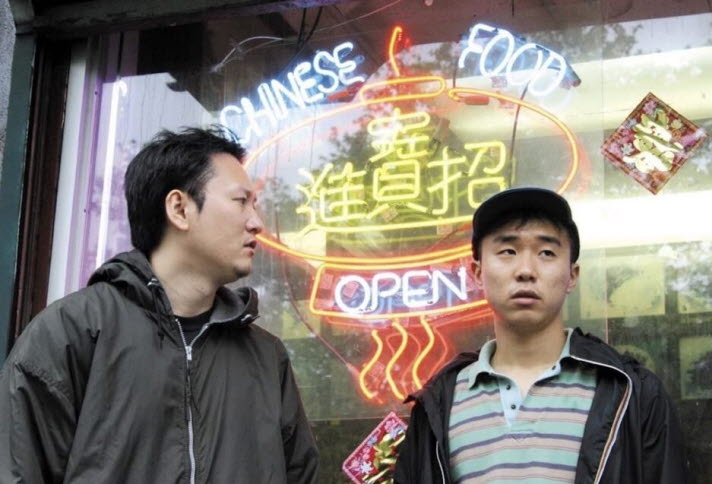
Sean Baker and Shih-Ching Tsou’s 2004 film “Take Out”, which was released on DVD and Blu-ray by Criterion in US a few years ago, is a modest but engaging immigrant drama which gradually draws you into its plain hero’s one particularly desperate day. Although it does not show and tell a lot about him, you will feel like getting to know him and his harsh daily reality more around the end of the film, and you may also admire how the movie handles his story with enough sensitivity and thoughtfulness while not ending up being your average misery porn.
The movie, which is set in a time not long after the 9/11 incident, opens with showing how things are quite bad for Ming Ding (Charles Jang), a young Chinese illegal immigrant who has worked as a delivery man at some little take-out restaurant located somewhere in the middle of the upper Manhattan neighborhood of New York City. He is a hard-working dude dreaming of having a better future along with his wife and their child who may come to US someday, but, alas, he currently owes a considerable amount of money to a local loan shark, and now he must pay those vicious criminals no less than 800 dollars before the end of the day.
At least, Ming’s situation turns out to be a bit better than we expected in the beginning, because there are some people willing to help him to some degree. First, he manages to obtain 500 dollars from a family member of his who is also very busy with earning her meager living just like many others like them. Second, Young (Jeng-Hua Yu), a fellow delivery man who is also Ming’s closest friend, is quite willing to step aside for allowing Ming to do more deliveries during that day after learning about Ming’s big imminent trouble.

What follows next is a series of brief episodic moments where Ming is diligently and desperately trying to earn as much as possible during next several hours. Although it frequently rains outside, that does not deter him at all, and we often watch him hurriedly delivering those packaged Chinese dishes here and there in the surrounding neighborhood.
As he encounters one customer after another along the story, you will be reminded more of how diverse New York City really is in terms of people – and how Ming and many other delivery guys out there are often disregarded and under-appreciated. The handheld camera of Baker, who also did the cinematography besides writing, producing, and editing the movie with Tsou, usually sticks around Ming, but we seldom see his face as he faces his customers one by one, and we become all the more aware of his frequently marginalized status in the city.
Although its production budget was no less than 3,000 dollars, the movie does not look limited that much by its very small production budget. While it surely feels raw and rough from the beginning to the end, Baker and Tsou did a commendable job of imbuing it with a lot of realism and verisimilitude, and the result is as vivid and impressive as other similar New York City immigrant films such as Ramin Bahrani’s “Man Push Cart” (2006). As a result, you may sometimes feel like watching a real slice of life being unfolded on the screen, and that is why we get more absorbed in its hero’s ongoing struggle.
You will also probably admire how Baker and Tsou’s screenplay allows some humor and humanity as Ming and several other main characters around him busily work hour by hour. Although they do not tell a lot about themselves as struggling to go through another day of their hard and difficult life as usual, they all come to us as realistic human figures to observe, and there is a little warm and humorous moment when they have a casual lunch break together later in the story.

During its last act, the movie expectedly throws another setback upon our struggling hero, but it does not lose any of its deep care toward its hero at all, and that is where its emotional power lies. From what it has steadily built up before that narrative point, the movie dexterously pulls out a little but precious moment of solidarity and compassion, and this feels all the more relevant considering how our global world and many of us have been crushed more and more by the worst sides of the humanity these days.
The movie certainly depends a lot on its lead actor, and Baker and Tsou found the right one for their film. Although he is actually a Korean American who can also speak Chinese, Charles Jang, who incidentally made a brief appearance in Baker’s recent Oscar-winning film “Anora” (2024), mostly looks natural in his unadorned embodiment of his character’s growing weariness and desperation, and he also clicks with several main cast members including Jeng-Hua Yu, Wang-Thye Lee, and Justin Wan, who respectively bring some colorful human details to the story without being too showy at all.
On the whole, “Take Out” shows how Baker already demonstrated his considerable potential as a new American independent filmmaker to watch. Mainly because of the timeless aspects of its immigrant drama, the movie still does not look that dated at all even at this point, and it is really remarkable to see how far he has advanced during last 20 years since this small but interesting low-budget film. Both “Take Out” and “Anora” show that he has always cared a lot with interest, understanding, consideration, and compassion, and you will agree that he is indeed one of the best American filmmakers of our time.


 Seongyong's Private Place