

My late mentor/friend Roger Ebert said that the movies are like a machine that generates empathy, and that is quite true in case of RaMell Ross’ latest work “Nickel Boys”, which was recently Oscar-nominated for Best Picture. Quite closely sticking to the viewpoints of two plain African American adolescent boys at the center of the story, this singular African American film often generates powerful human moments along their sad and poignant story, and their poetically empathic qualities will haunt your mind for a long time after the movie is over.
At the beginning, a series of free-flowing episodic moments establish the character background of one of those two African American boys in the story. His name is Elwood Curtis (Ethan Herisse), and we observe how he has grown up under his caring grandmother Hattie (Aunjanue Ellis-Taylor) in Tallahassee, Florida during the early 1960s. As the Civil Rights Movement is beginning in the country, Elwood naturally becomes more aware of the racial discrimination against him and many other African American people around him, but that does not deter him at all from his growing hope for doing something great in the future, and his grandmother is certainly willing to support her grandson’s hope and ambition as much as possible.
When he subsequently gets an opportunity to go to a college for promising young African American students like him, both Elwood and his grandmother are certainly happy and excited. However, he inadvertently gets himself into a big trouble when he is heading to that college, and this unfortunate incident eventually sends him to the Nickel Academy, a big state reform school for juvenile delinquents which is actually the fictional version of one of the most notorious reform schools in US.

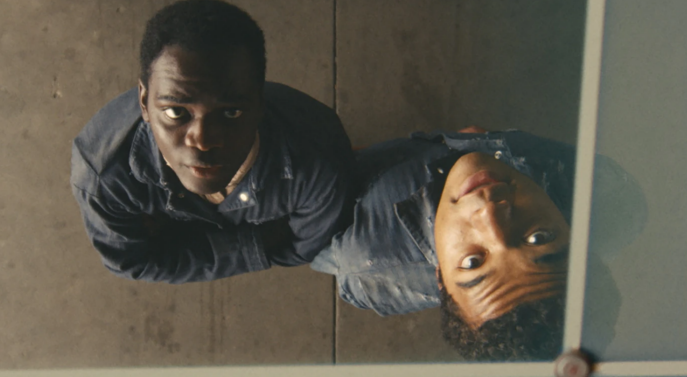
Up to this narrative point, the movie seldom shows Elwood to us because, well, the camera of cinematographer Jomo Fray, who should have been Oscar-nominated for his exceptional work here in this film, virtually functions as Elwood’s subjective viewpoint. This may sound very limited and suffocating to you, but, as effortlessly and dexterously unfolding whatever he sees or remembers on the screen, the movie gradually immerses us more into his thoughts and feelings, and we become all the more empathic to his ongoing plight.
We eventually see Elwood via another main viewpoint in the story, and that belongs to Turner (Brandon Wilson), one of the boys in the section for African American boys. When many of other boys are cold or hostile to Elwood, Turner willingly shows some kindness to Elwood, and that is the beginning of their friendship, which gradually becomes something they desperately hold onto as they and many other boys are frequently exploited or abused day by day under their heartless (and corrupt) White superintendent.
Never overlooking the systemic racism and corruption surrounding its two young main characters, the screenplay by Ross and his co-writer Joslyn Barnes, which is based on Colson Whitehead’s second Pulitzer-winning novel “The Nickel Boys” (His first Pulitzer-winning novel “The Underground Railroad” is already adapted into a superb TV miniseries by Barry Jenkins, by the way), handles the dark aspects of the story with enough thoughtfulness and restraint. We do not see much during some of the darkest moments in the film, but the human pain and horror inside them are succinctly and effectively conveyed to us nonetheless, and we become more aware of what may happen to Elwood and Turner at any point if they are not careful.
And that is why the occasional small moments of unexpected warmth and sensitivity shine and then touch us a lot. Ross and Fray did a commendable job of imbuing these wonderful moments with a considerable amount of lyrical realism, and this may sometimes take you back to those memorably beautiful moments in Ross’ Oscar-nominated documentary film “Hale County This Morning, This Evening” (2018).

However, the movie wisely does not resort to any easy closure for its two main characters’ story as another crucial viewpoint enters the picture later in the story. Although many years have passed since that horrible time at the Nickel Academy, older Elwood, played by Daveed Diggs, cannot help but feel quite troubled when he reads the articles on the belated discovery on many atrocities committed there, and the emotional scars on his heart and soul are evident to us even though the camera mostly observes him from the behind.
I will not go into details how the movie pulls out a little surprise and then one of the most moving endings I have ever seen during last several years, but I can tell you instead that I come to admire more of how Ross and his cast and crew members stick to his artistic vision to the end. While ably functioning as the heart and soul of the film, Ethan Herisse and Brandon Wilson are often harrowing in their unadorned performance, and they are also supported well by several notable performers including Hamish Linklater, Fred Hechinger, Jimmie Fails, and Aunjanue Ellis-Taylor, who always provides extra warmth to the story whenever she appears on the screen.
On the whole, “Nickel Boys” is definitely one of the best films of last year, and Ross surely advances further than what he achieved so remarkably in “Hale County This Morning, This Evening”. With these two exceptional works, he firmly establishes as one of the best American filmmakers at present, and he will be always remembered for their significant achievement, regardless of whatever may come next from him in the future.


 Seongyong's Private Place
Pingback: My Prediction on the 97th Academy Awards | Seongyong's Private Place
Pingback: 10 movies of 2025 – and more: Part 2 | Seongyong's Private Place