

Netflix film “Lucca’s World”, which was released in last month, is unabashedly sincere and sentimental without much honesty or human depth for becoming something more than “the disability of the week” movie. The movie is certainly pleasant and appealing to some degree, but I observed its story and characters with accumulating skepticism and cynicism during my viewing, and that was not a good sign at all.
As shown from the very beginning, the movie is a fictional presentation of the unbelievable real-life story of Bárbara Anderson (Bárbara Mori) and her first son Lucca (Julián Tello). When she is about to give birth to her son, Anderson is certainly hopeful and excited to say the least, but, alas, she and her son come to have a very serious medical situation at the time of her delivery, and this unfortunately leads to considerable brain damage to him.
As a result, Lucca has suffered a serious case of cerebral palsy during next several years, and we see how Anderson and her husband have devoted a lot of themselves to Lucca’s welfare. While she continues to work for supporting the family instead of her currently unemployed husband, she is always ready for more help and support to her dear son, and her second son is also quite supportive of his disabled older brother.

Nevertheless, things later get direr for Lucca and his family due to his more frequent seizures, and then Anderson happens to learn about a certain newly developed medical treatment which may actually help Lucca. Although nothing is definite at all about this new medical treatment which is incidentally being developed in some private clinic in India, Anderson soon becomes determined to take a chance with that, and this naturally leads to more financial burden on her and her husband.
Nevertheless, her husband supports her determination as usual, and what follows next is how Anderson and her husband try to get their son to that private clinic in India as soon as possible. Although Lucca’s doctor understandably shows some sensible skepticism, he eventually provides some guide on how to handle Lucca’s increasingly fragile medical condition during the long flight to India. In case of Anderson’s husband, he gets the money enough for the family’s trip to India via the mortgage on their big apartment, and Anderson certainly appreciates her husband’s efforts.
Even when she and her family eventually arrive in that private clinic in India, Anderson is not totally sure about whether she is really doing the right thing for her dear son, but, what do you know, her son actually shows considerable progress after going through a number of treatment sessions. Needless to say, she and her husband rejoice for this unexpected outcome, and then she considers getting her son treated more in Mexico.
Around that narrative point, the screenplay by director Marina Chenillo and her co-writer Javier Peñalosa unfortunately becomes quite shaky to our distraction. As trying more for the government authorization on using that new medical treatment on her son, Anderson comes to sense that there is something very suspicious about a Mexican doctor supposedly trying to get the authorization on the upcoming clinical trial in Mexico and US, but the movie is rather murky about this character to the end, and I also became all the more skeptical after coming to learn more about how much it actually fictionalized its real-life story. Sure, as shown to us at the end of the film, Lucca did show considerable progress after having that medical treatment in question, but, folks, I must emphasize that there has not been any official confirmation on whether his progress was directly resulted from that medical treatment, which I came to find all the more questionable after reading a recent Guardian article quite critical on the movie.
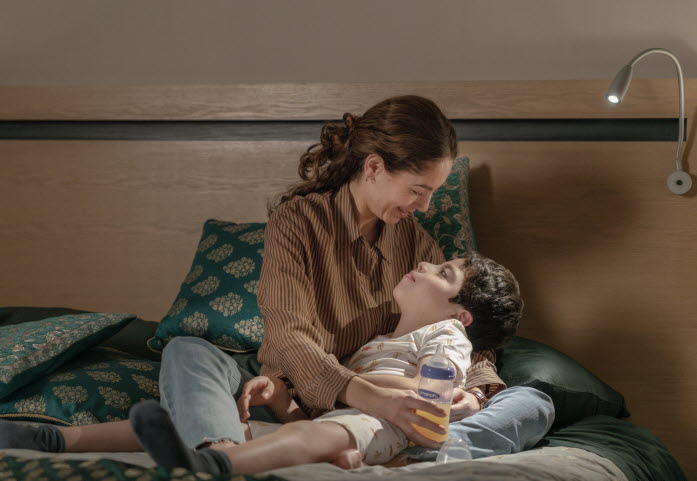
Furthermore, the movie merely scratches the surface in case of whatever Anderson and her family have endured for more help and support to Lucca for many years. Except one scene where she faces how her longtime devotion to Lucca negatively affects her professional career, we do not get to know that much about her own emotional toil, and that is why those supposedly feel-good moments later in the story where Anderson come to accept more of Lucca’s medical condition are quite contrived instead of giving more human dept to the story and characters.
At least, the main cast members of the film try their best, and their good efforts sometimes compensate for its many weak aspects. While Bárbara Mori carries the movie well with her earnest performance, Juan Pablo Medina dutifully stands by her as required even though there is not much to do for him except looking considerate or concerned, and young performer Julián Tello holds his own small place well between his two adult co-stars.
Overall, “Lucca’s World” is not totally intolerable because of some sincerity inside it, but I must point out that there are many better films out there which handle their inherently melodramatic medical matters with more thoughtfulness and sensitivity. In my humble opinion, not many of them can top the emotional power of George Miller’s Oscar-nominated film “Lorenzo’s Oil” (1992), and I sincerely recommend you to watch that excellent movie rather than watching this blandly passable Netflix product.



 Seongyong's Private Place