

Norwegian documentary film “The Painter and the Thief” observes a complex human relationship between two total strangers who happened to get involved with each other under one extraordinary circumstance. As alternating between their different viewpoints, the documentary makes us reflect more on human empathy and connection, and it is poignant to observe how its two human subjects came to understand each other more in the end.
Everything began from a small criminal incident which occurred at one art gallery in Oslo, Norway on one day of 2015. The two men broke into the art gallery and then stole the two paintings by a Czech female artist named Barbora Kysilkova, and they were eventually arrested not long after that, though neither of Kysilkova’s two paintings could not be retrieved even after their arrest.
When she came to learn about one of these two arrested criminals, Kysilkova became curious about who that person was, so she attended his following trial. He was a drug addict named Karl-Bertil Nordland, and, as reflected by a series of sketches accompanied with a piece of audio recording, she actually approached and then talked a bit to him when both of them were in the courtroom.

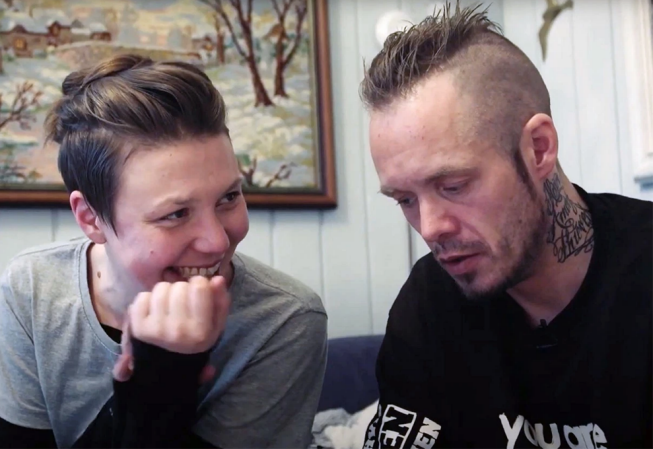
Some time later, Kysilkova approached to Nordland again, and she requested him to be the model for her latest painting. While not so willing to do that at first, Nordland eventually agreed to do some modelling for Kysilkova, and he could not help but become quite emotional when she later showed him his completed portrait. After that point, he and Kysilkova became close friends, and she also tried to understand more of how his life became quite messy. Despite experiencing some unhappiness during his childhood years, Nordland was a fairly promising young man, but then things went quite wrong – especially after he became a drug addict at some point.
Watching Nordland still struggling with his personal demons despite her help and support, Kysilkova became quite frustrated at times, and that also put considerable strain on her relationship with her Norwegian boyfriend. At one point, her boyfriend sharply points out the ethical aspects of how she regards Nordland as an artist, and she cannot help but become defensive as emphasizing that she really cares about Nordland.
The documentary also focuses on how Nordland felt about his accidental friendship with Kysilkova. While correctly sensing that she was often fascinated with his dark sides, he also appreciated her help and support, but then he became really incorrigible for not only Kysilkova but also a woman who was his girlfriend at that time. He was supposed to check himself into a local rehabilitation center, but he only ended up letting down these two good women, and that was when his girlfriend finally decided that enough is enough.
Anyone with some knowledge on addiction surely knows well that every addict is bound to reach the bottom of their addiction in the end, and Nordland was no exception, though he was more fortunate compared to many of those unlucky addicts out there. Not long after tumbling into his drug addiction again, he got himself into a real big trouble, and that was when he actively grabbed a good chance for becoming clean and sober.

Simply letting the story of its two human subjects roll by itself, the documentary often vividly captures a number of honest and powerful human moments to observe. There is a harrowingly painful moment when Nordland clashes with his girlfriend over his ongoing addiction problem, and the emotional intensity of this moment is quite palpable to us even though we do not see much of him and his girlfriend. Just like Nordland, Kysilkova was willing to show a lot of herself in front of the camera, and that is why several private moments between her and her boyfriend are exceptionally truthful to say the least. Both of them clearly discern how complicated their relationship issues are, but they are evidently struggling to resolve these personal issues – even though they care a lot about each other.
The documentary later puts some tension on the screen when Nordland and Kysilkova become quite distant to each other later in the story, and that is where it becomes a bit contrived to our distraction. It is not much of a spoiler to tell you that they eventually meet again, but then the documentary pulls out another narrative turn as Kysilkova reveals what she recently discovered by sheer coincidence. This surely makes their story more dramatic, but I wonder whether director Benjamin Ree, who also served as the co-cinematographer of his documentary, could present this little but crucial moment of revelation in a more organic way.
Anyway, “The Painter and the Thief”, which won the World Cinema Documentary Special Jury Award for Creative Storytelling when it was premiered at the Sundance Film Festival around the beginning of 2020 (How distant that time feels to many of us now because of the COVID-19 pandemic!), is a solid documentary with enough interesting human qualities to be observed and appreciated, and I admired the thoughtful handling of its compelling human story even while recognizing its few notable weak points. Yes, it could be more improved in my trivial opinion, but I assure you that you will never forget its two human subjects after watching it.


 Seongyong's Private Place