

Pablo Larraín’s latest film “Maria”, which was released on Netflix in US a few months ago, simply walks here and there around its famous real-life female figure. As the last entry in Larraín’s trilogy after “Jackie” (2016) and “Spencer” (2021), the movie is surely as unconventional as these two previous films, and I enjoyed its mood and style enough although it does not show and tell a lot about its main subject on the whole.
This is probably because Larraín takes a relatively softer approach in his fictional presentation of the last days of Maria Callas, who was one of the greatest opera singers in the 20th century. In case of “Jackie” and “Spencer”, both Jacqueline Kennedy and Diana Spencer were more or less than figures to be closely but objectively observed in meticulous details, and that was the main reason why these two good films felt rather distant to me at times. In case of “Maria”, Larraín seems to care more about Callas, and the movie steadily maintains a respectful distance between itself and her while shrouding her in warm and soft lights at times.
After the opening scene showing the day when Callas died in September 1977, the movie moves back to one week ago. Although she is currently retired due to her health problem, Callas (Angelina Jolie) has been trying to make a comeback someday, and we observe how things are not exactly good for her. While she lives in a fairly luxurious apartment, her medical condition is getting worse as she depends more on drug day by day, and her two dutiful servants, Ferruccio (Pierfrancesco Favino) and Bruna (Alba Rohrwacher), are certainly quite concerned about her.

Due to her constantly drugged state, Callas’ mind is frequently swept by old memories or hallucinations, and that allows the movie to bring more fictional elements to the story. At one point early in the film, she is visited and then interviewed by a young male journalist eager to record whatever she is going to say, but it soon turns out that he is just another hallucination experienced by Callas’ increasingly confused mind.
In case of Callas’ past, the screenplay by Steven Knight sometimes doles out a few personal moments to observe. We see how young Callas and her older sister had to earn their meager living during World War II, and that is not a pretty sight at all. We also see how Callas met Aristotle Onassis (Haluk Bilginer) for the first time, and then we observe how she got close to this wealthy Greek businessman, though their romance did not last long because he eventually married Jacqueline Kennedy (She incidentally does not appear in this film, by the way).
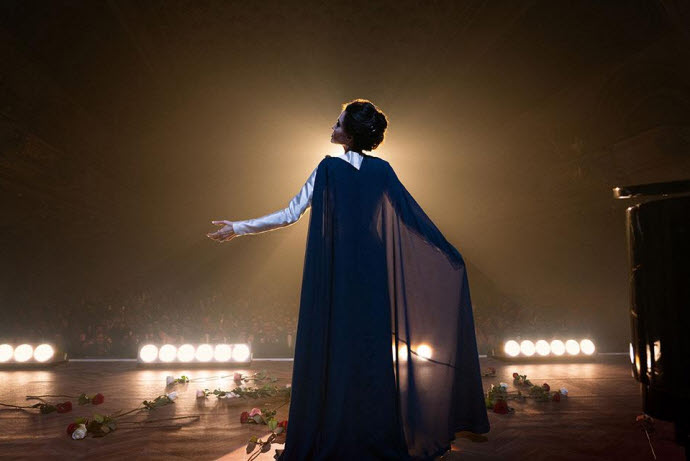
Due to the rather elusive narrative of the film, you may be disappointed if you expect to know more about Callas’ life and career, but the movie fills the screen with a lot of atmosphere and emotion as watching its heroine struggling to live another day. After all, there is something inherently operatic about a dying diva during her last days, and the movie naturally provides a number of grand moments such as the one when Callas imagines her playing the heroine of Giacomo Puccini’s classic opera “Madame Butterfly”.
Although the overall result may look and feel a bit superficial at times, the technical aspects are often terrific to watch. Cinematographer Edward Lachman, who was deservedly Oscar-nominated for this film a few weeks ago, did a commendable job of imbuing the screen with an ample amount of style and beauty, and his stunning visual achievement here in this film is surely worthwhile to watch on big screen. In case of the soundtrack, the movie utilizes a bunch of recordings of Callas’ performance from the beginning to the end, and they are effectively incorporated into the story although often reaching to the level of overkill.

Most of all, there is the good lead performance by Angelina Jolie, who demonstrates here that she has not lost any of her talent or presence yet even though she seems to focus more on other things besides acting these days. Besides being convincing in a number of key scenes where she must look like singing in Callas’ voice, Jolie skillfully embodies her character with grace and dignity, and it is certainly one of the best performances in her career.
Around Jolie, several notable cast members in the film are required to fill their respective spots while humbly supporting her to the end. Pierfrancesco Favino, a charismatic Italian actor who was memorable in Marco Bellocchio’s “The Traitor” (2019), and Alba Rohrwacher bring some human qualities to their characters, and that is crucial in setting the attitude of the movie toward its main human subject. While Turkish actor Haluk Bilginer is always fun to watch as Onassis, Stephen Ashfield, Vincent Macaigne, and Valeria Golino did a bit more than demanded during their brief appearance, and Kodi Smit-McPhee is unfortunately stuck in his rather thankless supporting role.
In conclusion, “Maria” is less successful compared to “Spencer” or “Jackie”, but it is still another admirable work from Larraín, who has been quite prominent since his Oscar-nominated Chilean film “No” (2012). To be frank with you, I am not that enthusiastic about many of his films except “No” and “El Conde” (2023), but he is still an interesting filmmaker with distinctive style and talent to observe, and “Maria” reminds me of that again.


 Seongyong's Private Place
Pingback: My Prediction on the 97th Academy Awards | Seongyong's Private Place