
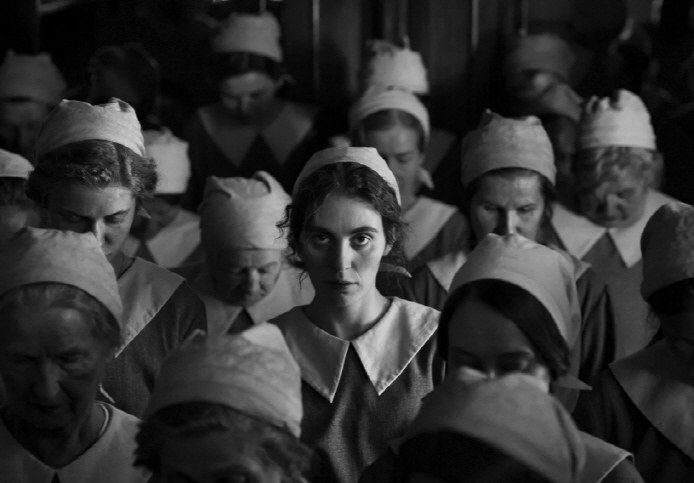
“The Girl with the Needle”, which was recently Oscar-nominated for Best International Film, is a stark and unnerving period drama about one unfortunate woman who happens to be under a very gloomy circumstance. As she struggles for life in one way or another, the movie shows more of the harsh reality around her, and we are all the more chilled as observing the evil and madness shown later in the story.
Set in Copenhagen, Denmark around the end of World War I, the story begins with how things have been desperate for Karoline (Vic Carmen Sonne), a married woman who has earned her meager living alone by herself since her husband went to the war several years ago. She works as a seamstress in a big local clothing factory, but that is not enough for her poor economic status, and the opening scene shows her being suddenly evicted by her landlord due to not being able to pay her rent during last several weeks. While she manages to find another place to live, Karoline still needs some financial help, so she later applies for widow’s compensation because her husband is presumed to be dead, but she is not allowed for that just because her husband’s death is not official yet.
Not long after Karoline eventually depends on the generosity of the wealthy owner of the factory and then gets pregnant because of him, her husband unexpectedly returns. Although she feels some pity toward his disfigured status, she promptly reveals to him that she is pregnant due to her current extramarital affair. She also notifies her pregnancy to the factory owner, who promises to marry her as soon as possible. Not so surprisingly, his stern mother, who has the total financial control over her son, does not approve of that at all, and that leads to a very painful moment of humiliation for our heroine.

Consequently abandoned while her baby is growing inside her body day by day, Karoline lives again with her husband who begins to work as a sideshow in a local circus troupe. He is actually quite willing to accept the baby as his child to take care of, but she still does not want the baby at all, and that leads to a gut-wrenching scene where she attempts something quite drastic at a local bathhouse for women.
That is how she encounters a middle-aged woman named Dagmar (Trine Dyrholm) again, who is incidentally the new lodger of Karoline’s previous residence. After taking care of a little mess caused by Karoline, Dagmar tells Karoline that she can help Karoline a bit when the baby is born, and Karoline soon visits Dagmar not long after the eventual birth of her baby.
Quite welcoming to Karoline, Dagmar says that she will take the baby to some affluent couple willing to adopt the baby, and it looks like she has been doing this illegal business quite a long time while running her little candy store. After her baby is taken by Dagmar, Karoline suggests that Dagmar should hire her as a wet nurse, and Dagmar gladly has Karoline take care of those unwanted babies to come and then go.
The mood becomes more disturbing as Karoline comes to wonder more where Dagmar takes those babies later in the story, and the screenplay by director Magnus von Horn and his co-writer Line Langebek, which is loosely based on a notorious real-life criminal case in Denmark during 1910s, gradually reveals more horror and darkness under the surface. Cinematographer Michał Dymek, who shot the movie in black and white film in the ratio of 1.50:1, often fills the screen with a barren sense of despair and dread, and there are several emotionally shattering moments which are thankfully handled with enough restraint while still horrifying us enough on the whole.
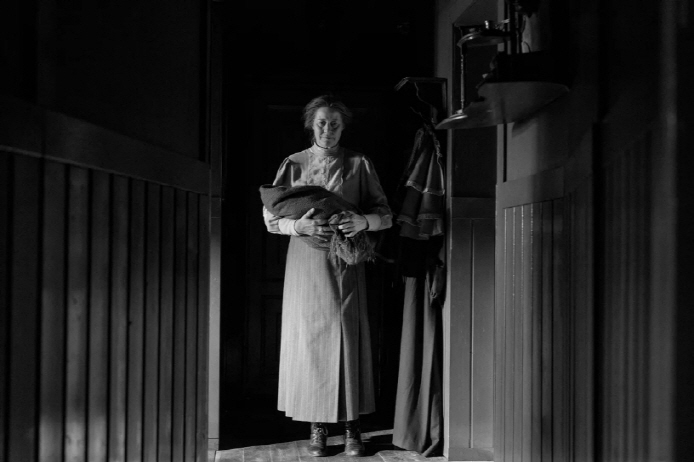
As the story eventually reaches to the inevitable finale waiting for its heroine, the movie still holds our attention thanks to the strong lead performance from Vic Carmen Sonne, who previously played one of the substantial supporting characters in “Godland” (2022). Often feeling quite jaded and tarnished in her weary appearance, Sonne also ably conveys well to us her character’s silent but defiant inner strength, and it is poignant to see how her character comes to find a way to care and love more after her grim emotional journey along the story.
Around Sonne, several main cast members of the film have each own moment to demonstrate their considerable talent. Trine Dyrholm is quite effective especially when Dagmar casually justifies what she has done behind her back for years, and she and Sonne are convincing in the growing emotional dependency between their characters in the story. Around Sonne and Dyrholm, young performer Avo Knox Martin holds her own little place well as a little girl who is supposed to be Dagmar’s daughter, and Besir Zeciri, Joachim Fjelstrup, and Tessa Hoder are also solid in their substantial supporting roles.
In conclusion, “The Girl with the Needle” is definitely not something you can comfortably watch on Sunday afternoon, but it is still worthwhile to watch for its mood, storytelling, and performance. Considering how misogyny and sexism are still serious issues even at present, the movie certainly feels quite relevant like many other dark feminist tales out there such as Margaret Atwood’s “The Handmaid’s Tale”, and its utterly gloomy impression will haunt your mind for a while.



 Seongyong's Private Place
Pingback: My Prediction on the 97th Academy Awards | Seongyong's Private Place