
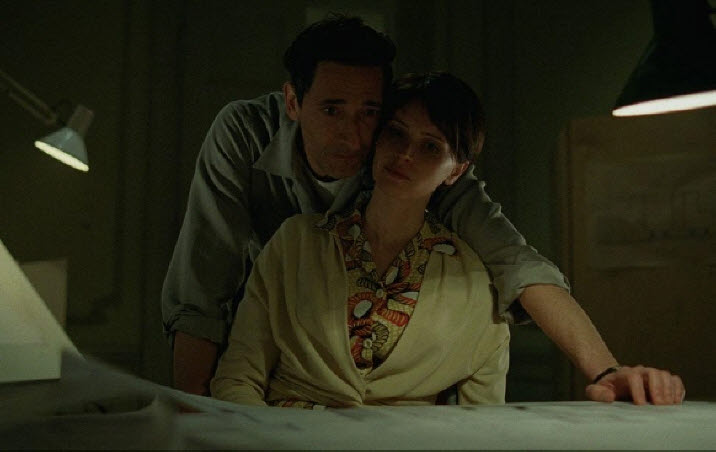
Brady Corbet’s latest film “The Brutalist” is an ambitious piece to behold and admire. While often boldly trying to emulate the style and form of those Hollywood classic epic drama films of the 1950-60s, it also brings a considerable amount of modern touch and sensibility to its story and characters, and the result is utterly spellbinding, regardless of how you feel about this adamantly monumental film.
The story of the movie feels like a typical American immigrant tale at first. Its hero is László Tóth (Adrien Brody), a Hungarian-Jewish Holocaust survivor who emigrates to America in 1947. Before the World War II, he worked as an architect, but now he is virtually a nobody just like many other emigrants, and he can only hope that his cousin living in Philadelphia, who has run a little furniture shop, will provide him a job and a place to stay.
Anyway, once he arrives in Philadelphia, László is gladly greeted by his cousin, and we observe how he tries to bring some architecture sensibility of his to those handmade furniture pieces to be sold. On one day, he and his cousin are requested to renovate the library in a big house belonging to a wealthy businessman named Harrison Lee Van Buren (Guy Pierce) for a surprise birthday gift for him, and the movie patiently follows how László and his crew make the library look quite different than before.
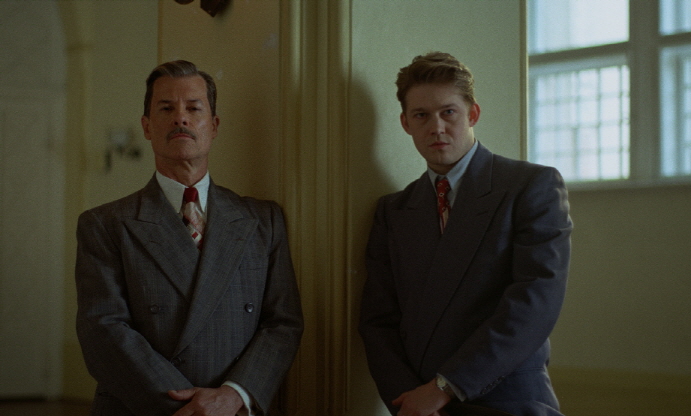
However, Van Buren is not so amused when he arrives at his house earlier than expected. Consequently, the situation becomes very difficult for László during next few years, but, what do you know, Van Buren changes his mind when his new modern library comes to draw a lot of attention later, and he is ready to help László in more than one way. Besides hiring László as the architect of a grand new big building to bear the name of his family, Van Buren also helps László’s wife and niece, who also managed to survive the Holocaust just like László, coming from Hungary to US at last.
It is not much of a spoiler to tell you that László eventually becomes conflicted about the issues of principle and integrity as coming to clash with his rich sponsor more and more along the story. While he seems ready to support László all the way at first, Van Buren gradually shows more of his heartless sides as things do not seem to be going well from his viewpoint, and László’s wife Erzsébet (Felicity Jones) begins to notice how her husband becomes more distant from her as he struggles to stick to his artistic integrity in front of Van Buren and others.
As the screenplay by Corbet and his co-writer Mona Fastvold steadily builds up the story and characters with more details, the movie constantly impresses us with a number of stunning visual moments to be appreciated. Cinematographer Lol Crawley did a superlative job of filling the screen with vivid and realistic period atmosphere (The movie was actually shot via the VistaVison process and cameras for accentuating that, by the way), and the result is seamlessly mixed with the occasional archival footage clips from the 1950-60s. The editing by Dávid Jancsó is precise and efficient in maintaining the narrative pacing throughout the film, which is incidentally more than 3.5 hours including the 15-minute intermission part. The score by Daniel Blumberg feels a little too simple and restrained, but it still plays a crucial part in setting the tone of several key scenes in the movie.
Above all, the movie depends a lot on the hauntingly soulful acting of Adrien Brody, who was deservedly Oscar-nominated for his best performance since his Oscar-winning turn in Roman Polanski’s “The Pianist” (2002). While never making any excuse on his character’s many human flaws, Brody deftly illustrates his three-dimensional character’s inner conflicts along the story, and he is compelling to watch whenever he subtly suggests whatever is churning behind his character’s seemingly passive appearance.
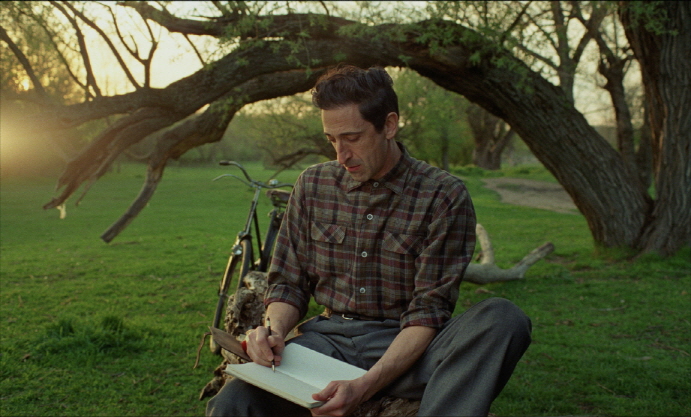
Around Brody, Corbet assembles several good performers, who have each own moment to shine in one way or another. While Guy Pearce is suitably obnoxious as a rich man who turns out to be more brutal and controlling than he seems at first, Felicity Jone, who was Oscar-nominated along with Brody and Pearce, manages to overcome her rather thankless role, and Joe Alwyn, Raffey Cassidy, Stacy Martin, Alessandro Nivola, Jonathan Hyde, and Isaach de Bankolé are also solid in their substantial supporting parts.
On the whole, “The Brutalist”, which received 10 Oscar nominations including the one for Best Picture (It also won the Silver Lion for Best Director when it was premiered at the Venice International Film Festival in last year, by the way), is quite impressive for its masterful technical qualities as well as its confident handling of story and character. Although I am a bit less enthusiastic about it than many others because it is not wholly perfect due to several notable flaws including a few abrupt narrative turns during its second half, this is surely not something we can see everyday, and its mesmerizing moments still linger around my mind even at this point.
Now I am reminded of what my late friend/mentor Roger Ebert wrote about Paul Thomas Anderson’s “There Will Be Blood” (2007): “…“There Will Be Blood” is not perfect, and in its imperfection we may see its reach exceeding its grasp. Which is not a dishonorable thing.” In my trivial opinion, his words can also be applied to “The Brutalist”, and I wonder whether it will look greater than before when I revisit it someday.


 Seongyong's Private Place
Pingback: My Prediction on the 97th Academy Awards | Seongyong's Private Place
Pingback: 10 movies of 2025 – and more: Part 2 | Seongyong's Private Place