

As a human being, Bob Dylan is probably one of the most distant figures among the greatest American songwriters during the late 20th century. Sure, many of his songs have been remembered and admired for their timeless artistic qualities, but Dylan himself has been adamantly enigmatic to many of us during last 60 years, even though there have been many films and documentaries associated with him in the meantime.
James Mangold’s latest film “A Complete Unknown”, which received 8 Oscar nominations including the one for Best Picture, does not delve much into who the hell Dylan is as a human being, but it instead focuses on presenting one of the highlights in his career with enough mood and details to enjoy. Although I still do not get to know anything particularly new in the end despite being not so familiar with Dylan’s life and career from the beginning, the movie mostly succeeds in what it intends to do at least, and I was entertained enough despite some reservation.
The movie begins with how Dylan, played by Timothée Chalamet, gets associated with several prominent musicians who come to help him in one way or another during the early 1960s. In 1960, Dylan is just a young anonymous folk singer coming to New York City, but then he comes across an unexpected opportunity when he visits a hospital in New Jersey for meeting legendary folk singer Woody Guthrie (Scoot McNairy) there. Guthrie’s equally famous folk singer Peter Seeger (Edward Norton) is also visiting Guthrie right at that moment, and Seeger gladly takes Dylan under his wing once he sees Dylan’s little impromptu performance along with Guthrie.

Thanks to Seeger’s support, Dylan quickly rises as a new talent in the town while encountering a number of notable figures in American folk music besides Seeger. When he sees the performance of Joan Baez (Monica Barbaro), something clicks between them as they recognize each other’s considerable talent, and that is the beginning of their rather rocky personal/professional relationship during next several years. When Johnny Cash (Boyd Holbrook), whose life and career is incidentally the main subject of Mangold’s previous film “Walk the Line” (2005), shows a lot of enthusiastic admiration on Dylan’s songs, Dylan is certainly delighted to say the least, and he and Cash instantly hit off with each other when they finally meet later.
Meanwhile, Dylan’s popularity goes up and up, but his romantic relationship with a young woman named Sylvie Rosso (Elle Fanning) gets more strained due to his increasingly aloof attitude. No matter how much she tries to understand and accept him, Rosso only becomes more frustrated with him, and there eventually comes a point where she notices something going on between him and Baez (Rosso is actually the barely fictional version of one of Dylan’s real-life girlfriends, by the way).
When the movie eventually moves onto 1965 later, the screenplay by Mangold and his co-writer Jay Cocks, which is based on Elijah Wald’s 2015 book “Dylan Goes Electric!”, sticks to its detached attitude just like its hero. As getting more pressured by many others just for being regarded as the new young leader of the American folk music, Dylan becomes more distant to others including Baez and Seeger, and then he fully demonstrates his determination to go his way in front of many audiences at the 1965 Newport Folk Festival.
Needless to say, Mangold and his crew members including cinematographer Phedon Papamichael and editors Andrew Buckland and Scott Morris pull all the stops during this climactic part, which gives a vivid look into how intense that controversial moment was. Yes, what Dylan did at that time certainly angered many audiences out there, but it also induced a lot of enthusiasm and excitement at the same time, and the movie did a commendable job of presenting this famous (or infamous) moment with enough thrill and energy.
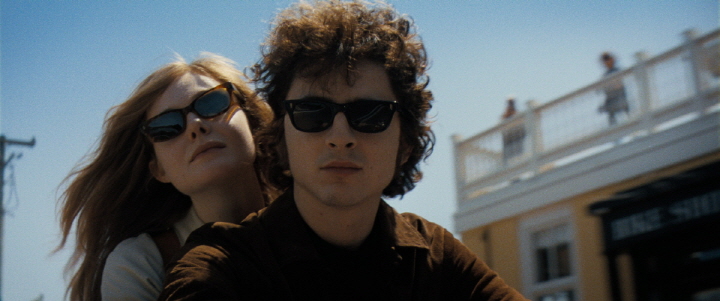
Although Dylan remains a very distant figure to the end, Chalamet, who was Oscar-nominated for this film, flawlessly embodies his character’s distinctive qualities instead of resorting to mere mimicry. While never flinching from how Dylan sometimes looks like your average stubborn artist prick, Chalamet ably suggests the insecurity and vulnerability behind his character’s aloof façade, and he is also excellent in a number of obligatory musical performances in the movie.
Several principal cast members in the film simply come and go around Chalamet, but they leave some impression on us despite that. Edward Norton is effective in his gentle supporting performance, and he is especially wonderful when his character comes to recognize and then accept that Dylan will never be the successor to Guthrie as expected by many others including Seeger. Monica Barbaro, who was Oscar-nominated along with Chalamet and Norton, and Elle Fanning are well-cast in their respective supporting roles, and the same thing can be said about a bunch of notable performers including Boyd Holbrook, Dan Fogler, Norbert Leo Butz, P.J. Byrne, Michael Chernus, and Scoot McNairy, who speaks volumes in his mostly silent performance.
To be frank with you, I am still scratching my head on Dylan as a human being, but I must also admit that “A Complete Unknown” is a well-made biographical musical drama film. Sure, this is a conventional stuff relatively less ambitious and interesting than how Todd Haynes creatively and fascinatingly presented Dylan’s life and career in “I’m Not There” (2007), but there are some entertaining elements including the good efforts from Chalamet and several other cast members at least, and I will not grumble for now.


 Seongyong's Private Place
Pingback: My Prediction on the 97th Academy Awards | Seongyong's Private Place