
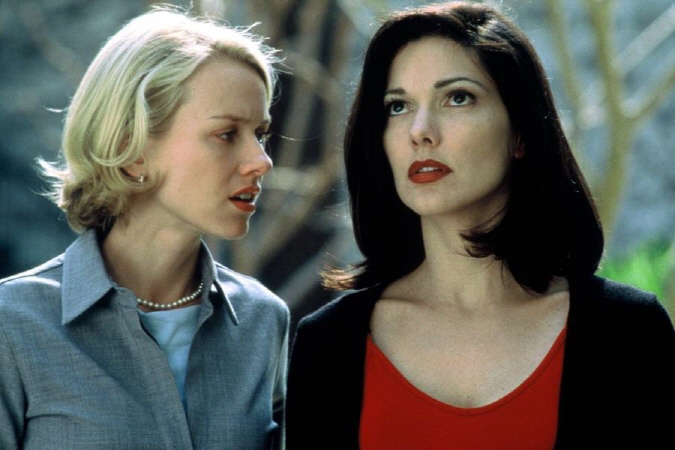
Somebody must be sad, regretful, and fading away. That is a lingering impression I get whenever I visit David Lynch’s 2001 film “Mulholland Drive”, which happens to be re-released here in South Korean theaters not long after Lynch’s death in last month. Although I still have no clear idea on who that person really is in the movie, many of its strikingly enigmatic moments are still quite compelling to watch, and these fascinating moments keep me wondering about what it is about while also mesmerized by how it is about.
On the surface, the first half of the movie seems to be your typical Hollywood adventure story. A young aspiring actress named Betty Elms (Naomi Watts) comes to Hollywood, while being full of hope and dream just like many other countless young actresses out there in Hollywood. Fortunately, she is allowed to stay in a nice and comfortable apartment belonging to her actress aunt during her aunt’s temporary absence, and she is certainly determined to do her best for the upcoming audition.
However, right from her first day in Hollywood, she encounters someone quite unexpected. It turns out that there is a mysterious young woman hiding inside the aunt’s apartment, and this young lady is quite confused and scared due to being not able to remember who she is. All she can remember is that she had a car accident on Mulholland Drive, and she eventually presents herself as “Rita” (Laura Harring), a name which she instantly got from the old poster of a certain famous Rita Hayworth film.
Sincerely feeling sorry for Rita, Betty tries to help her as much as possible, but we already know that there is something sinister happening somewhere out there in Hollywood. As shown from the opening scene, somebody wants to eliminate Rita, and both the local police and those figures associated with that incident are already looking for her. In case of the latter, they are also probably the ones pressuring a certain promising young movie director for having some “right girl” cast as the lead role of his upcoming movie.

However, of course, things go pretty weird here and there as you can expect from a David Lynch film, and the movie throws small and big moments to intrigue and then puzzle you. There is a darkly absurd moment where a guy who inadvertently causes much more mess than planned. There is a truly spooky scene where a man tries to show his friend what has been scaring him in his recurring dream. There is a charmingly cheerful old-fashioned musical moment which subtly spreads an ambiguous tone under the surface. And there is also a disturbing scene where Betty and Rita discover something very, very, very unnerving in the middle of their own Nancy Drew adventure.
After a certain narrative point later in the story, all these and many other things in the film are re-arranged and then reassembled to leave us with more interest and bafflement. As the movie continues to blur the line between reality and dream, we become more doubtful about not only Rita but also Betty, and we keep getting puzzled as not totally discerning what is actually happening around them.
In my trivial opinion, I think the movie is more or less a stream of unconsciousness swirling inside a mind riddled with a lot of guilt and sadness. Fragments of memories and experiences simply come and go without making much sense at all, and the last act of the film, which incidentally becomes quite more ambiguous than before, may reflect the painful awakening of that mind toward the emerging harsh reality, though I cannot tell you anything certain about the actual reality beneath the story and characters.
Yes, it is quite possible that everything in the film is not real at all, but what a spellbinding experience it is. While frequently resonating with its main background in one way or another (After all, Hollywood itself has been regarded as a sort of dream factory, right?), the movie playfully bounces around numerous various elements ranging from show business satire to lesbian erotica, and the overall picture is often astounding for Lynch’s artistic ambition and confidence. You may scratch your head from time to time, but you cannot take your eyes away from the movie at all because Lynch always gets things under control in his own way, and we do not complain much even when the movie eventually ends with more mystery and puzzlement.

As many of you know, the movie was initially produced as the pilot episode of a TV drama series planned by Lynch himself. We will never know what Lynch would have presented if that TV drama project of his had been green-lighted (Would it have been something like the subsequent third season of “Twin Peaks”, I wonder?), but what he developed further from that pilot episode led to another breakthrough in Lynch’s career, and he became highly regarded more than before thanks to that (The excerpt from Roger Ebert’s enthusiastic 2001 review: “David Lynch has been working toward “Mulholland Drive” all of his career, and now that he’s arrived there I forgive him for “Wild at Heart” (1990) and even “Lost Highway” (1997).”).
Above all, “Mulholland Drive” shows more of heart and soul like Lynch’s previous work “The Straight Story” (1999). Yes, Betty and Rita are certainly archetypes just like many other colorful figures in the story, but many of emotional moments between them are handled with sincerity and sensitivity, and Naomi Watts and Laura Harring, who became more notable thanks to the critical success of the movie, are simply terrific as fluidly modulating their good performances along the dream narrative of the film. Even though we are not so sure about Betty and Rita’s respective real identities, we care about their dreamy drama nonetheless, and that is the source of the lingering sadness and regret hovering over the movie.
Although it has been almost 25 years since it came out, “Mulholland Drive” remains as the pinnacle of Lynch’s long and illustrious filmmaking career. You may not like all of his works, but each of them is distinctive for his own style to be cherished, and you will agree that he was indeed one of the greatest filmmakers of our time. Good night, Mr. Lynch, it has been really a pleasure to admire and appreciate your cinematic art.


 Seongyong's Private Place