

French film “The Animal Kingdom” is a modest but intriguing SF drama with enough style and substance to interest and then engage us. Although it is rather a bit too vague about its story premise, the movie stays focused on story and characters in addition to having a fair amount of mood and details to observe, and the result is an interesting genre piece with some haunting qualities to be appreciated.
Right from the beginning, the movie throws us right into how things have become quite different for its two main characters, François (Romain Duris) and his teenage son Émile (Pual Kircher), and many others around the world. There has been the global outbreak of a mysterious disease turning humans into various animals, and the French government has been trying to get things under control via isolating many of those infected people as much as possible, though numerous people still get infected and then isolated everyday.
In case of François, his wife has been hospitalized since she turned out to be infected, and, despite his hope and efforts, his wife has only become less and less human instead. In the end, his wife is going to be sent off to some secluded area located somewhere in Southern France along with many other infected people, so he decides to move to that area along with his son, though Émile is not so particularly pleased about that as getting more distant from not only his father but also his infected mother.
However, an unexpected incident happens not long after François and his son move to that region. A carrier truck carrying those infected people including François’ wife crashed down to a river before its arrival, and it looks like many of those infected people in the truck managed to survive and then escape. As the local police embark on hunting for these fugitives, François decides to look for his wife for himself, and his son joins him although he still feels conflicted about his mother.
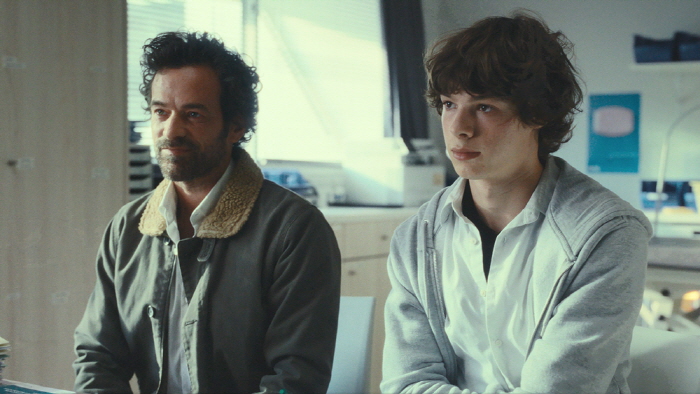
Not so surprisingly, François soon finds himself facing dead ends in his rather unproductive search process, while also reminded of how the circumstance becomes more serious for him and many others in the region. As a female local police officer informs him later, the military already join the search, and both the police and the military are ready to kill those infected people if that seems necessary.
This makes François all the more determined to find his wife, but this also makes him more distant to his son, who turns out to have some very serious issues behind his mostly passive attitude. While struggling to adjust himself to his new school, Émile also finds his own body beginning to show a number of alarming signs, and that makes him more withdrawn from his father.
Patiently rolling the story and characters, director/co-writer Thomas Cailley, who wrote the screenplay with Pauline Munier, also pays a lot of attention to bringing considerable realism to the screen. While it surely utilizes a lot of CGI in case of depicting several infected figures in the film, the movie dryly maintains a considerable degree of realism on the screen, and these infected figures certainly make a striking impression on us whenever they enter the plainly realistic background of the film.
Above all, the movie makes us care more about the relationship drama between its two main characters. While he is not exactly the one who can get the Father of the Year award, François simply does what he thinks is the best for his wife as well as his son, and Émile understands that to some degree. Although they do not communicate that well with each other, they also care a lot about each other nonetheless, and that is evident particularly when François makes a big important decision for his son later in the story.

Under Cailley’s competent direction, his several main cast members are convincing as ordinary people trying to handle their extraordinary situation. Romain Duris, who was terrific in Jacques Audiard’s “The Beat That My Heart Skipped” (2005), is effective as embodying his character’s gritty determination, and his intense performance is matched well with the sensitive low-key acting of Paul Kircher, who is incidentally the eldest son of Irène Jacob and Jérôme Kircher. Whenever they are together on the screen, Duris and Kircher deftly convey to us the shared long history between their characters, which comes to function as the solid ground for the eventual climactic part of the story.
In case of the other main cast members, they just occupy their respective spots around Duris and Kircher, but some of them manage to elevate their thankless supporting roles a bit. While Adèle Exarchopoulos, who has steadily advanced since her breakthrough performance in “Blue Is the Warmest Color” (2013), is rather under-utilized to my disappointment, Tom Mercier and Billie Blain are well-cast in their respective substantial parts, and they have each own moment to shine along the story.
In conclusion, “The Animal Kingdom”, which is the second feature film from Cailley after “Love at First Sight” (2014), works fairly well despite some weak points, and I admire its mood, storytelling, and performance enough on the whole. Although I have not seen “Love at First Sight” yet, “The Animal Kingdom” shows that Cailley is another promising filmmaker to watch, and it will be interesting to see what he may do next after this engaging genre film.


 Seongyong's Private Place