

Japanese film “Ripples”, which happens to be released in South Korean theaters in this week, is a distant but occasionally amusing character study to observe. Although you may not like its rather neurotic heroine that much, you will also observe her behaviors with some fascination at least, and you will come to wonder more about what may happen in the end.
The opening part, which is set in 2011 March, introduces us to a middle-aged housewife named Yoriko Sudo (Mariko Tsutsui), and the movie observes how her daily life is abruptly disrupted in more than one way. As the whole nation is being shaken by the Fukushima nuclear accident, Yoriko tries to continue her daily life as usual despite being concerned about drinking water as much as her neighbors, but then her husband is suddenly gone missing for no apparent reason.
The story immediately moves forward to around 10 years later. After her husband’s inexplicable disappearance, Yoriko had to take care of her remaining family members including her dying father-in-law, and we later come to learn that she inherited everything from her father-in-law after his death. After her son eventually left for his college study, she has lived alone in the family house while working at a local supermarket for earning her living, and we often observe how she is particularly fastidious about the maintenance of a little Japanese dry garden inside her residence.

However, there is one serious matter in Yoriko’s daily life. Not long after her husband’s disappearance, she came to join a rather silly cult group strongly believing in a certain special water supposed to have a spiritual cleaning/healing power. Regardless of how much she actually believes, she has showed considerable devotion to her cult group, and we cannot help but amused by how she and several other cult members easily let themselves deceived by their questionable leader.
And then something unexpected happens on one day. When she returns to her residence, she is approached by her husband, and it turns out that he has been ill due to a very serious case of cancer. According to him, he needs to be treated with some very expensive medicine, and he certainly needs his wife’s help as having been virtually penniless and homeless during last several years.
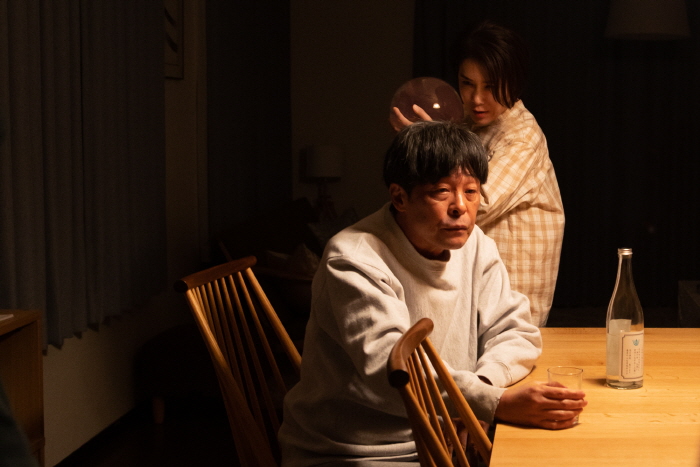
It goes without saying that Yoriko does not welcome her husband’s return at all, but she lets him stay in the house, and he certainly begins to annoy her in one way or another. Besides rudely behaving as if he is entitled to live there, he often looks around here and there in the house for finding anything to benefit him, and, above all, he does not show much consideration on his wife’s religious activities. Naturally, Yoriko comes to lean more on her cult group and its leader, but the leader only sees more chance to deceive and then control Yoriko more than before.
As advised by her leader, Yoriko tries to be nice and good as suppressing any dark thought and feeling inside her, but, of course, that turns out to be not so easy to her frustration. Her husband keeps behaving like a jerk, and there is also a very rude old customer who often bullies Yorko and other supermarket employees. In addition, her son has some surprise news when he visits her residence later, and Yoriko cannot accept what he is soon going to do regardless of whether she approves of that or not.
Meanwhile, there comes an unexpected moment of friendship from a middle-aged janitor at Yoriko’s workplace. Whenever she spends some time with her unlikely new friend, Yoriko feels a little better mainly due to the no-nonsense attitude of her friend, though it subsequently turns out that she also has a fair share of personal issues just like Yoriko.
As one audience sitting near me during the screening observed, there is not any normal person in the story, but the movie continues to engage us even while continuing to maintain its distant attitude toward its heroine’s mental struggles along the story. As the camera of cinematographer Hideo Yamamoto often calmly sticks to its static position, we become more aware of the subtle emotional tension beneath the screen, and that is evident whenever Yoriko does her routine maintenance work on her dry Japanese garden.
The screenplay by director/writer Naoko Ogigami, who has steadily built up her filmmaking career since her first feature film “Yoshino’s Barber Shop” (2004), depends a bit too much on symbolism during several key scenes in the story, but it did a good job of steadily building the characters along the story, and the main cast members are mostly solid in their low-key performance. While Mariko Tsutsui firmly holds the center, several other main cast members including Ken Mitsuishi, Midoriko Kimura, and Hayato Isomura have each own moment to shine around Tsutsui, and Kimura is particularly fun to watch when her character casually provides some common sense to Yoriko at one point.
On the whole, “Ripples” works as a dryly wry mix of comedy and drama, though it may require some patience from you at first due to its rather slow narrative pacing. I must confess that I often got baffled or impatient during my viewing, but the movie is interesting enough on the whole, so I recommend you to give it a chance someday.


 Seongyong's Private Place