
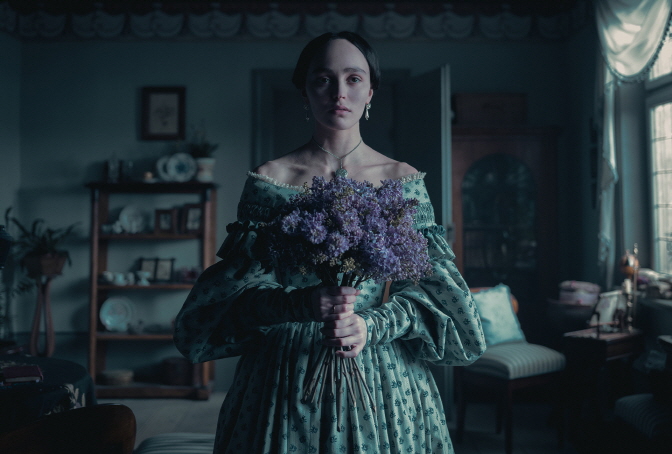
Robert Eggers’ new film “Nosferatu” is something he has been destined to make. After all, his three previous films, “The Witch” (2015), “The Lighthouse” (2019), and “The Northman” (2022), are all intensely gothic in one way or another, and his remake of F.W. Murnau’s 1922 classic silent horror film “Nosferatu: A Symphony of Horror” certainly confirms to us again that he is indeed a grim and intense wunderkind of horror.
The story, which is set in 1833, closely follows the footsteps of its 1922 senior. A promising young lawyer named Thomas Hutter (Nicholas Hoult) is instructed by his new employee to visit a shabby big castle located somewhere in the rural region of Transylvania, because he needs to handle the contract documents to be signed by the mysterious owner/occupant of that castle. Needless to say, that figure is question, Count Orlok (Bill Skarsgård), is an old vampire who has been quite eager to be set loose onto the world outside, and Hutter soon finds himself confronting the unspeakable horror of his fiendish host.
Besides spreading his evil influence all over the outside world, Count Orlok, who surely looks as spooky and grotesque as required, also has the other purpose behind his back. As shown from the opening scene of the film, Hutter’s wife Ellen (Lily-Rose Depp), who happens to have a sort of supernatural sense, got her mind connected with Count Orlok in the middle of one of those unstable night of hers some years ago, and she inadvertently beckoned him at that time.
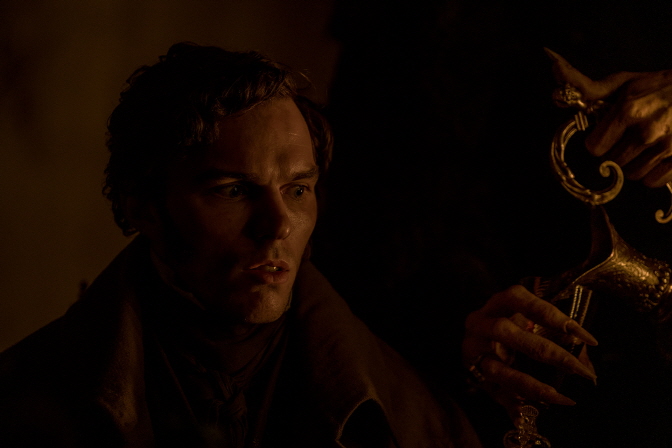
After her husband left their city for Romania, Ellen soon finds herself overcome by the unfathomable sense of dread, and her mental condition gradually gets worsened as Count Orlok is already reaching to her from the distance. Quite concerned about her, Hutter’s friend Friedrich Harding (Aaron Taylor-Johnson) and his wife Anna (Emma Corin), who is incidentally Ellen’s best friend, call for Dr. Wilhelm Sievers (Ralph Ineson), and, after very perplexed and disturbed by the increasingly disturbing symptoms shown from Ellen, Dr. Sievers eventually decides to get some second opinion from his eccentric mentor Professor Albin Eberhart Von Franz (Willem Dafoe), who has a fair share of knowledge on the certain areas ignored by modern science.
Around this narrative point, the movie dials up more the level of tension and dread across the screen, and we are served with a number of darkly disturbing moments including the ones clearly influenced by Murnau’s 1922 film. We see more of how Hutter gets more terrified by the creepy aura of doom from Count Orlok. We watch the doomed voyage of a cargo ship which happens to carry something very important to Count Orlok. And we also behold how Count Orlok unleashes his evil influence across the city once he eventually arrives (The movie did a nice homage to another famous classic silent horror film of Murnau, by the way).
All these and many other insidious moments are vividly and strikingly presented on the screen by Eggers and his crew members. His frequent cinematographer Jarin Blaschke, who was Oscar-nominated for “The Lighthouse”, often evokes the qualities of black and white film especially during numerous nocturnal scenes in the film, and the resulting moody visual texture of the film is further accentuated by the oppressive score by Robin Carolan, who previously collaborated with Eggers in “The Northman”.

The movie surely relies a lot on its titular character, and Bill Skarsgård, who has been a frequent performer for playing evil characters since his diabolical villain performance in Andy Muschietti’s “It” (2017) and “It Chapter Two” (2019), has some grim fun with playing one of the creepiest monsters in the movie history. While mostly covered with a lot of makeup and CGI, Skarsgård deftly exudes evil and menace even when the camera does not show much of his character, and the result is another impressive performance in his advancing acting career.
On the opposite, the other main cast members function as the counterparts to Skarsgård, but they hold each own place well in their respective spots. While Nicholas Hoult, who incidentally played Count Dracula’s servant in “Renfield” (2023), is quite convincing in his character’s accumulating terror and dread along the story, Aaron Taylor-Johnson and Emma Corrin manage to bring some personality to their rather thankless roles, and Ralph Ineson, who previously appeared in “The Witch”, and Simon McBurney are well-cast in their crucial supporting characters. In case or Lily-Rose Depp, who is, yes, the daughter of Johnny Depp, she shows a lot of admirable commitment a la Tobe Hopper’s SF horror film “Lifeforce” (1985) as her character goes through a series of ups and downs throughout the film, and Willem Dafoe surely brings a touch of class to his rather hammy role as he previously did in “The Lighthouse” (You may be also amused to remember that he was Oscar-nominated for playing a real vampire playing Count Orlok in E. Elias Merhige’s overlooked black comedy horror film “Shadow of the Vampire” (2000)).
On the whole, “Nosferatu” is another interesting genre work from Eggers. Although I thought “The Lighthouse” and “The Northman” were mildly interesting genre exercises compared to his first feature film “The Witch”, I admire their technical qualities enough at least, and “Nosferatu” shows some more progress in my humble opinion. I must point out that this is a rather tough stuff you cannot easily enjoy, but it will leave some indelible impression, and you will surely admire it more if you have watched its 1922 senior.


 Seongyong's Private Place
Pingback: My Prediction on the 97th Academy Awards | Seongyong's Private Place