
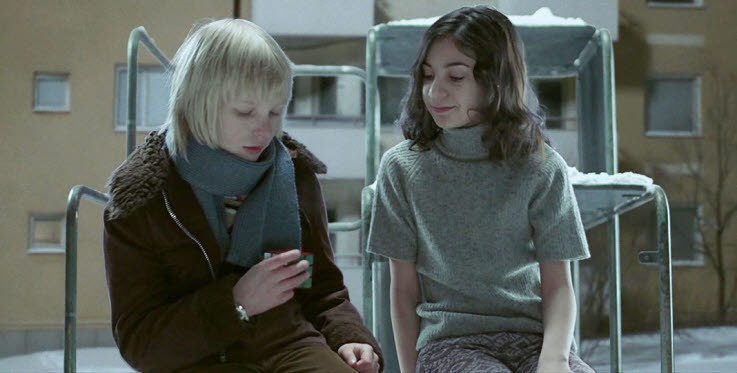
Is there any vampire movie as sad and poignant as the 2008 Swedish film “Let the Right One In”? This is a hauntingly chilly romance horror tale of loneliness and desperation, and I am glad to report to you that it does not lose any of its dark emotional power at all even though more than 15 years have passed since it came out.
The story is set a suburban neighborhood of Stockholm, Sweden in 1982, and the early part of the film succinctly establishes how things have been miserable for a 12-year-old boy named Oskar (Kåre Hedebrant). Probably because of his rather fragile appearance, he has been often bullied at his elementary school, but he has been neglected at both his home and school, and the opening scene shows him struggling to process his deep anger and resentment alone in his room during one cold night.
And that is when he notices the two figures moving into an empty apartment right next to the one where he and his divorced mother live. It is apparent that there is something suspicious about these two mysterious figures, and Oskar subsequently encounters one of these two figures, who turns out to be a young girl around his age. Her name is Eli (Lina Leandersson), and, though their first encounter is not exactly cordial, she and Oskar come to befriend each other more as discerning the deep loneliness in each other.
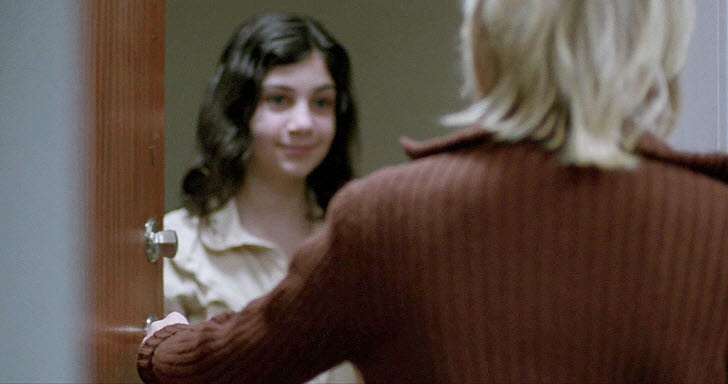
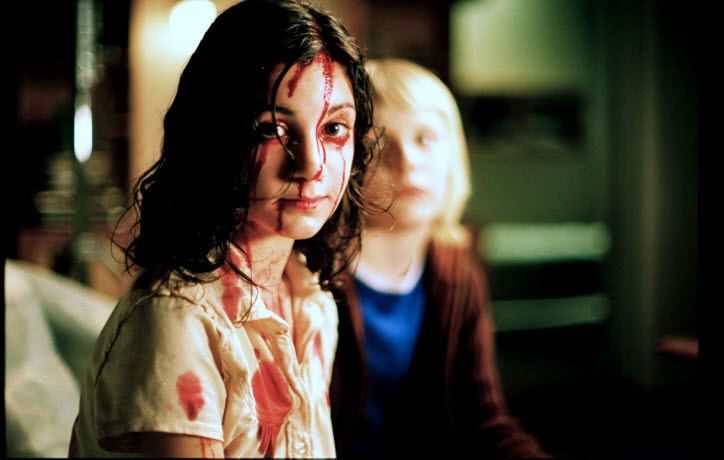
While spending more time with each other, Oskar finds himself more smitten with Eli, but, as it is gradually revealed to us along the story, Eli is not a normal girl at all. She is actually a vampire who has lived for several centuries at least, and we come to gather that her guardian, who is incidentally a middle-aged man, is not her father but actually her servant who often kills people for getting some human blood to satiate her unspeakable hunger.
Patiently rolling the story and characters, the screenplay by John Ajvide Lindqvist, which based on the novel of the same name written him, doles out a number of familiar genre conventions. While having some supernatural power, our vampire girl cannot eat anything besides human blood, and she must always avoid sunshine. Above all, as reflected by the title of the movie, she can get inside only after being invited, and we later see what can happen to her if she ever breaks that time-honored rule for vampires like her.
It does not take much time for Oskar to learn the horrific secret of his new friend, but, despite his initial horror and surprise, he does not mind this much because, well, he still likes Eli and both of them are comforted a lot by their unlikely relationship. Sure, Eli is actually quite much older than Oskar, but that does not matter much to both of them as they come to sense more of the kinship between them, and we later wonder whether this is actually the beginning of another chapter in many centuries of Eli’s existence.
However, the movie never forgets its horror story elements as Eli often gets hungry again, and the overall mood is darkened more by not only the stark ambiance of winter night but also the glum mood shared by the adults residing in Oskar’s neighborhood. While his mother is often too busy with her work to pay attention to her son, his father, who currently lives alone at some remote spot outside the city, disappoints Oskar a lot when a friend of his visits for some night drinking. In case of many other adults in the neighborhood, most of them are pathetic losers who usually spend their nighttime at a local bar, and their several scenes reflect how depressing things were many people in Sweden during that time due to the failure of their social system.
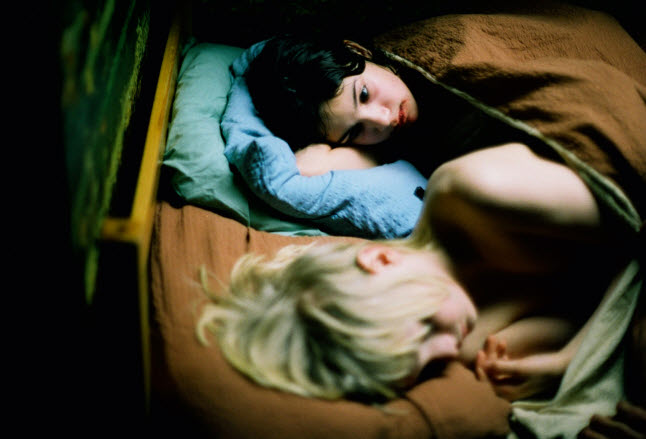
In such a barren and melancholic environment like that, the budding romantic relationship between Oskar and Eli feels somewhat touching to us, and the chilly aspects of their unlikely romance are often accentuated by the cold poetic beauty of the cinematography by Hoyte van Hoytema, who would eventually move onto a number of notable Hollywood films including several works of Christopher Nolan (He won an Oscar for Nolan’s latest film “Oppenheimer” (2023) early in last year, by the way). He and director Thomas Alfredson, who also became more prominent as directing “Tinker Tailor Solider Spy” (2011) later, frequently fills the screen with the palpable sense of coldness and loneliness, and you may want to hold a hot cup of coffee or tea while watching the film.
The movie also depends a lot on the unadorned good chemistry between its two young lead performers, who incidentally made a movie acting debut here in this film. While Kåre Hedebrant is alternatively disturbing and harrowing as the deeply trouble young hero of the story, Lina Leandersson balances her character well between icy beauty and bloody horror, and they ably illustrate the dramatic relationship development between their characters along the story. In case of several adult performers surrounding them, they are all believable in their respective supporting parts, and the special mention goes to Per Ragnar, whose horrific character is somehow more sympathetic to us as we reflect more on the very last scene of the movie.
In conclusion, “Let the Right One In”, which happens to be re-released in South Korean theaters in the same week when Robert Eggers’ “Nosferatu” (2024) arrives in South Korea, is still a powerful vampire film to be appreciated and admired, and its considerable achievement shines more and more after we survived those Twilight flicks. As a matter of fact, I was rather tired when I watched the movie yesterday evening, but I soon got quite engaged as I did many years ago, and that says a lot about the undeniable emotional power of this very special film.
Sidenote: Yes, the movie was followed by the 2010 American remake version. That is also a fairy good one, but I still prefer the original version a bit more.


 Seongyong's Private Place