

You should have some patience in case of the works of Turkish filmmaker Nuri Bilge Ceylan. I saw “Once Upon a Time in Anatolia” (2011), “Winter Sleep” (2014), and “The Wild Pear Tree” (2018), and they are quite long in their running time. Nevertheless, they actually become more engaging than expected once you simply go along with their slow but steady narrative flow, and his latest work “About Dry Grasses”, which was selected as the official submission of Turkey to Best International Film Oscar in 2023, is no exception.
The movie, which is set in some remote region of Eastern Anatolia during one cold and snowy winter, mainly revolves around Samet (Deniz Celiloğlu), a teacher who has just returned to a village where he has worked during last few years. His holiday is over, and he and his colleague Kenan (Musab Ekici), who has incidentally lived with him as a housemate, now have to prepare for another semester in their school.
As observing how he and several other teachers start the first day of the new semester in their school, we come to sense more of how much Samet has been frustrated with his current status. Mainly because of the isolated rural environment surrounding the village, Samet has been eager to get any possible chance to be transferred to any city out there, but it seems that he will be stuck here for several years more, and his teaching work brings no particular joy or satisfaction to him at all, though he tries his best for teaching his classroom students more.
Besides Kenan, Samet does not have anyone to talk with in the village besides two guys who have been his frequent drinking companions. The mood gets lightened up a bit as they drink together later, but they still all feel depressed and miserable in each own way while talking more and more with each other, and this surely makes Samet all the more bitter about how his life and career have been going nowhere.
On one day, there comes an unexpected trouble to Samet and Kevan. Not long after Samet happens to clash a bit with one of his female classroom students who has been quite nice to him, he and Kevan are accused of some unspecified misconduct, and this certainly brings lots of headache to not only them but several others around them. Understandably quite exasperated, Samet attempts to get to the bottom of the situation, but nobody wants to talk openly about that allegation against him and Kevan, and he only comes to show his worse sides to others around him including his classroom students.
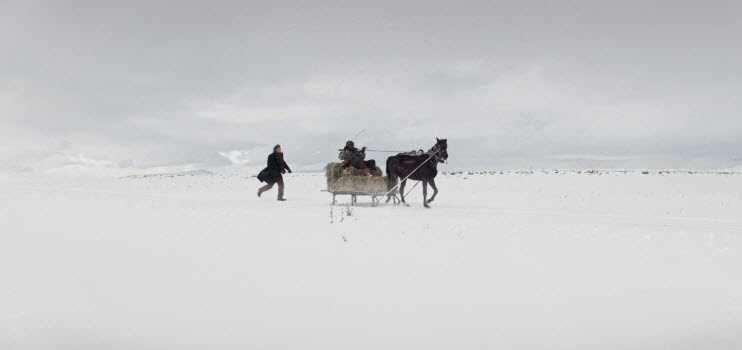
Now you may think the plot finally thickens a bit, but the screenplay by Ceylan, who also co-edited the film with Oğuz Atabaş, and his co-writers Ebru Ceylan and Akin Aksu continues to roll the story and characters slowly and steadily while focusing more on mood and characterization. As the camera of cinematographers Kürşat Üresin and Cevahir Şahin vividly captures the cold wintry atmosphere surrounding the characters in the film, the frequent shots of those vast snowy landscapes become more oppressive along the story, and we come to sense more of Samet’s growing exasperation and frustration.

Although he becomes more misanthropic as letting himself driven by his petty anger and resentment, Samet also comes to us as a believable human figure to observe at least, and Deniz Celiloğlu did a good job of embodying his character’s rather unpleasant human flaws. Even when Samet does not seem to signify much on the surface, Celiloğlu’s subtle performance ably conveys to us his character’s quietly sour state of mind, and this sometimes generates a considerable dramatic tension in case of several key scenes in the film, which are driven by long but tense dialogues as you can expect from Ceylan.
One of such scenes happens between Samet and Nuray (Merve Dizdar), a woman who came to work as a teacher after losing one of her legs due to some terror incident. When he is introduced to her early in the story, Samet is not very interested in her, and he remains distant even when Kenan becomes attracted to Nuray later in the story, but then he changes his mind after coming to learn something about Kenan. He deliberately makes her have a little dinner only with him at her residence, and their dinner is soon followed by a rather intense political conversation between them. As they push and pull each other over their very different sociopolitical viewpoints, the movie deftly builds up tension across the screen, and Celiloğlu and Dizdar, who deservedly won the Best Actress Award when the movie was premiered at the Cannes Film Festival early in 2023, are simply superlative in the gradually dynamic interactions between their characters.
While its long running time (197 minutes) may feel cumbersome to you from the start, “About Dry Grasses” is another interesting work from Ceylan, and I admire it even though I struggled a bit to grasp what is actually about. I am not so sure about whether a certain moment of breaking the fourth wall works as well as intended, and I also think the epilogue part, which makes a striking visual contrast with the rest of the film for a good reason, is a bit redundant. Nevertheless, the movie is still worthwhile to watch thanks to Ceylan’s confident handling of mood, story, and characters, and you should give it a chance if you are ready for something different.


 Seongyong's Private Place