
When I was young and wild during the 1990s, I voraciously consumed any book good enough to intrigue my innocent and curious mind. At first, it was just a bunch of science books which were the origin of my current professional career, When I grew up more later, I also got quite interested in reading novels, and my taste was rapidly widened as I willingly threw myself into the works of various novelists ranging from Agatha Christie and James Joyce to Stephen King and Sidney Sheldon. In other words, I was ready for anything, and I must tell you that my resulting wide taste has compensated for those occasional moments of snobbism during last 30 years.
Among these numerous books I busily engulf during those exciting days of my childhood years, the first two novels of Umberto Eco (1932~2016) were two of the most important ones in my childhood years. Although I do not think I totally understood the subjects and themes of these two interesting novels at that time, I was genuinely impressed by not only his good storytelling but also his immense intelligence glimpsed between words and lines nonetheless, and I really wished to be as vastly knowledgeable as this acclaimed Italian academic figure someday.
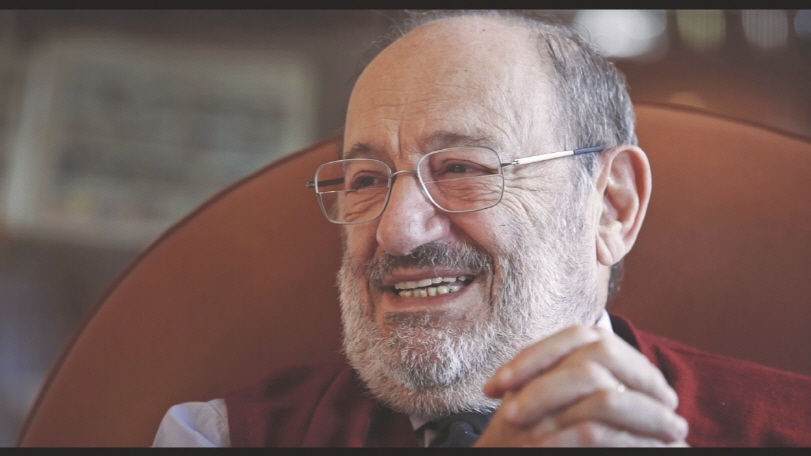
That is the main reason why I did not hesitate to grab the chance to watch documentary film “Umberto Eco: A Library of the World” at a small local independent movie theater early in this morning, and I am happy to report to you that the documentary alternatively delighted and enlightened me. Although it does not show that much about Eco as a human being, but it freely explores his immense personal library and a truly brilliant mind behind it, and that surely tells us a lot about Eco as a scholar.

At first, the documentary simply looks around Eco’s personal library, which incidentally occupies a lot of his residence for having around 30,000 books at least. Regardless of whether he actually read them all, a number of old books shown in the documentary convey to us Eco’s irrepressible intellectual curiosity in many different fields ranging from comic books to symbology, and he was surely an interesting figure to observe as shown from a bunch of archival interview clips shown in the documentary.
Even as lots of books got digitalized day by day, Eco simply preferred to collect and read books instead because, as he correctly perceived, what is written on paper can actually last more than whatever has been stored in computers and data storage systems. In addition, he also discerned the growing importance of selecting and gathering real information and knowledge during our current digital era, and he made a shrewd point on how many people can be stuck in each own world due to the increasing chaos and confusion on the Internet.
However, Eco was not your average snobbish scholar at all, considering how equally he evaluated many different subjects. While he was a first-class intellectual with the vast knowledge on history, culture, and language, he was fascinated with the popular culture stuffs such as Superman or Snoopy, and he could be quite funny with his carefree wit and humor, as shown from one brief interview clip in the middle of the documentary. His surviving family members including his wife also fondly remember him, and you may be get tickled a bit when his grandson remembers when he got some extra help on his little homework from his dear grandfather.
Meanwhile, the documentary has several figures quoting the excerpts from the essays written by Eco himself, and we get to know more about Eco’s own philosophy and intelligence. To be frank with you, I do not totally understand the contents as a guy not so familiar with philosophy, but they still intrigued me nonetheless, and I became more determined to check out more of Eco’s essay books later.

Needless to say, the most interesting part of the documentary for me is how Eco became quite a popular public figure thanks to the unexpected success of his first novel “The Name of the Rose”. Although he was not so interested in writing stories at first, he eventually decided to write his first novel after being asked to write a short mystery story, and the big success of “The Name of the Rose” made him very famous not only in his country but also around the world.
In my trivial opinion, Eco’s second novel “Foucault’s Pendulum” is more interesting in comparison, and it is a shame that the documentary does not delve much into how that compelling novel is a sort of anti-thesis to those passable novels of Dan Brown including, yes, “The Da Vinci Code”. As wryly making a intellectual fun on conspiracy theories, “Foucault’s Pendulum” makes an acerbic point on their inherent danger, and Eco certainly did not mince his words on Dan Brown at all.
Although it is rather short in its running time (80 minutes), “Umberto Eco: A Library of the World”, directed by Davide Ferrario, is still a fairly rich experience on the whole, and you will be definitely entertained if you are a typical bookworm like me. While my own little library is much more modest compared to Eco’s, I tend to keep whatever I read for preserving my own knowledge and experience to share with many others around me, and I sincerely hope that my library will be more bountiful as I keep reading during the rest of my life.


 Seongyong's Private Place