
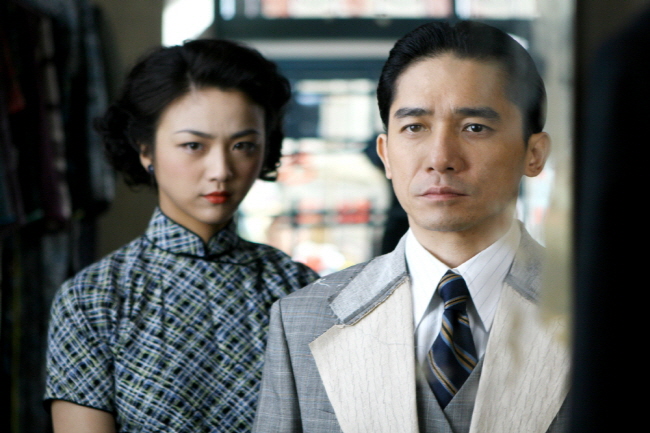
Ang Lee’s 2007 film “Lust, Caution”, which is currently being shown again in selected South Korean theaters, is a slow but sensual period drama which works best whenever it focuses on the guarded psychology of the two very different main characters at the center of its story. While both of them are quite reserved for each own reason, they are also helplessly attracted to each other, and the movie willingly goes all the way along with them as they heedlessly throw themselves into lust despite also being restricted by caution at the same time.
The prologue scene, which is set in Shanghai, China in 1942, shows four women playing Mahjong together inside a luxurious house belonging to one of them. She is Mrs. Yee (Joan Chen in a rather thankless supporting role), and we come to gather along the story that her husband, Mr. Yee (Tony Leung Chiu-wai), is a powerful high-ranking official of the puppet government installed by the occupying Imperial Japanese Army.
When Mr. Yee unexpectedly stops by the house, it becomes apparent to us that there is something going on between Mr. Yee and one of his wife’s Mahjong friends, who looks evidently younger compared to her fellow Mahjong friends. Not long after Mr. Yee leaves, she also leaves for somewhere, and then it turns out that she is involved in some clandestine operation against Mr. Yee.
And then the movie goes back to Hong Kong, 1938. “Mrs. Mak” is actually a college student/actress named Wong Chai Chi (Tang Wei), and the first act of the film shows us how she and her fellow performers try to assassinate Mr. Yee. Although they do not know anything about assassination from the beginning, they happen to have an opportunity to get closer to Mr. Yee while he is visiting Hong Kong, and Wong is certainly ready to push herself and her acting talent more for that. She and one of her colleagues present themselves as “Mr. and Mrs. Mak”, and, what do you know, she soon comes to spend more time with Mr. and Mrs. Yee while her “husband” is often conveniently absent.
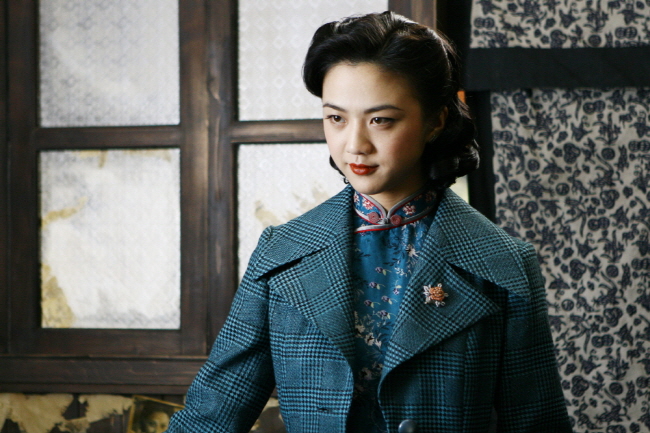
When it is clear that Mr. Yee is quite attracted to “Mrs. Mak”, Wong and her colleagues decide to set a “honey trap” for killing their target, but there is one big problem. Wong happens to be quite inexperienced in case of, uh, physical intimacy, so there soon comes a rather painfully awkward moment between her and a certain colleague of hers who happens to be the only experienced one in their group.
However, there later comes an unexpected plot turn for Wong and her colleagues, and the screenplay by Wang Hui-ling and James Schamus, which is based on the novel of the same name by Eileen Chang, moves back to Shanghai in 1942. As going through another hard day just like many others in the city, Wong is approached by one of her former colleagues who is officially a resistance member now, and this colleague requests her to act again as “Mrs. Mak” in front of Mr. Yee.
While successfully entering the daily life of Mr. and Mrs. Yee again, Wong also draws the attention of Mr. Yee as before, but, what do you know, Mr. Yee turns out to be a much trickier target than expected. Even though he gets more and more attracted to Wong, he is quite watchful while not easily trusting anyone at all, and Wong must try her best for making her target lower his usual guard at least for a while.
For attaining her goal, Wong must submit herself to Mr. Yee’s darkest sexual impulses during their little secret private meeting, and that is where the movie becomes as sensually disturbing as “Last Tango in Paris” (1972) or “The Night Porter” (1974). Not so surprisingly, the movie was rated NC-17 at the time of its initial theatrical release in US, and it surely deserves that rating, considering how explicit its several sex scenes really are.
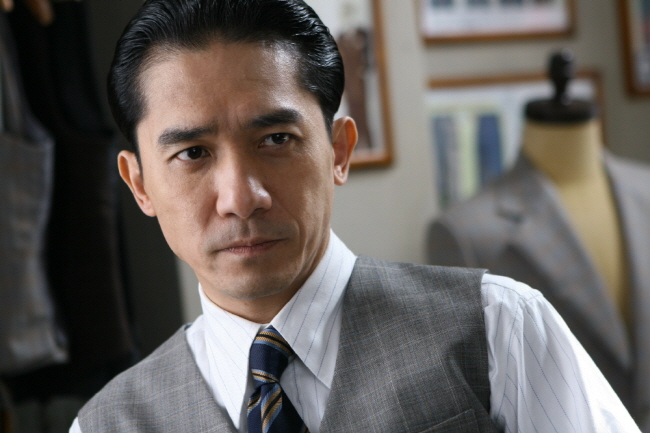
Nevertheless, these sex scenes are more about delving deeper into its two main characters’ conflicted inner feelings than merely illustrating their various carnal acts across the screen, and the two lead performers of the film are thoroughly committed in their daringly raw performance. Tony Leung Chiu-wai, who has been one of the most charismatic actors of our time as recently shown from his stellar villain performance in “Shang-Chi and the Legend of the Ten Rings” (2021), palpably embodies the dark human passion churning behind the reserved façade of his deplorably monstrous character, and his effective restrained performance is complemented well by the equally fearless performance by Tang Wei, who has steadily impressed us a lot with a series of excellent turns for more than 15 years since the movie came out.
It is a bit shame that the finale is quite anti-climactic compared to what has been slowly built up for more than 2 hours, but the movie is filled with goodies to be admired besides its dark and steamy sexual energy. Thanks to cinematographer Rodrigo Prieto, who deservedly received the Golden Osella Award when the movie was premiered at the 2007 Venice International Film Festival (The movie also won the Golden Lion Award for Best Film, by the way), the movie is often filled with vivid period atmosphere and details often evoking those old Hollywood classic films during the 1940s, and this is further accentuated by the elegant score by Alexandre Desplat.
In my consequential opinion, “Lust, Caution” remains on the middle range of Lee’s long and illustrious filmmaking career compared to his several better films including “Brokeback Mountain” and “Life of Pi” (2012), but it is still an interesting work to admire at least. It does not get closer to my heart even at this point, but I appreciate what Lee attempted with his cast and crew members here in this film as before, and that is certainly more than enough for recommendation.


 Seongyong's Private Place