
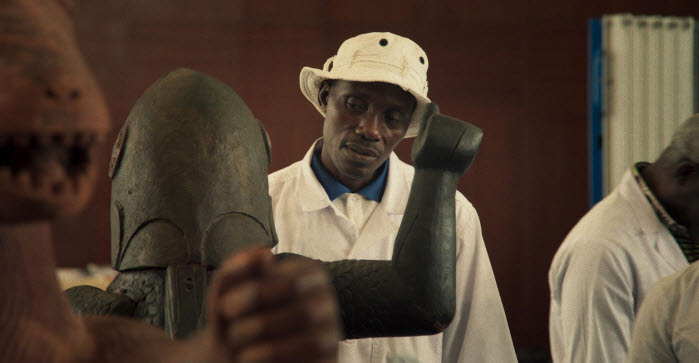
Mati Diop’s documentary film “Dahomey”, which won the Golden Bear award when it was premiered at the Berlin International Film Festival early in last year, mainly revolves around a number of stolen artifacts finally returned to their home country. As explained to us at the beginning of the documentary, around 7,000 of valuable artifacts from the Kingdom of Dahomey (1600 ~ 1904) in Africa were taken to France during the French colonial period (1872 ~ 1960), and the French government eventually agreed to return 26 of those royal treasures to the Beninese government in 2022 only after a public campaign for repatriation.
Instead of giving some more background information on this historical repatriation, the documentary takes a rather unconventional approach to its main subjects. As we observe how some of these 26 artifacts get carefully examined and then packaged inside wooden containers, they speak to us one by one via the voice of the Haitian writer Makenzy Orcel, who incidentally wrote this part of the documentary. This method feels a bit too odd at first, but the words “spoken” by these artifacts sound true and sincere as we pay more attention to them, and we come to reflect that most of those invaluable artifacts in numerous western museums are actually stolen from many other countries around the world.
As the camera of cinematographer Joséphine Drouin-Viallard sometimes looks closely at these artifacts, their historical/cultural value feels more evident to us. In case of the statures of two Dahomey kings, they look pretty simple as broadly depicting the kings as animal gods, but we can clearly sense their old history and culture, while also admiring the considerable artistry observed from these seemingly simple but undeniably striking artifacts.
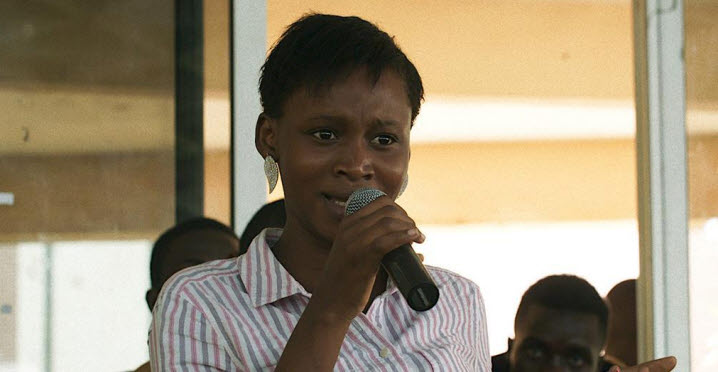
Although the return of these and other stolen artifacts is certainly welcomed a lot by Benin and its people, the returning artifacts feel rather conflicted about their return, and so do many of Beninese people, who have some mixed feelings about this return. This is quite evident when the documentary looks at a student discussion meeting held at the University of Abomey-Calavi, which provides to us a close glimpse into what a complicated matter the return of those artifacts actually is. Throughout the discussion, it is frequently pointed out that only 26 artifacts were selected for repatriation, and some of the students sharply argue that this is just for improving the public image of the French government and the Beninese government, even while recognizing the importance of reclaiming some parts of their cultural heritage.
Many people in Benin also have some ambivalent feelings about the past represented by those returned artifacts, many of which reflect a certain unpleasant aspect of the Kingdom of Dahomey. As shown from recent Netflix documentary film “Descendants” (2022), the Kingdom of Dahomey was closely associated with the slave trade in Africa during the 19th century, and that is particularly evident when the camera focuses on the slave figures decorating the lower part of a royal throne.
While not trying to give any simple answer to these rather complicated issues surrounding those returned artifacts, the documentary just observes how the student discussion often gets intense thanks to the occasional arguments between conflicting viewpoints. The participants are all sincere and passionate in their arguments, and they all care a lot about not only the past but also the present and future of their country. Sure, it is really nice for them and many other Beninese people to see those valuable artifacts returned to their country, and their heated discussions sometimes emphasizes on how the country and its people should move on while also valuing their culture and history more.
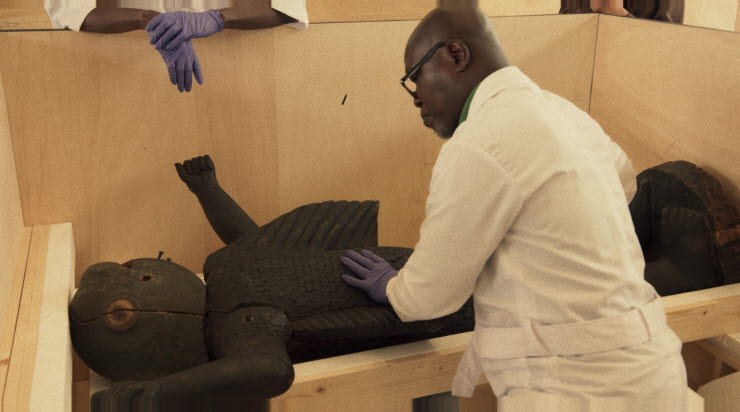
The documentary subsequently moves back to those returned artifacts, and the mood becomes quite reflective as some of them muse a bit on their belated return. Yes, things have changed a lot in their home country during their absence, but life goes on as it always has for many centuries, and they express a bit of hope and optimism in the end.
Before making her first feature film “Atlantics” (2019), Diop made a number of short films and documentaries, and she did a commendable job of presenting the main subjects of her documentary with enough respect and sensitivity. Although I wish that it gave more information about those interesting artifacts, the documentary does not waste any second during its rather short running time (68 minutes), while succinctly making its points to us. In addition, Diop brings some subtle poetic qualities to the documentary as she did in “Atlantics”. As a result, the documentary feels more like a piece of musing to be experienced instead of a conventional history lesson, and some of its key moments will linger on your mind for a long time after it is over.
On the whole, “Dahomey”, which was selected as the Senegalese entry to Best International Film Oscar in last year (It was eventually included the shortlist for Best Documentary Oscar as well as Best International Film Oscar a few weeks ago, by the way), is one of more impressive documentaries of last year, and it surely demonstrates more of Diop’s considerable filmmaking talent. If you admired “Atlantics” as much as I did (I chose it as one of the 10 best films of 2019), the documentary is certainly something worthwhile to check out, and you will come to have more expectation on whatever may come next from Diop.


 Seongyong's Private Place
Pingback: 10 movies of 2025 – and more: Part 2 | Seongyong's Private Place