

Hou Hsiao-hsien’s 2001 film “Millennium Mambo”, whose 4K restoration version was released in South Korean theaters on the first day of this year, is an acquired taste for me just like many of Hou’s films, but it somehow engaged me to my surprise. While phlegmatically observing one messy young woman’s tale of romance from the distance, the movie handles her depressing human condition with some sensitivity and poetry, and its somber but poignant ending will linger on your mind for a while after it is over.
The narration of the film is rather amusing to us now because the narrator observes its contemporary story and characters from 2010. When the movie came out in 2001, 2010 was merely a close future. As we are entering the middle point of the 2020s, 2010 becomes a distant past now, and the movie ironically feels more distant to us.
The first act of the movie revolves around the cheerlessly gloomy human condition of its young heroine, played by Shu Qi, and a lad with whom she has been stuck during last several years. Since they left their respective family homes for more fun and freedom, they have lived in a small and shabby place located somewhere in Taipei, Taiwan, but we see how often they aimlessly throw themselves into more fun and pleasure at every night.

In case of their private life, they are often miserable to be with each other, but it is apparent that they have no other choice besides each other, regardless of whether they really love each other. In one particularly early scene, the lad tries to have some sexual fun with her, but she is not so interested to say the least, and what follows next is one of the most joyless sex scenes I have even seen during last several years.
The lad does not mind at all when his girlfriend later has to work at a local strip club for paying their delayed rent, and that is how she gets close to a local gangster who is actually more generous and understanding than her crummy boyfriend. Nevertheless, she cannot help but get attracted to her boyfriend again and again, and the same thing can be said about him, though they only cause more unhappiness between them as they always did.
They and their night life are certainly not very pleasant to watch, but Hou and his crew members including cinematographer Mark Lee Ping Bin and sound designer Tu Duu-chih, who deservedly received the Technical Grand Prize when the movie was premiered at the Cannes Film Festival in 2001, did a splendid job of immersing us into the glum, stuffy, but undeniably realistic world inhabited by the main characters of the film. Steadily maintaining the distance between itself and the main characters, the camera patiently observes them during a number of extended scenes in the film, and you will appreciate more of the mood and details observed from the screen.
Meanwhile, the overall melancholic mood of the film is sometimes interrupted by the occasional moments of unexpected warmth. At one point in the middle of the story, the heroine’s encounter with some Japanese Taiwanese lad leads to a montage sequence unfolded in his Japanese mother’s hometown, and several lovely moments surely bring some fresh air to the story and characters despite their chilly winter mood.
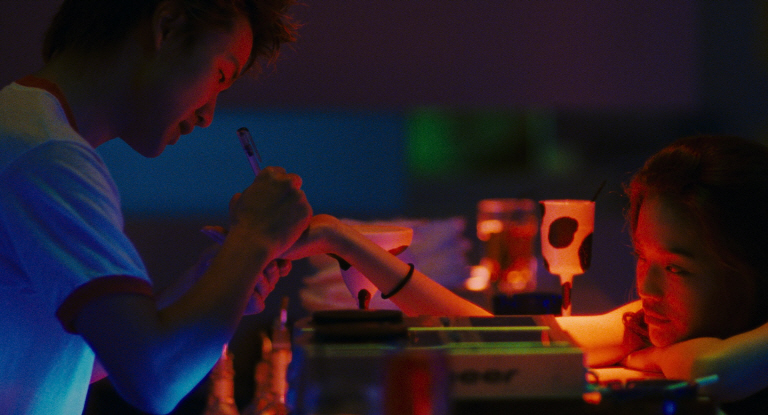
Another unexpected moment of warmth comes from the aforementioned gangster figure, who gladly lets the heroine into his little but cozy residence when she is let down again by her boyfriend. It seems that she may lean more on this dude instead of that crummy lad, but she still cannot give up her usual wild night life, and he is often distant from her due to whatever he must handle outside for his criminal business.
Often casually wandering here and there just like its heroine, the movie surely requires some patience from us during its first act, but the poetic sensitivity gradually emerging from its seedy background under Hou’s thoughtful direction comes to hold our attention. When its heroine finds herself stuck with more aimless uncertainty around the end of the story, the movie pulls out a hauntingly beautiful moment, and I will let you behold its sublime beauty for yourself.
I must confess that I watched only three films of Hou before watching “Millennium Mambo” at last and was actually less enthusiastic about them compared to many others, but I still could appreciate Hou’s cinematic mastery nonetheless. While I have considered revisiting “Three Times” (2005) for more appreciation, I fondly remember those calm but lovely moments from his last feature film “The Assassin” (2015), and I may admire it more than when I wrote my 3-star review at that time, if I have a chance to watch it again on a big screen.
Although it is a shame that he is retired now because of Alzheimer’s disease, Hou is still regarded as one of the best filmmakers from Taiwan along with Edward Yang and Ang Lee. Besides, his movies still exert considerable influence on many other good filmmakers including Barry Jenkins, whose Oscar-winning film “Moonlight” (2016) definitely shows that Jenkins learned a lot from Hou’s cinematic artistry and sensibility. As long as cinema is alive and well, Hou will be remembered as one of the most interesting filmmakers of our time, and I am certainly glad that I watched one of his notable works at a local movie theater.


 Seongyong's Private Place