

“Armand”, which was selected as the Norwegian entry for Best Internation Film Oscar in last year, attempts a sort of high-wire stunt between the chamber drama films of Ingmar Bergman and the psychological thriller movies of Roman Polanski. While I am not so sure about whether it works as well as intended, the movie distinguishes itself to some degree via mood and style, and it is also anchored by several good performances to notice.
The movie opens with a woman hurriedly driving to somewhere. She is a single mother named Elizabeth (Renate Reinsve), and it gradually becomes evident that she is coming to her 6-year-old son Armand’s elementary school because it looks like he caused some serious trouble at the school. Still not knowing that well about her son’s trouble, she soon meets his classroom teacher Sunna (Thea Lambrechts Valuen) shortly after her arrival, but Sunna is reluctant to tell anything to Elizabeth mainly because the parents of the other kid involved with her son’s trouble have not arrived yet.
Once the parents of the other kid, Sarah (Ellen Dorrit Petersen) and Anders (Endre Hellestveit), arrive, we slowly gather some information about why they come to have a meeting with Elizabeth under Sunna’s supervision. A few days ago, Sarah and Anders’ son was found quite disturbed and distraught in a bathroom in the school, and it was suspected that their son was physically violated by Elizabeth’s son in a very atrocious way. Needless to say, Sarah is thrown into shock and disbelief, and she naturally tries to defend her son, while the others in the room often emphasize to her on how serious the situation may be for not only the kids but also themselves.
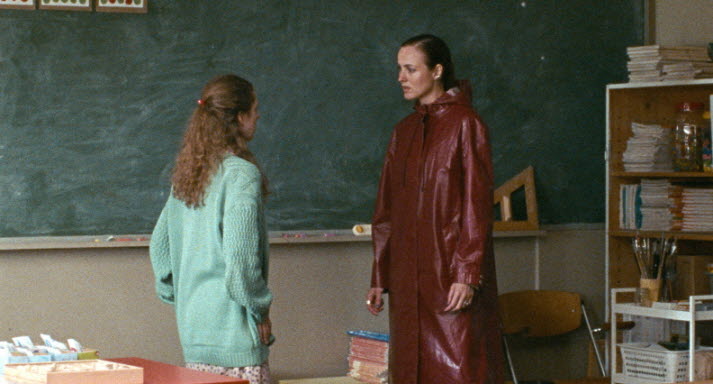
As the argument between Elizabeth and Sarah is going nowhere, things turn out to be more complicated than it seemed to us at first. Their sons have been pretty close to each other because Sarah is not only Elizabeth’s close neighbor but also her sister-in-law. Elizabeth’s husband, who incidentally died some time ago, and Sarah once attended the same school attended by Sarah and Elizabeth’s kids, and the school principal, who comes into the ongoing argument between Sarah and Elizabeth later in the story, still remembers when Sarah and her dead brother were his students.
While these and a few other main characters including Sunna pull and push each other, the movie steadily builds up tension across the screen with the frequent close-ups during its several key scenes, and then it enters the realm of warped psychodrama after Elizabeth’s defiant facade eventually crumbles with hysterical laughter at one point in the middle of the story. Getting cornered by Sarah and the school principal in one way or another, she keeps getting exasperated and frustrated, and her state of mind becomes more unreliable as she wanders around the empty corridors of the school alone by herself. If the first half of the film is as tense and sobering as those Bergman chamber drama film, the second half of the film is often reminiscent of several notable Polanski films such as “Repulsion” (1965), and we are not so surprised when Elizabeth comes to lose herself more among hallucinatory figures.
However, the screenplay by director/writer Halfdan Ullmann Tøndel, who made a feature film debut here, adamantly sticks to its distant ambiguity without delving more into its rather broad characters. Constantly vague about many things outside the story besides what really happened between those two kids (They are almost never shown in the film, by the way), the movie just coldly observes its main characters’ increasingly isolated struggles from the distance, and it also feels rather contrived when it has to deliver an eventual resolution around the end of the story.
At least, the movie is fairly engaging thanks to the strong raw performance from Renate Reinsve, who has been more notable thanks to her acclaimed performance in Oscar-nominated Norwegian film “The Worst Person in the World” (2021). While we do not to get to know that much about her character, Reinsve fills her character with considerable intensity and personality, and she is particularly effective during that memorably hysterical scene of hers in the film. We are surely baffled and annoyed at first with Elizabeth’s uncontrollable laughter, but we gradually sense more of her anxiety and frustration as she keeps laughing to the embarrassment of others as well as herself.
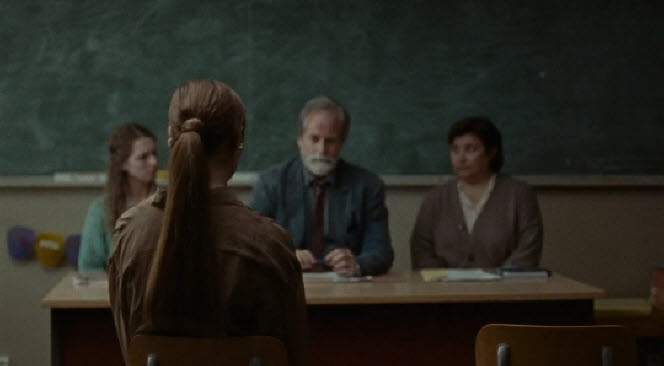
In case of several cast members surrounding Reinsve, they are also solid in each way. While Thea Lambrechts Vaulen, Øystein Røger, and Vera Veljovic are well-cast as the three different schoolteachers in the story, Ellen Dorrit Petersen and Endre Hellestveit have each own moment along the story, and they have a dim but remarkably intense scene when their characters come to confront a number of issues in private later in the story.
Overall, “Armand”, which was released as “Everything Began from Armand” in South Korean theaters on the first day of this year, is not entirely satisfying, but it has some interesting elements including Reinsve’s commendable efforts. Tøndel, who received the Caméra d’Or at the Cannes Film Festival early in last year, shows some potential here as a promising new filmmaker, and it will be interesting to see whether he will impress us more in the next time.


 Seongyong's Private Place