
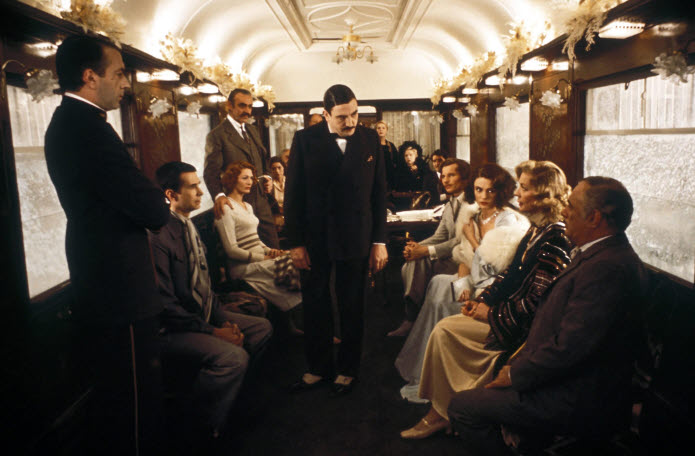
Sidney Lumet’s 1974 film “Murder on the Orient Express” is all about style and mood. While this is not exactly one of the best film adaptations of Agatha Christie novels, it still works as an enjoyable genre piece packed with enough class and skill, and, above all, it is also quite fun to watch all of these stellar cast members in the film stuck together within a rather limited background.
The story, which is based on one of Christie’s most famous mystery novels, is mainly driven by another seemingly impossible challenge for Christie’s famous Belgian private detective Hercules Poirot (Albert Finney). Not long after he gets on the Orient Express train departing from Turkey, Istanbul, one of the passengers approaches to him because this person in question is quite concerned about his safety right now, but Poirot rejects this person’s request just because he is not particularly interested. What do you know, this person is found murdered in the very next morning, and Poirot agrees to do some investigation as requested by his old Italian friend, one of the passengers who is also incidentally an executive of the train company.
Before the story becomes a bit more serious with this unexpected incident, Lumet and his crew members including cinematographer Geoffrey Unsworth did a masterful job of filling the screen with enough period atmosphere and details to behold. As a result, we find ourselves immersed into its romantically old-fashioned style and mood around the time when every passenger of the Orient Express is on the board, and this impression is further accentuated by the Oscar-nominated score by Richard Rodney Bennett (The film received the total six Oscar nominations at that time, by the way).

While the train itself certainly adds extra nostalgia as it passes through a series of landscapes, it is also filled with a bunch of colorful figures who are played by variously distinguished performers to notice. They are (in alphabetical order) Martin Balsam, Ingrid Bergman, Jacqueline Bisset, Jean-Pierre Cassel, Sean Connery, John Gielgud, Wendy Hiller, Anthony Perkins, Vanessa Redgrave, Rachel Roberts, Richard Widmark, and Michael York, and you will be more impressed to know that many of them already won or previously nominated for Oscar before this film (Ingrid Bergman somehow won a Best Supporting Oscar for this film, though even she thought she did not deserve her third Oscar that much).
Around the narrative point where the train unexpectedly gets snowbound in the middle of the second night of its long journey across the Europe continent, the movie efficiently sets up the stage for the next act. A number of small and big incidents happen here and there on the train while our detective hero is trying to sleep, and Bennett’s score naturally takes an ominous tone around this point.
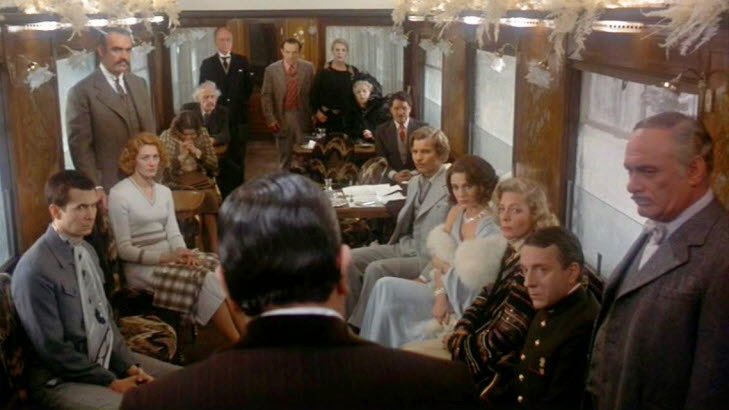
After the aforementioned passenger is eventually found murdered, the movie accordingly goes through a series of Q&A sessions conducted by Poirot inside the snowbound train, and that is where the movie becomes less interesting than before. Whenever Poirot asks some pointed questions to each of those possible suspects, they all naturally look as suspicious as required with some necessary overacting, and this pattern simply goes on and on until our detective hero finally presents his conclusion in front of everyone on the train.
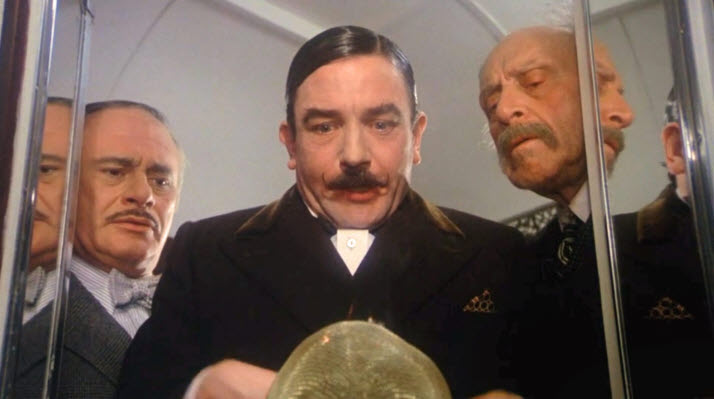
However, the movie fortunately does not lose its sense of fun and humor at all, even though it turns out later that the murder case in the story is closely associated with a devastatingly tragic case of child kidnapping, which is clearly based on the kidnapping and murder of Charles Lindbergh’s son in 1932. Lumet and legendary editor Anne V. Coates make sure that the story keeps rolling as our detective hero digs up one crucial thing after another along the narrative, and Unsworth’s camera steadily focuses on whatever is being exchanged between Poirot and each of his interrogation targets without making the film feel too static or stuffy within its limited background.
Above all, Lumet allows his performers to bring some extra personality to their broad archetype roles in addition to having each own moment along the story, and their game efforts are firmly anchored by the masterful comic performance by Albert Finney, who got deservedly Oscar-nominated for this film. While quite amusing in many of his deliberately mannered touches to savor, Finney gradually takes the center as the plot thickens as expected, and he eventually dominates over all of his other fellow cast members when his character has to deliver a rather long explanation on what really happened at that time (Critic Roger Ebert wrote in his 1974 review: “…it’s fun of a rather malicious sort watching a dozen high-priced stars keep their mouths shut and just listen while Finney masterfully dominates the scene.”).
In conclusion, “Murder on the Orient Express” does not look that fresh after 50 years while looking rather trivial due to being sandwiched right between Lumet’s two greater works “Serpico” (1973) and “Dog Day Afternoon” (1975). Nevertheless, it remains fairly entertaining thanks to Lumet’s competent direction and the good performances from his stellar cast members, and it remains to be two or three steps above that recent movie adaptation directed by Kenneth Branagh, which is not bad but merely passable on the whole. Yes, this is an old-fashioned stuff indeed, and it is equipped with enough charm and craft at least, and you may want to savor it again just because of that.


 Seongyong's Private Place