

Tarsem’s 2006 film “The Fall”, whose 4K remastered version will be released in South Korean theaters on Christmas, is a glorious folly of striking images to behold. Loosely based on the screenplay of the 1981 Bulgarian film “Yo Ho Ho”, the film bets almost everything on impressing us more and more with its sheer visual power, and that is definitely something you should watch it on big screen, regardless of whether you like it or not in the end.
The narrative ground of the movie is fairly simple. After the striking opening sequence shown in black and white film, we are introduced to a young Romanian immigrant girl named Alexandria (Catinca Untaru), who has been recovering from her serious arm injury at a hospital located somewhere in California around the 1920s. Just like any curious kid, she moves around here and there in the hospital, and that is how she encounters Roy Walker (Lee Pace), a Hollywood stuntman who has also been recovering from some serious accident. As befriending Alexandria during next several days, he tells her a rather rudimentary fairy tale concocted by himself, and she eagerly listens to his story with growing enthusiasm.
The movie shows us whatever Alexandria imagines in her mind while listening to Roy’s story, and we often get amused by how her innocent mind processes those colorful elements of Roy’s story. When he introduces an “Indian” character into his story early in the film, Roy actually means an American Native character, but Alexandria imagines this figure as a literally Indian guy just because, as shown later in the film, she knows an Indian immigrant guy hired at a local orange orchard where she and her family work. Likewise, many of other figures in Roy’s story are imagined as a number of various people Alexandria previously encountered, and it is particularly funny to observe how a bunch of armored soldiers in Roy’s story are imagined in Alexandria’s mind at one point.
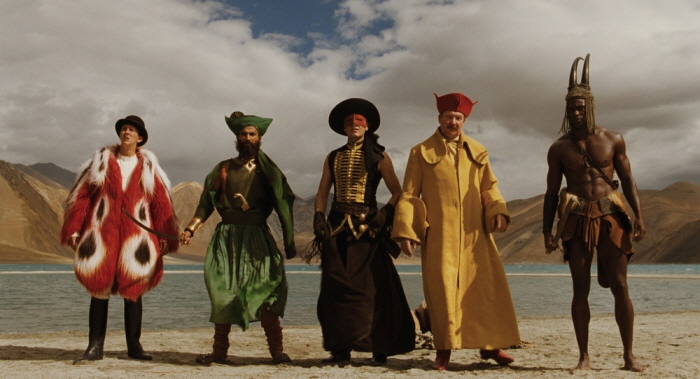
Anyway, Roy’s story is quite familiar to the core. Around one valiant masked hero, who naturally looks identical to Roy, several different figures including that Indian figure are gathered, and all of them are quite willing to have their revenge on their common enemy who is incidentally quite rich and powerful to say the least. For example, this bad guy entrapped the wife of that Indian figure in a maze full of stairs and corridors once after coming to discern that he could not have her at any chance, and her husband still does not get over the devastation caused by her eventual death.
This huge maze scene looks quite real on the screen just like many other scenes in the film, because, well, Tarsem and his crew members including cinematographer Colin Watkinson actually shot the film bit by bit around the numerous real locations around the world for no less than 4 years instead of using CGI. As a matter of fact, Tarsem financed the production of the film for himself, though he subsequently struggled more for its theatrical distribution before it eventually got released in US in 2008.
Sadly, Tarsem’s admirable efforts here in the film were not praised that much at first. The following box office result was pretty unsuccessful (It only earned 3.7 million dollar while its total production budget was no less than 30 million dollar), and many of critics and audiences were not particularly enthusiastic about the film at that time. At least, it was admired a lot by a few notable critics including my late friend/mentor Roger Ebert, who not only gave it a 4-star review but also willingly introduced it at the 2009 Ebertfest.

Impressed by the mesmerizing visual power of “The Fall” as much as Ebert was at that time, I gladly wrote my 3.5-star Korean review around the end of 2008, and I still stand by my initial feelings and thoughts on the film. Yes, the story itself feels quite contrived and superficial especially in case of its numerous fantasy scenes, but these fantasy scenes remain grounded well by the human poignancy observed from the budding friendship between Roy and Alexandria. Still very heartbroken by a painful personal matter of his, Roy attempts to manipulate Alexandria via his fairy tale for attaining a certain hidden goal, but he comes to care about her a lot more than expected, and, what do you know, she eventually functions as an unexpected savior in not only his fairy tale but also his real life.
Everything depends a lot on the effortless chemistry between the two lead performers of the movie, who are certainly the heart and soul of the story. Besides looking as dashing as required during the fantasy scenes of the film, Lee Pace did a good job of embodying his character’s despair and anguish, and he is also complemented well by the genuine sincerity of young performer Catinca Untaru, who is instantly engaging from the very beginning with her unadorned natural performance.
On the whole, “The Fall” still has the power to astound and impress us thanks to its many striking visual moments, while remaining to be the best work in Tarsem’s rather uneven filmography. After making a promising feature film debut with “The Cell” (2000), he seemed to advance further with this precious personal project of his, but, alas, his subsequent works including “Immortals” (2011) were not so successful in many aspects compared to his first two feature films. Nevertheless, he gave us “The Fall” at least, and we will continue to remember it as one of the most daring and interesting cinematic gambles during last several decades.


 Seongyong's Private Place