
Nagisa Ōshima’s 1983 film “Merry Christmas, Mr. Lawrence”, whose 4k restoration version was recently released in South Korean theaters several weeks ago, is a fascinatingly odd war film which attempts to present two very different human relationships at the center of the story but somehow feels rather unbalanced on the whole. While it remains adamantly distant about one of these two human relationships, it is also often reluctant to delve into the other one which is actually more poignant and interesting in my inconsequential opinion, and I came to have some reservation even though I observed its story and characters with enough interest.
At the beginning, the movie, which is based on Sir Laurens van der Post’s 1963 autobiographical novel “The Seed and The Sower”, feels like your typical prisoner-of-war movie. Its main background is a Japanese prisoner camp located somewhere in the Java Island of Indonesia, and the story, which is set around late 1942, opens with the latest matter to be handled by John Lawrence (Tom Conti), a Lieutenant Colonel of the British Army who has functioned as a liaison officer between his fellow British soldiers and those Japanese soldiers led by Captain Yonoi (Ryuichi Sakamoto) mainly because he is the only one who can speak Japanese in his group. His job is certainly quite thankless to say the least, but Lawrence tries to do his best for his fellow British soldiers despite that, and he has mostly been on good terms with Sergeant Hara (Takeshi Kitano) even though there is always a considerable distance between them.
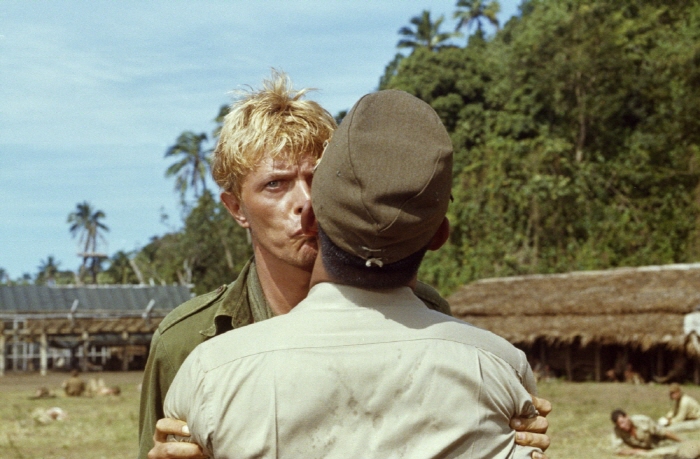
Meanwhile, a new prisoner is sent to the camp. He is Major Jack “Strafer” Celliers (David Bowie), and he recently surrendered himself to the Japanese Army after his latest military operation was failed, but he remains defiant as unflappably sticking to his pride and dignity. This stubborn attitude of his comes to attract the attention of Yonoi, who becomes gradually obsessed with this dashing British dude for a reason which is probably elusive even to himself.

The homosexual undertone between Celliers and Yonoi is unmistakable to say the least, but the screenplay by Ōshima and his co-writer Paul Mayersberg only comes to tantalize us with suggestions and possibilities without much resolution. Is Celliers actually aware of whatever is going on between him and Yonoi? And is Yonoi really conflicted a lot about whatever he feels and thinks behind his stiffly tense appearance? Although there eventually comes an emotional highlight between them, these two vastly contrasting characters still do not click well with each other, and we are only left with rather hollow impressions even after the movie goes a bit into what makes Celliers tick.
This baffling problem is probably due to how Ōshima deliberately generated the clash of acting style between his Western and Eastern cast members. While he encouraged his Japanese performers toward more acting details, he simply let his Wester performers act as casually as possible in contrast, and the result is particularly evident from the vast difference between David Bowie and Ryuichi Sakamoto. While Sakamoto frequently tries for more acting across the screen, Bowie sticks to his usual cool appearance, and this contrast in style is often fascinating to watch at least for a while.
However, the movie never gets deeper into the strained relationship between Celliers and Yonoi, and, most of all, it also fails to generate enough chemistry between Bowie and Sakamoto. Often reminiscent of Peter O’Toole in “Lawrence of Arabia” (1961) throughout the film, Bowie simply coasts along his own uncanny presence, but he is not supported that well by Sakamoto, who unfortunately gives us a prime example of Overacting 101 here in this film. As later shown again in “The Last Emperor” (1987), Sakamoto is not a very good actor at all, but his rather weak performance can be forgiven to some degree thanks to his memorable score which incidentally won a BAFTA award (It was also his first movie score, by the way).

On the other hand, another main narrative in the story, which is associated with the equally strained relationship between Lawrence and Hara, is more effective in comparison. Although they are not exactly friendly to each other, Lawrence and Hara somehow come to recognize and respect each other more as they push and pull each other throughout the film, and that is why the last moment between them is more touching than expected.
Again, the clash in acting style is evident in this case, but Tom Conti and Takeshi Kitano are more successful compared to Bowie and Sakamoto. Although he had to memorize his Japanese lines phonetically, Conti, who recently appeared briefly in Christopher Nolan’s Oscar-winning film “Oppenheimer” (2023), clicks well with Kitano during several key scenes of theirs, and Kitano, who looks relatively more expressive here compared to that usual static screen persona shown in his subsequent movies, manages to bring some personality and humanity to his bluntly callous character.
In conclusion, “Merry Christmas, Mr. Lawrence” is a flawed but engaging result from Ōshima, who has been mainly known from his highly controversial film “In the Realm of the Senses” (1976). Compared to that shocking work, the movie feels rather mild in addition to being hampered by some glaring weak elements, but it is still a curious mixed bag to admire and remember, and I recommend you to give it a chance someday.


 Seongyong's Private Place