

Barry Jenkins’ new film “Mufasa: The Lion King” is something bound to happen sooner or later. After winning two Oscars via “Nomadland” (2020), Chloé Zhao moved on to making a Marvel Cinematic Universe flick called “Eternals” (2021). After getting a Best Director Oscar nomination thanks to “Minari” (2020), Lee Isaac Chung moves on to giving us a Hollywood blockbuster film named “Twisters” (2022) several months ago. Most of all were rather surprised (or dismayed) to hear that Jenkins was going to direct the prequel to “The Lion King” (2019), but that looks now sort of inevitable considering that interesting current trend observed from many of rising American independent filmmakers.
The 2019 film is a competent but unnecessary live action version of the 1994 animation film, which incidentally remains on the top of the bunch. As I have said many times before, live action film usually cannot surpass animation film in many aspects, and that was quite evident to me when I eventually watched the 2019 film a few days ago as sort of a homework to do before watching “Mufasa: The Lion King”. While it is not that bad, it inarguably feels inferior to the 1994 film despite some strong points, and, above all, many of animal characters in the film look rather bland or shabby (I felt the constant urge to send all of the lion characters in the film to a local laundry, by the way).
In case of “Mufasa: The Lion King”, everything in the film is visually improved to considerable degree, and I was glad to see it at the Dolby Cinema screening room of a local theater. While its animal characters look more expressive in addition to feeling realistic as much as possible, several different backgrounds in the film are often filled with enough details to engage our eyes, and the overall result is surely an improvement over its predecessor.

The movie begins with showing how things have been pretty good since what happened at the end of the 2019 film. While her parents Simba (voiced by Donald Glover) and Nala (voiced by Beyoncé Knowles-Carter) are absent due to some personal business, a young female lion cub named Kiara (voiced by Blue Ivy Carter, who is Knowles-Carter’s daughter) happens to be under the care of a wise-cranking meerkat named Timon (voiced by Billy Eichner) and a jolly warthog named Pumbaa (voiced by Seth Rogen), and you may get amused (or annoyed) as Timon and Pumbaa attempt to cheer up Kiara with an exaggerated tale on their adventure in the previous film.
Anyway, there soon comes an old but wise mandrill named Rafiki (voiced by John Kani), who willingly tells a story about Kiara’s legendary grandfather. When he was just a lion cub, young Mufasa (voiced by Braelyn and Brielle Rankin) and his parents were going through a long and arduous journey to a certain place which might be a haven for not only them but also many other animals, but then he happened to get separated from his parents when he got himself swept away by the big current of water caused by a sudden downpour. Not long after he finds himself in some distant region, young Mufasa is rescued by a lion cub named Taka (voiced by Theo Somolu), who happens to be the son of Eshe (voiced by Thandiwe Newton) and Obasi (voiced by Lennie James). As the current leader of his clan, Obasi does not welcome young Mufasa much, but Eshe willingly takes care of young Mufasa, and young Mufasa and Taka soon become more like brothers as time goes by.
Several years later, Mufasa, who is now voiced by Aaron Pierre, and Taka, who is now voiced by Kelvin Harris Jr., find themselves facing a serious problem due to Kiros (voiced by Mads Mikkelsen), an evil and ruthless white lion who has led a bunch of vicious lions willing to kill anyone standing on his way to more power. Mikkelsen, who has been mainly known for his chilling performance in American TV drama series “Hannibal”, surely knows how to exude menace and malice, and he even has a diabolical musical moment which may take you back to how Jeremy Irons delighted us in the 1994 animation film (This and several songs in the film are written by Lin-Manuel Miranda, though I do not think any of them will be as popular as his notable songs in “Moana” (2016) or “Encanto” (2021)).
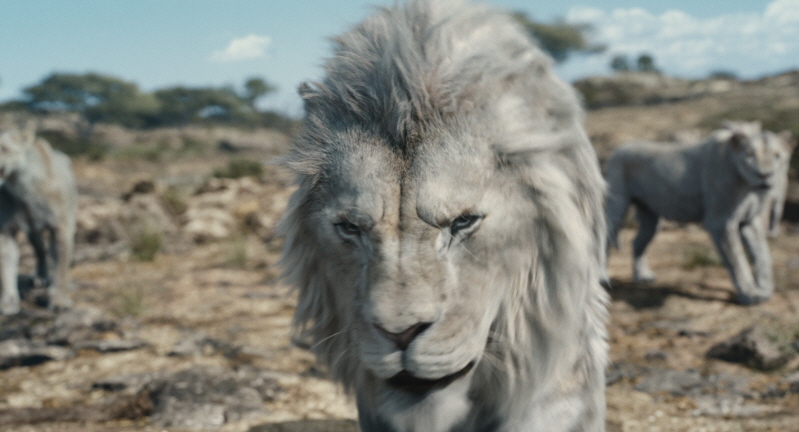
Eventually becoming totally left alone by themselves due to Kiros and his merciless clan, Mufasa and Taka must look for a new place to live besides evading their enemies, and they are soon joined by young Rafiki (voiced by Kagiso Lediga during this part) and a young lioness named Sarabi (voiced by Tiffany Boone). As these four main characters go together through a long journey to what Mufasa’s parents were searching for at that time, the movie expectedly provides a series of lovely landscape shots as required, and Jenkins and his cinematographer James Laxton, who was Oscar-nominated for Jenkins’ great film “Moonlight” (2016), make sure that we can behold and appreciate numerous background details, whenever the movie is not driven by busy actions unfolded across the screen.
Around the narrative point where Mufasa must come forward for not only himself and his companions but also many other animals, the story naturally becomes more predictable, and we often cannot help but reflect more on some inherent contradiction inside the story. Mufasa surely proves himself as a noble and righteous leader for every animal around him, but you may also observe that he and his clan will kill and then eat some of other animals for their survival in the end just like any other predator on the top of the food chain. No, I do not expect at all the movie to be realistic as your average nature documentary, and but that harsh fact of nature kept remaining in my mind during my viewing.
In conclusion, “Mufasa: The Lion King” is not entirely without good elements to enjoy mainly thanks to Jenkins’ sensitive touches and the game efforts from his voice cast members, but it is relatively passable compared to what Jenkins has achieved during last 16 years since his remarkable first feature film “Medicine for Melancholy” (2008). Now I remember what film critic Justin Chang said about “Eternals”: “You walk out in the depressing realization that you’ve just seen one of the more interesting movies Marvel will ever make, and hopefully the least interesting one Chloé Zhao will ever make.”. In my humble opinion, a similar thing can be said about Jenkins and “Mufasa: The Lion King”, and I am sure that he will move onto better things to come just like Zhao.


 Seongyong's Private Place