

South Korean independent film “The Tenants” tries to be a quirky mix of SF, comedy, and a bit of horror. The overall result is amusing as sort of a satiric allegory on the current economic struggle of many people out there in the South Korean society, but it is unfortunately hampered at times by its thin plot and broad characterization, and I wonder whether it would be more effective if it were a short film instead.
Mostly set in some neighborhood area of a dystopian version of Seoul, the story mainly revolves around Sin-dong (Kim Dae-gun), a young man who works in some big company known for a certain groundbreaking food technology. Because the condition of life in the city has not been that good to say the least because of the severe environmental pollution, Sin-dong has hoped to move to a cleaner place somewhere out there just like many others in the city, but that possibility seems beyond his reach – even when the company later announces that it is going to select a few employees to be transferred to that good place.
Meanwhile, Sin-dong has been struggling to pay the rent for his little residence, and then there comes an unexpected problem due to his very young landlord, who wants him to leave his current residence within a few weeks just because of some renovation. Fortunately, one of his online friends informs Sing-dong about a rather preposterous scheme which may stop the landlord. All he will have to do is subletting his toilet to somebody else, and, according to his online friend, there are actually many people out there who are willing to live in toilet just because, well, that is far cheaper.

Despite some skepticism, Sin-dong eventually decides to sublet the toilet, and what do you know, he is soon visited by a rather odd couple quite ready to live in the toilet. Once this couple start to live in the toilet, Sin-dong succeeds in preventing himself from getting evicted by his landlord, and it looks like everything will go fairly well for him at least for a while, but, not so surprisingly, it does not take much time for Sin-dong to realize how strange his tenants are in many aspects. Whenever they cause disturbance in his residence in one way or another, the tenants always apologize for that, but Sin-dong cannot help but get disturbed more and more by their unnerving presence as experiencing a number of bizarre moments at night.
Meanwhile, there comes a bit of hope for him as it seems that he may actually be selected as one of the employees to be sent to that good place – if he works harder than before. Although many of his co-workers are rather skeptical, he becomes more determined about attaining his goal, and he does not even hesitate to do some unfair things just for going ahead of others.
However, he keeps getting disturbed by his tenants as usual, so he decides to evict them as soon as possible, but then, to our little amusement, he comes to learn that his tenants actually sublet a certain part of their residence to some other person. As his online friend told him early in the film, that has been actually promoted and supported by the government for solving housing problems, and Sin-dong’s situation becomes all the more absurd when he really needs to meet that mysterious “sub-tenant” in question as soon as possible later in the story.
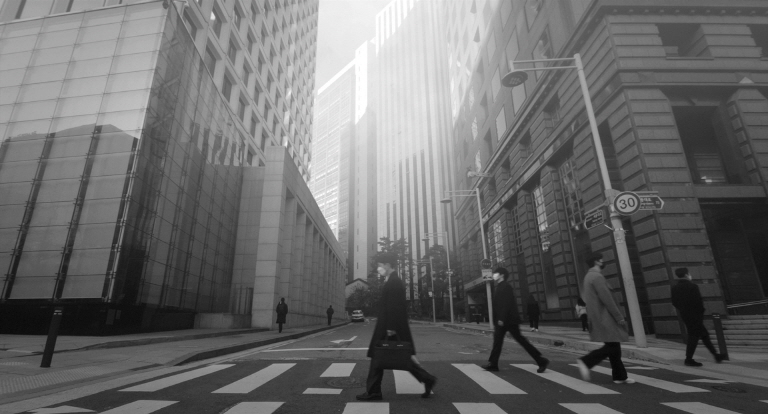
Even when the story becomes weirder than before, the movie steadily maintains its deadpan attitude under the gloomy surreal atmosphere generated by its black and white cinematography, and you may come to accept that anything can happen around its unfortunate hero. No matter how much he tries, Sin-dong finds himself stuck more inside his residence along with his strange tenants, and you may not be surprised much when the movie takes a sudden left turn before its eventual finale.

However, the screenplay by director/writer Yoon Eun-kyung, who previously made a feature film debut with “Hotel Lake” (2018) and will soon give us “Sisterhood” (2024) around the next year, stumbles more than once in terms of narrative and characterization. While its one-joke plot comes to lose its comic momentum later in the film, its main characters are more or less than caricature figures, so we come to observe the story and characters from the distance without much care in the end.
At least, the principal cast members of the movie try their best in filling their broad caricature parts, and they did a good job of playing their respective roles as straight as possible. While Kim Dae-geon dutifully holds the center as required with his earnest performance, Heo Dong-won and Park So-hyun have some juicy fun with their more colorful characters, and their deliberately mannered performances always keep us on alert whenever either of them appears on the screen.
On the whole, “The Tenants” is not recommendable enough mainly due to its narrative deficiency and superficial characterization, but its absurd satire works to some degree as morbidly reflecting what many South Korean people struggle with day by day, and Yoon demonstrates some potential here in this film. I have not seen “Hotel Lake” yet, but, as far as I can see from this film, she is a good filmmaker who knows one or two things about how to engage the audiences via mood and details, and I sincerely hope that her upcoming next film will be more entertaining for me.


 Seongyong's Private Place